2 Corinthians 5:11–21
The NET BibleOther versions
English
- NET The NET Bible
- DARBY 1890 Darby Bible
- ASV American Standard Version
- AV 1873 The Cambridge Paragraph Bible of the Authorized English Version
- CSB Christian Standard Bible
- D-R Douay-Rheims Bible
- ESV English Standard Version
- GW GOD’S WORD Translation
- GNB Good News Translation
- HCSB The Holman Christian Standard Bible
- KJV 1900 King James Version
- LSB Legacy Standard Bible
- LEB The Lexham English Bible
- MSG The Message: The Bible in Contemporary Language
- NASB95 New American Standard Bible (1995)
- NCV New Century Version
- NIrV New International Reader’s Version (1998)
- NIV New International Version (2011)
- NKJV The New King James Version
- NLT New Living Translation
- NRSVue New Revised Standard Version: Updated Edition
- RSV The Revised Standard Version
- RSVCE The Revised Standard Version, Catholic Edition
- YLT Young’s Literal Translation
Arabic
Czech
French
German
Greek
Hungarian
Italian
Korean
Latin
Portuguese
Russian
Simplified Chinese
Spanish
Traditional Chinese
The Message of Reconciliation
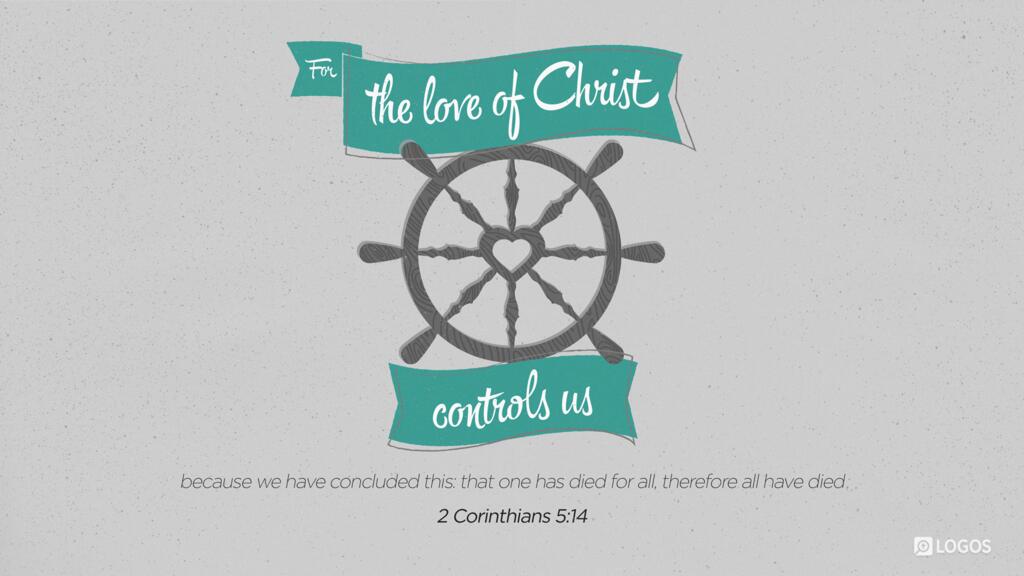
5:11Therefore, because we know the fear of the Lord,18 we try to persuade19 people,20 but we are well known21 to God, and I hope we are well known to your consciences too. 5:12We are not trying to commend22 ourselves to you again, but are giving you an opportunity to be proud of us,23 so that you may be able to answer those who take pride24 in outward appearance25 and not in what is in the heart. 5:13For if we are out of our minds, it is for God; if we are of sound mind, it is for you. 5:14For the love of Christ26 controls us, since we have concluded this, that Christ27 died for all; therefore all have died. 5:15And he died for all so that those who live should no longer live for themselves but for him who died for them and was raised.285:16So then from now on we acknowledge29 no one from an outward human point of view.30 Even though we have known Christ from such a human point of view,31 now we do not know him in that way any longer. 5:17So then, if anyone is in Christ, he is a new creation; what is old has passed away32—look, what is new33 has come!345:18And all these things are from God who reconciled us to himself through Christ, and who has given us the ministry of reconciliation. 5:19In other words, in Christ God was reconciling the world to himself, not counting people’s trespasses against them, and he has given us35 the message of reconciliation. 5:20Therefore we are ambassadors for Christ, as though God were making His plea36 through us. We plead with you37 on Christ’s behalf, “Be reconciled to God!” 5:21God38 made the one who did not know sin39 to be sin for us, so that in him40 we would become the righteousness of God.
Footnotes
- 18 Or “because we know what it means to fear the Lord.”
- 19 The present tense of πείθομεν (peithomen) has been translated as a conative present.
- 20 Grk “men”; but ἄνθρωπος (anthrōpos) is generic here since clearly both men and women are in view (Paul did not attempt to win only men to the gospel he preached).
- 21 Or “clearly evident.” φανερόω 2.b.β has “θεῷ πεφανερώμεθα we are well known to God 2 Cor 5:11a, cp. 11b; 11:6 v.l.”
- 22 The present tense of συνιστάνομεν (sunistanomen) has been translated as a conative present.
- 23 Or “to boast about us.”
- 24 Or “who boast.”
- 25 Or “in what is seen.”
- 26 The phrase ἡ ἀγάπη τοῦ Χριστοῦ (hē agapē tou Christou, “the love of Christ”) could be translated as either objective genitive (“our love for Christ”) or subjective genitive (“Christ’s love for us”). Either is grammatically possible, but with the reference to Christ’s death for all in the following clauses, a subjective genitive (“Christ’s love for us”) is more likely.
- 27 Grk “one”; the referent (Christ) has been specified in the translation for clarity.
- 28 Or “but for him who died and was raised for them.”
- 29 Grk “we know.”
- 30 Grk “no one according to the flesh.”
- 31 Grk “we have known Christ according to the flesh.”
- 32 Grk “old things have passed away.”
- 33 Most have the words τὰ πάντα (ta panta, “all things”; cf. “behold, all things are become new”), some after καίνα (kaina, “new”; D2 K L P Ψ 104 326 945 2464 ) and others before it (6 33 81 614 630 1241 1505 1881 ). The reading without τὰ πάντα, however, has excellent support from both the Western and Alexandrian texttypes (𝔓46 א B C D* F G 048 0243 365 629 1175 1739 co), and the different word order of the phrase which includes it (“all things new” or “new all things”) in the tradition indicates its secondary character. This secondary addition may have taken place because of assimilation to τὰ δὲ πάντα (ta de panta, “and all [these] things”) that begins the following verse.
- 34 Grk “new things have come [about].”
- 35 Or “he has entrusted to us.”
- 36 Or “as though God were begging.”
- 37 Or “we beg you.”
- 38 Grk “He”; the referent (God) has been specified in the translation for clarity.
- 39 The one who did not know sin is a reference to Jesus Christ.
- 40 That is, “in Christ.”
The NET Bible First Edition, Copyright 1996-2005 by Biblical Studies Press