Matthew 13:3–58
Today’s New International VersionOther versions
English
- TNIV Today’s New International Version
- DARBY 1890 Darby Bible
- ASV American Standard Version
- AV 1873 The Cambridge Paragraph Bible of the Authorized English Version
- CSB Christian Standard Bible
- D-R Douay-Rheims Bible
- ESV English Standard Version
- GW GOD’S WORD Translation
- GNB Good News Translation
- HCSB The Holman Christian Standard Bible
- KJV 1900 King James Version
- LSB Legacy Standard Bible
- LEB The Lexham English Bible
- MSG The Message: The Bible in Contemporary Language
- NET The NET Bible
- NASB95 New American Standard Bible (1995)
- NCV New Century Version
- NIrV New International Reader’s Version (1998)
- NIV New International Version (2011)
- NKJV The New King James Version
- NLT New Living Translation
- NRSVue New Revised Standard Version: Updated Edition
- RSV The Revised Standard Version
- RSVCE The Revised Standard Version, Catholic Edition
- YLT Young’s Literal Translation
Arabic
Czech
French
German
Greek
Hungarian
Italian
Korean
Latin
Portuguese
Russian
Simplified Chinese
Spanish
Traditional Chinese
Then he told them many things in parables, saying: “A farmer went out to sow his seed. As he was scattering the seed, some fell along the path, and the birds came and ate it up. Some fell on rocky places, where it did not have much soil. It sprang up quickly, because the soil was shallow. But when the sun came up, the plants were scorched, and they withered because they had no root. Other seed fell among thorns, which grew up and choked the plants. Still other seed fell on good soil, where it produced a crop—a hundred,c sixty or thirty times what was sown. Whoever has ears, let them hear.”d
The disciples came to him and asked, “Why do you speak to the people in parables?”
He replied, “The knowledge of the secrets of the kingdom of heavene has been given to you,f but not to them. Those who have will be given more, and they will have an abundance. As for those who do not have, even what they have will be taken from them.g This is why I speak to them in parables:
“Though seeing, they do not see;
though hearing, they do not hear or understand.h
In them is fulfilledi the prophecy of Isaiah:
“ ‘You will be ever hearing but never understanding;
you will be ever seeing but never perceiving.
For this people’s heart has become calloused;
they hardly hear with their ears,
and they have closed their eyes.
Otherwise they might see with their eyes,
hear with their ears,
understand with their hearts
and turn, and I would heal them.’j
But blessed are your eyes because they see, and your ears because they hear.k Truly I tell you, many prophets and righteous people longed to see what you seel but did not see it, and to hear what you hear but did not hear it.
“Listen then to what the parable of the sower means: When people hear the message about the kingdomm and do not understand it, the evil onen comes and snatches away what was sown in their hearts. This is the seed sown along the path. The seed falling on rocky ground refers to people who hear the word and at once receive it with joy. But since they have no root, they last only a short time. When trouble or persecution comes because of the word, they quickly fall away.o The seed falling among the thorns refers to people who hear the word, but the worries of this life and the deceitfulness of wealthp choke the word, making it unfruitful. But the seed falling on good soil refers to people who hear the word and understand it. They produce a crop, yielding a hundred, sixty or thirty times what was sown.”q
The Parable of the Weeds
Jesus told them another parable: “The kingdom of heaven is likea a man who sowed good seed in his field. But while everyone was sleeping, his enemy came and sowed weeds among the wheat, and went away. When the wheat sprouted and formed heads, then the weeds also appeared.
“The owner’s servants came to him and said, ‘Sir, didn’t you sow good seed in your field? Where then did the weeds come from?’
“ ‘An enemy did this,’ he replied.
“The servants asked him, ‘Do you want us to go and pull them up?’
“ ‘No,’ he answered, ‘because while you are pulling the weeds, you may uproot the wheat with them. Let both grow together until the harvest. At that time I will tell the harvesters: First collect the weeds and tie them in bundles to be burned; then gather the wheat and bring it into my barn.’ ”b
The Parables of the Mustard Seed and the Yeast
13:31,32pp — Mk 4:30–32 13:31-33pp — Lk 13:18–21
He told them another parable: “The kingdom of heaven is likea a mustard seed,b which a man took and planted in his field. Though it is the smallest of all seeds, yet when it grows, it is the largest of garden plants and becomes a tree, so that the birds come and perch in its branches.”c
He told them still another parable: “The kingdom of heaven is liked yeast that a woman took and mixed into about sixty pounds of floure until it worked all through the dough.”f
Jesus spoke all these things to the crowd in parables; he did not say anything to them without using a parable.g So was fulfilledh what was spoken through the prophet:
“I will open my mouth in parables,
I will utter things hidden since the creation of the world.”i
The Parable of the Weeds Explained
Then he left the crowd and went into the house. His disciples came to him and said, “Explain to us the parablea of the weeds in the field.”
He answered, “The one who sowed the good seed is the Son of Man.b The field is the world, and the good seed stands for the people of the kingdom. The weeds are the people of the evil one,c and the enemy who sows them is the devil. The harvestd is the end of the age,e and the harvesters are angels.f
“As the weeds are pulled up and burned in the fire, so it will be at the end of the age. The Son of Mang will send out his angels,h and they will weed out of his kingdom everything that causes sin and all who do evil. They will throw them into the blazing furnace, where there will be weeping and gnashing of teeth.i Then the righteous will shine like the sunj in the kingdom of their Father. Whoever has ears, let them hear.k
The Parables of the Hidden Treasure and the Pearl
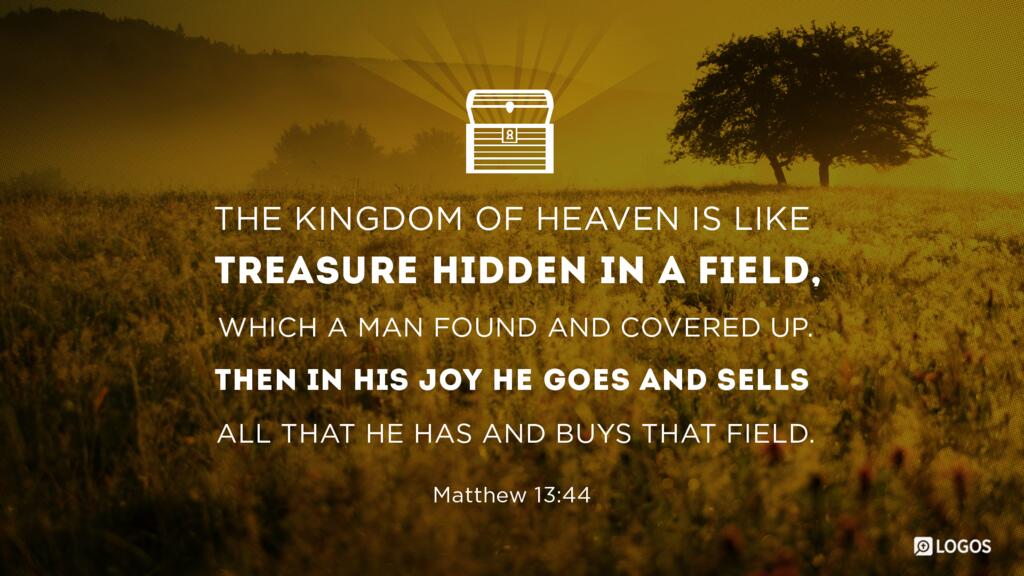
“The kingdom of heaven is likea treasure hidden in a field. When a man found it, he hid it again, and then in his joy went and sold all he had and bought that field.b
“Again, the kingdom of heaven is likec a merchant looking for fine pearls. When he found one of great value, he went away and sold everything he had and bought it.
The Parable of the Net
“Once again, the kingdom of heaven is likea a net that was let down into the lake and caught all kindsb of fish. When it was full, the fishermen pulled it up on the shore. Then they sat down and collected the good fish in baskets, but threw the bad away. This is how it will be at the end of the age. The angels will come and separate the wicked from the righteousc and throw them into the blazing furnace, where there will be weeping and gnashing of teeth.d
“Have you understood all these things?” Jesus asked.
“Yes,” they replied.
He said to them, “Therefore every teacher of the law who has been instructed about the kingdom of heaven is like the owner of a house who brings out of his storeroom new treasures as well as old.”
A Prophet Without Honor
13:54-58pp — Mk 6:1–6
When Jesus had finished these parables,a he moved on from there. Coming to his hometown, he began teaching the people in their synagogue,b and they were amazed.c “Where did this man get this wisdom and these miraculous powers?” they asked. “Isn’t this the carpenter’s son?d Isn’t his mother’se name Mary, and aren’t his brothersf James, Joseph, Simon and Judas? Aren’t all his sisters with us? Where then did this man get all these things?” And they took offenseg at him.
But Jesus said to them, “Only in their own towns and in their own homes are prophets without honor.”h
And he did not do many miracles there because of their lack of faith.
Footnotes
- ppIdentical or nearly identical passages are noted with “pp.”
Cross references
- cGe 26:12
- d Mt 11:15
- e Mt 3:2
- fMt 11:25; 16:17; 19:11; Jn 6:65; 1Co 2:10,14; Col 1:27; 1Jn 2:20,27
- g Mt 25:29
- hDt 29:4; Jer 5:21; Eze 12:2
- iver 35; Mt 1:22
- jIsa 6:9,10; Jn 12:40; Ac 28:26,27; Ro 11:8
- kMt 16:17
- lJn 8:56; Heb 11:13; 1Pe 1:10–12
- mMt 4:23
- n Mt 5:37
- oMt 11:6; 26:31
- pMt 19:23; 1Ti 6:9,10,17
- qver 8
- aver 31,33,45,47; Mt 18:23; 20:1; 22:2; 25:1; Mk 4:26,30
- bMt 3:12
- a ver 24
- bMt 17:20; Lk 17:6
- cPs 104:12; Eze 17:23; 31:6; Da 4:12
- d ver 24
- eGe 18:6
- fGal 5:9
- g Jn 16:25
- hver 14; Mt 1:22
- iPs 78:2; Ro 16:25,26; 1Co 2:7; Eph 3:9; Col 1:26
- aMt 15:15
- b Mt 8:20
- cJn 8:44,45; 1Jn 3:10
- dJoel 3:13
- eMt 24:3; 28:20
- fRev 14:15
- g Mt 8:20
- hMt 24:31
- i Mt 8:12
- jDa 12:3
- k Mt 11:15
- a ver 24
- bIsa 55:1; Mt 19:21; Php 3:7,8
- c ver 24
- a ver 24
- bMt 22:10
- cMt 25:32
- d Mt 8:12
- a Mt 7:28
- b Mt 4:23
- c Mt 7:28
- dLk 3:23; Jn 6:42
- e Mt 12:46
- f Mt 12:46
- gJn 6:61
- hLk 4:24; Jn 4:44
Copyright 2005 The Zondervan Corporation.