Titus 2:13–14
The NET BibleOther versions
English
- NET The NET Bible
- DARBY 1890 Darby Bible
- ASV American Standard Version
- AV 1873 The Cambridge Paragraph Bible of the Authorized English Version
- CSB Christian Standard Bible
- D-R Douay-Rheims Bible
- ESV English Standard Version
- GW GOD’S WORD Translation
- GNB Good News Translation
- HCSB The Holman Christian Standard Bible
- KJV 1900 King James Version
- LSB Legacy Standard Bible
- LEB The Lexham English Bible
- MSG The Message: The Bible in Contemporary Language
- NASB95 New American Standard Bible (1995)
- NCV New Century Version
- NIrV New International Reader’s Version (1998)
- NIV New International Version (2011)
- NKJV The New King James Version
- NLT New Living Translation
- NRSVue New Revised Standard Version: Updated Edition
- RSV The Revised Standard Version
- RSVCE The Revised Standard Version, Catholic Edition
- TNIV Today’s New International Version
- YLT Young’s Literal Translation
Arabic
Czech
French
German
Greek
Hungarian
Italian
Korean
Latin
Portuguese
Russian
Simplified Chinese
Spanish
Traditional Chinese
2:13as we wait for the happy fulfillment of our hope in the glorious appearing19 of our great God and Savior, Jesus Christ.202:14He21 gave himself for us to set us free from every kind of lawlessness and to purify for himself a people who are truly his,22 who are eager to do good.23
Footnotes
- 19 Grk “the blessed hope and glorious appearing.”
- 20 The terms “God and Savior” both refer to the same person, Jesus Christ. This is one of the clearest statements in the NT concerning the deity of Christ. The construction in Greek is known as the Granville Sharp rule, named after the English philanthropist-linguist who first clearly articulated the rule in 1798. Sharp pointed out that in the construction article-noun-καί-noun (where καί [kai] = “and”), when two nouns are singular, personal, and common (i.e., not proper names), they always had the same referent. Illustrations such as “the friend and brother,” “the God and Father,” etc. abound in the NT to prove Sharp’s point. The only issue is whether terms such as “God” and “Savior” could be considered common nouns as opposed to proper names. Sharp and others who followed (such as T. F. Middleton in his masterful The Doctrine of the Greek Article) demonstrated that a proper name in Greek was one that could not be pluralized. Since both “God” (θεός, theos) and “savior” (σωτήρ, sōtēr) were occasionally found in the plural, they did not constitute proper names, and hence, do fit Sharp’s rule. Although there have been 200 years of attempts to dislodge Sharp’s rule, all attempts have been futile. Sharp’s rule stands vindicated after all the dust has settled. For more information on Sharp’s rule see , esp. . See also 2 Pet 1:1 and Jude 4.
- 21 Grk “who” (as a continuation of the previous clause).
- 22 Or “a people who are his very own.”
- 23 Grk “for good works.”
The NET Bible First Edition, Copyright 1996-2005 by Biblical Studies Press
In other versions
ESVEnglish Standard Version
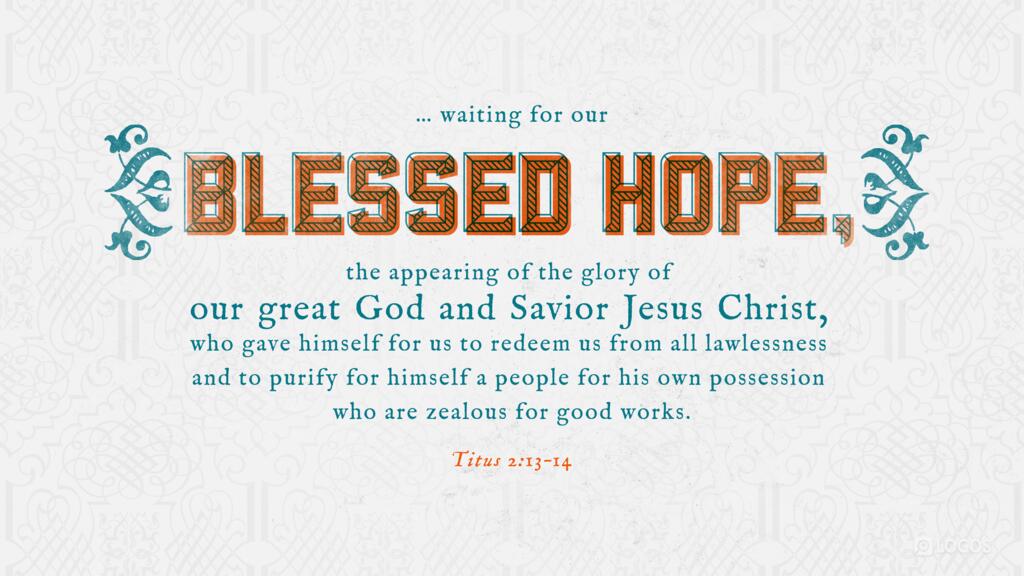
waiting for our blessed hope, the appearing of the glory of our great God and Savior Jesus Christ, who gave himself for us to redeem us from all lawlessness and to purify for himself a people for his own possession who are zealous for good works.
Copyright 2001 Crossway Bibles
NIVNew International Version (2011)
while we wait for the blessed hope—the appearing of the glory of our great God and Savior, Jesus Christ, who gave himself for us to redeem us from all wickedness and to purify for himself a people that are his very own, eager to do what is good.
Copyright 1973, 1978, 1984, 2011 Biblica, Inc.
CSBChristian Standard Bible
while we wait for the blessed hope, the appearing of the glory of our great God and Savior, Jesus Christ. He gave himself for us to redeem us from all lawlessness and to cleanse for himself a people for his own possession, eager to do good works.
Copyright 2017 Holman Bible Publishers
NLTNew Living Translation
while we look forward with hope to that wonderful day when the glory of our great God and Savior, Jesus Christ, will be revealed. He gave his life to free us from every kind of sin, to cleanse us, and to make us his very own people, totally committed to doing good deeds.
Holy Bible, New Living Translation, copyright © 1996, 2004, 2015 by Tyndale House Foundation. Used by permission of Tyndale House Publishers. All rights reserved.
LEBThe Lexham English Bible
looking forward to the blessed hope and the glorious appearing of our great God and Savior Jesus Christ, who gave himself for us, in order that he might redeem us from all lawlessness and purify for himself a people for his own possession, zealous for good deeds.
Copyright 2012 Lexham Press
KJV 1900King James Version
Looking for that blessed hope, and the glorious appearing of the great God and our Saviour Jesus Christ; Who gave himself for us, that he might redeem us from all iniquity, and purify unto himself a peculiar people, zealous of good works.
Public Domain