Romans 8:34–36
The NET BibleOther versions
English
- NET The NET Bible
- DARBY 1890 Darby Bible
- ASV American Standard Version
- AV 1873 The Cambridge Paragraph Bible of the Authorized English Version
- CSB Christian Standard Bible
- D-R Douay-Rheims Bible
- ESV English Standard Version
- GW GOD’S WORD Translation
- GNB Good News Translation
- HCSB The Holman Christian Standard Bible
- KJV 1900 King James Version
- LSB Legacy Standard Bible
- LEB The Lexham English Bible
- MSG The Message: The Bible in Contemporary Language
- NASB95 New American Standard Bible (1995)
- NCV New Century Version
- NIrV New International Reader’s Version (1998)
- NIV New International Version (2011)
- NKJV The New King James Version
- NLT New Living Translation
- NRSVue New Revised Standard Version: Updated Edition
- RSV The Revised Standard Version
- RSVCE The Revised Standard Version, Catholic Edition
- TNIV Today’s New International Version
- YLT Young’s Literal Translation
Arabic
Czech
French
German
Greek
Hungarian
Italian
Korean
Latin
Portuguese
Russian
Simplified Chinese
Spanish
Traditional Chinese
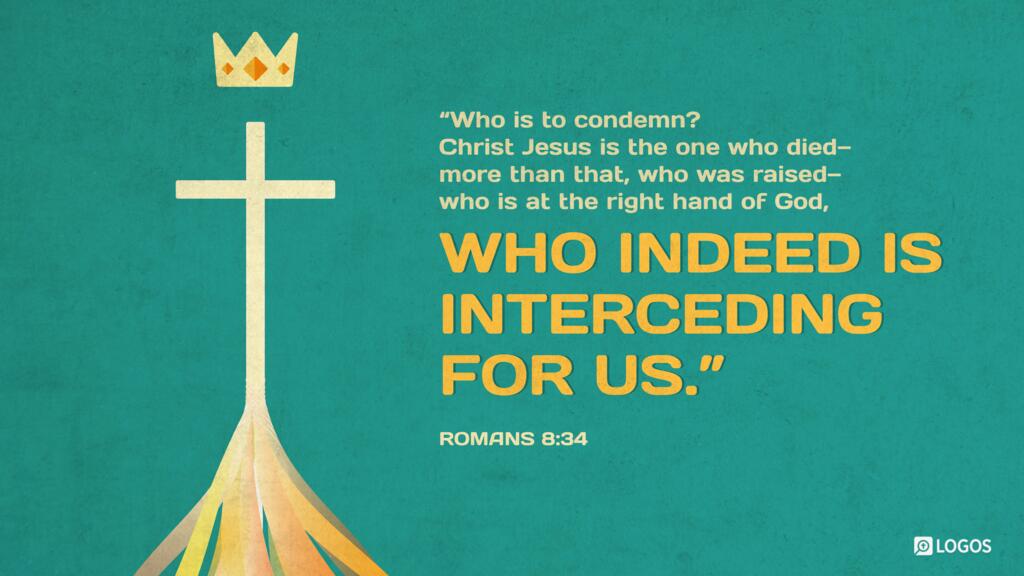
8:34Who is the one who will condemn? Christ37 is the one who died (and more than that, he was raised), who is at the right hand of God, and who also is interceding for us. 8:35Who will separate us from the love of Christ? Will trouble, or distress, or persecution, or famine, or nakedness, or danger, or sword?388:36As it is written, “For your sake we encounter death all day long; we were considered as sheep to be slaughtered.”39
Footnotes
- 37 A number of significant and early witnesses, along with several others (𝔓46vid א A C F G L Ψ 6 33 81 104 365 1505 lat bo), read Ἰησοῦς (Iēsous, “Jesus”) after χριστός (Christos, “Christ”) in v. 34. But the shorter reading is not unrepresented (B D 0289 1739 1881 𝔐 sa). Once Ἰησοῦς got into the text, what scribe would omit it? Although the external evidence is on the side of the longer reading, internally such an expansion seems suspect. The shorter reading is thus preferred. has the word in brackets, indicating doubt as to its authenticity. Grk “who also.”
- 38 Here “sword” is a metonymy that includes both threats of violence and acts of violence, even including death (although death is not necessarily the only thing in view here).
- 39 A quotation from Ps 44:22.
The NET Bible First Edition, Copyright 1996-2005 by Biblical Studies Press
In other versions
ESVEnglish Standard Version
Who is to condemn? Christ Jesus is the one who died—more than that, who was raised—who is at the right hand of God, who indeed is interceding for us. Who shall separate us from the love of Christ? Shall tribulation, or distress, or persecution, or famine, or nakedness, or danger, or sword? As it is written,
“For your sake we are being killed all the day long;
we are regarded as sheep to be slaughtered.”
Copyright 2001 Crossway Bibles
NIVNew International Version (2011)
Who then is the one who condemns? No one. Christ Jesus who died—more than that, who was raised to life—is at the right hand of God and is also interceding for us. Who shall separate us from the love of Christ? Shall trouble or hardship or persecution or famine or nakedness or danger or sword? As it is written:
“For your sake we face death all day long;
we are considered as sheep to be slaughtered.”
Copyright 1973, 1978, 1984, 2011 Biblica, Inc.
CSBChristian Standard Bible
Who is the one who condemns? Christ Jesus is the one who died, but even more, has been raised; he also is at the right hand of God and intercedes for us. Who can separate us from the love of Christ? Can affliction or distress or persecution or famine or nakedness or danger or sword? As it is written:
Because of you
we are being put to death all day long;
we are counted as sheep to be slaughtered.
Copyright 2017 Holman Bible Publishers
NLTNew Living Translation
Who then will condemn us? No one—for Christ Jesus died for us and was raised to life for us, and he is sitting in the place of honor at God’s right hand, pleading for us.
Can anything ever separate us from Christ’s love? Does it mean he no longer loves us if we have trouble or calamity, or are persecuted, or hungry, or destitute, or in danger, or threatened with death? (As the Scriptures say, “For your sake we are killed every day; we are being slaughtered like sheep.”)
Holy Bible, New Living Translation, copyright © 1996, 2004, 2015 by Tyndale House Foundation. Used by permission of Tyndale House Publishers. All rights reserved.
LEBThe Lexham English Bible
Who is the one who condemns? Christ is the one who died, and more than that, who was raised, who is also at the right hand of God, who also intercedes for us. Who will separate us from the love of Christ? Will affliction or distress or persecution or hunger or lack of sufficient clothing or danger or the sword? Just as it is written,
“On account of you we are being put to death the whole day long;
we are considered as sheep for slaughter.”
Copyright 2012 Lexham Press
KJV 1900King James Version
Who is he that condemneth? It is Christ that died, yea rather, that is risen again, who is even at the right hand of God, who also maketh intercession for us. Who shall separate us from the love of Christ? shall tribulation, or distress, or persecution, or famine, or nakedness, or peril, or sword? As it is written, For thy sake we are killed all the day long; we are accounted as sheep for the slaughter.
Public Domain