Romans 10:8–9
The NET BibleOther versions
English
- NET The NET Bible
- DARBY 1890 Darby Bible
- ASV American Standard Version
- AV 1873 The Cambridge Paragraph Bible of the Authorized English Version
- CSB Christian Standard Bible
- D-R Douay-Rheims Bible
- ESV English Standard Version
- GW GOD’S WORD Translation
- GNB Good News Translation
- HCSB The Holman Christian Standard Bible
- KJV 1900 King James Version
- LSB Legacy Standard Bible
- LEB The Lexham English Bible
- MSG The Message: The Bible in Contemporary Language
- NASB95 New American Standard Bible (1995)
- NCV New Century Version
- NIrV New International Reader’s Version (1998)
- NIV New International Version (2011)
- NKJV The New King James Version
- NLT New Living Translation
- NRSVue New Revised Standard Version: Updated Edition
- RSV The Revised Standard Version
- RSVCE The Revised Standard Version, Catholic Edition
- TNIV Today’s New International Version
- YLT Young’s Literal Translation
Arabic
Czech
French
German
Greek
Hungarian
Italian
Korean
Latin
Portuguese
Russian
Simplified Chinese
Spanish
Traditional Chinese
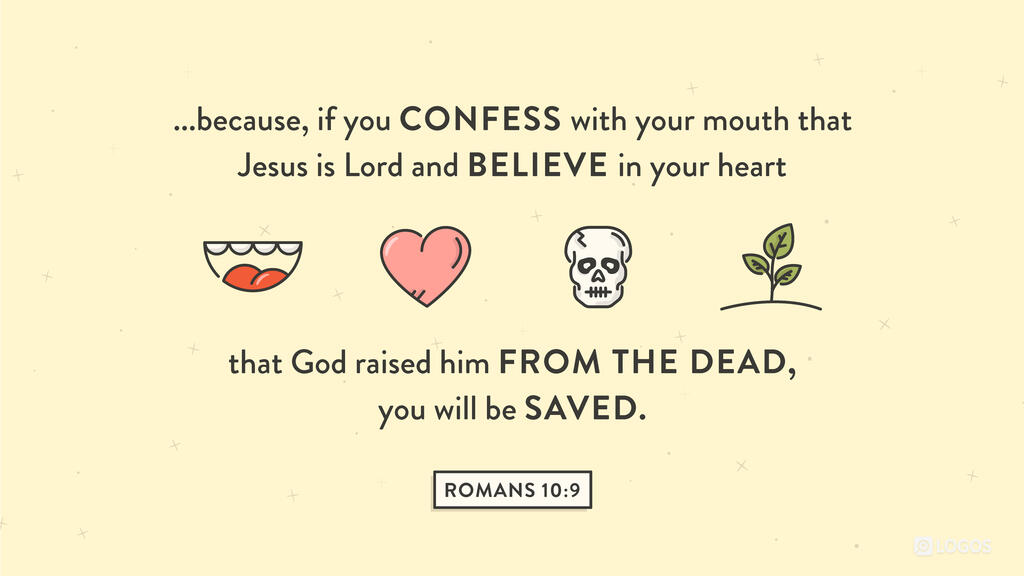
10:8But what does it say? “The word is near you, in your mouth and in your heart”9 (that is, the word of faith that we preach), 10:9because if you confess with your mouth that Jesus is Lord10 and believe in your heart that God raised him from the dead, you will be saved.
Footnotes
- 9 A quotation from Deut 30:14.
- 10 Or “the Lord.” The Greek construction, along with the quotation from Joel 2:32 in v. 13 (in which the same “Lord” seems to be in view) suggests that κύριον (kurion) is to be taken as “the Lord,” that is, Yahweh. Cf. D. B. Wallace, “The Semantics and Exegetical Significance of the Object-Complement Construction in the New Testament,” 6 (1985): .
The NET Bible First Edition, Copyright 1996-2005 by Biblical Studies Press
In other versions
ESVEnglish Standard Version
But what does it say? “The word is near you, in your mouth and in your heart” (that is, the word of faith that we proclaim); because, if you confess with your mouth that Jesus is Lord and believe in your heart that God raised him from the dead, you will be saved.
Copyright 2001 Crossway Bibles
NIVNew International Version (2011)
But what does it say? “The word is near you; it is in your mouth and in your heart,” that is, the message concerning faith that we proclaim: If you declare with your mouth, “Jesus is Lord,” and believe in your heart that God raised him from the dead, you will be saved.
Copyright 1973, 1978, 1984, 2011 Biblica, Inc.
CSBChristian Standard Bible
On the contrary, what does it say? The message is near you, in your mouth and in your heart. This is the message of faith that we proclaim: If you confess with your mouth, “Jesus is Lord,” and believe in your heart that God raised him from the dead, you will be saved.
Copyright 2017 Holman Bible Publishers
NLTNew Living Translation
In fact, it says,
“The message is very close at hand;
it is on your lips and in your heart.”
And that message is the very message about faith that we preach: If you openly declare that Jesus is Lord and believe in your heart that God raised him from the dead, you will be saved.
Holy Bible, New Living Translation, copyright © 1996, 2004, 2015 by Tyndale House Foundation. Used by permission of Tyndale House Publishers. All rights reserved.
LEBThe Lexham English Bible
But what does it say? “The word is near to you, in your mouth and in your heart” (that is, the word of faith that we proclaim), that if you confess with your mouth “Jesus is Lord” and believe in your heart that God raised him from the dead, you will be saved.
Copyright 2012 Lexham Press
KJV 1900King James Version
But what saith it? The word is nigh thee, even in thy mouth, and in thy heart: that is, the word of faith, which we preach; That if thou shalt confess with thy mouth the Lord Jesus, and shalt believe in thine heart that God hath raised him from the dead, thou shalt be saved.
Public Domain