Psalm 95:7–11
The NET BibleOther versions
English
- NET The NET Bible
- DARBY 1890 Darby Bible
- ASV American Standard Version
- AV 1873 The Cambridge Paragraph Bible of the Authorized English Version
- CSB Christian Standard Bible
- D-R Douay-Rheims Bible
- ESV English Standard Version
- GW GOD’S WORD Translation
- GNB Good News Translation
- HCSB The Holman Christian Standard Bible
- KJV 1900 King James Version
- LSB Legacy Standard Bible
- LEB The Lexham English Bible
- MSG The Message: The Bible in Contemporary Language
- NASB95 New American Standard Bible (1995)
- NCV New Century Version
- NIrV New International Reader’s Version (1998)
- NIV New International Version (2011)
- NKJV The New King James Version
- NLT New Living Translation
- NRSVue New Revised Standard Version: Updated Edition
- RSV The Revised Standard Version
- RSVCE The Revised Standard Version, Catholic Edition
- TNIV Today’s New International Version
- YLT Young’s Literal Translation
Arabic
Czech
French
German
Hebrew
Hungarian
Italian
Korean
Latin
Portuguese
Russian
Simplified Chinese
Spanish
Traditional Chinese
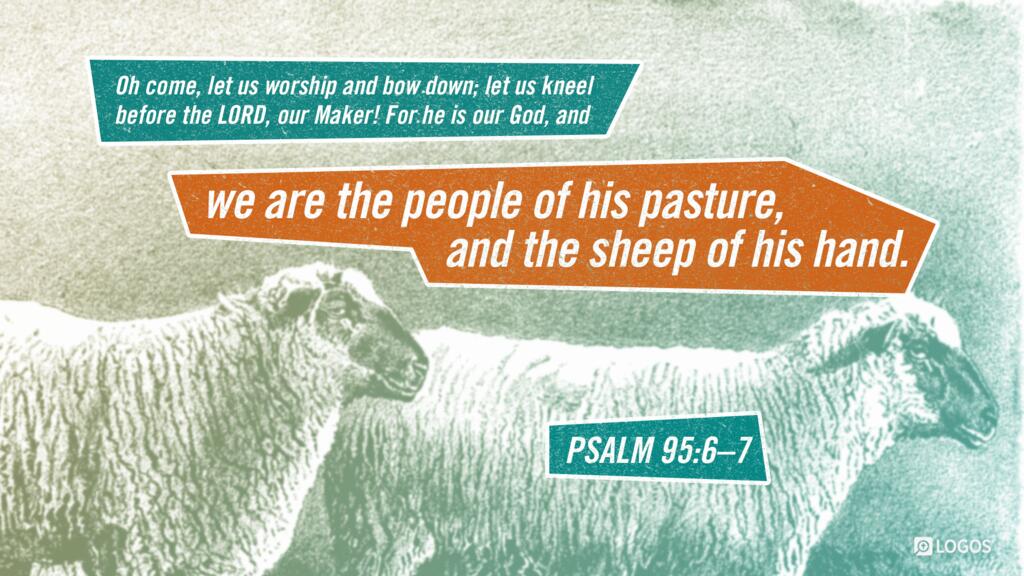
95:7For he is our God;
we are the people of his pasture,
the sheep he owns.7
Today, if only you would obey him!8
95:8He says,9 “Do not be stubborn like they were at Meribah,10
like they were that day at Massah11 in the wilderness,12
95:9where your ancestors challenged my authority,13
and tried my patience, even though they had seen my work.
95:10For forty years I was continually disgusted14 with that generation,
and I said, ‘These people desire to go astray;15
they do not obey my commands.’16
95:11So I made a vow in my anger,
‘They will never enter into the resting place I had set aside for them.’ ”17
Footnotes
- 7 Heb “of his hand.”
- 8 Heb “if only you would listen to his voice.” The Hebrew particle אִם (’im, “if”) and following prefixed verbal form here express a wish (cf. Ps 81:8). Note that the apodosis (the “then” clause of the conditional sentence) is suppressed.
- 9 The words “he says” are supplied in the translation to clarify that the following words are spoken by the Lord (see vv. 9–11).
- 10 The name Meribah means “strife.” Two separate but similar incidents at Meribah are recorded in the Pentateuch (Exod 17:1–7; Num 20:1–13, see also Pss 81:7; 106:32). In both cases the Israelites complained about lack of water and the Lord miraculously provided for them.
- 11 The name Massah means “testing.” This was another name (along with Meribah) given to the place where Israel complained following the Red Sea Crossing (see Exod 17:1–7, as well as Deut 6:16; 9:22; 33:8).
- 12 Heb “do not harden your heart[s] as [at] Meribah, as [in] the day of Massah in the wilderness.”
- 13 Heb “where your fathers tested me.”
- 14 The prefixed verbal form is either a preterite or an imperfect. If the latter, it emphasizes the ongoing nature of the condition in the past. The translation reflects this interpretation of the verbal form.
- 15 Heb “a people, wanderers of heart [are] they.”
- 16 Heb “and they do not know my ways.” In this context the Lord’s “ways” are his commands, viewed as a pathway from which his people, likened to wayward sheep (see v. 7), wander.
- 17 Heb “my resting place.” The promised land of Canaan is here viewed metaphorically as a place of rest for God’s people, who are compared to sheep (see v. 7).
The NET Bible First Edition, Copyright 1996-2005 by Biblical Studies Press
In other versions
ESVEnglish Standard Version
For he is our God,
and we are the people of his pasture,
and the sheep of his hand.
Today, if you hear his voice,
do not harden your hearts, as at Meribah,
as on the day at Massah in the wilderness,
when your fathers put me to the test
and put me to the proof, though they had seen my work.
For forty years I loathed that generation
and said, “They are a people who go astray in their heart,
and they have not known my ways.”
Therefore I swore in my wrath,
“They shall not enter my rest.”
Copyright 2001 Crossway Bibles
NIVNew International Version (2011)
for he is our God
and we are the people of his pasture,
the flock under his care.
Today, if only you would hear his voice,
“Do not harden your hearts as you did at Meribah,
as you did that day at Massah in the wilderness,
where your ancestors tested me;
they tried me, though they had seen what I did.
For forty years I was angry with that generation;
I said, ‘They are a people whose hearts go astray,
and they have not known my ways.’
So I declared on oath in my anger,
‘They shall never enter my rest.’ ”
Copyright 1973, 1978, 1984, 2011 Biblica, Inc.
CSBChristian Standard Bible
For he is our God,
and we are the people of his pasture,
the sheep under his care.
Today, if you hear his voice:
Do not harden your hearts as at Meribah,
as on that day at Massah in the wilderness
where your ancestors tested me;
they tried me, though they had seen what I did.
For forty years I was disgusted with that generation;
I said, “They are a people whose hearts go astray;
they do not know my ways.”
So I swore in my anger,
“They will not enter my rest.”
Copyright 2017 Holman Bible Publishers
NLTNew Living Translation
for he is our God.
We are the people he watches over,
the flock under his care.
If only you would listen to his voice today!
The Lord says, “Don’t harden your hearts as Israel did at Meribah,
as they did at Massah in the wilderness.
For there your ancestors tested and tried my patience,
even though they saw everything I did.
For forty years I was angry with them, and I said,
‘They are a people whose hearts turn away from me.
They refuse to do what I tell them.’
So in my anger I took an oath:
‘They will never enter my place of rest.’ ”
Holy Bible, New Living Translation, copyright © 1996, 2004, 2015 by Tyndale House Foundation. Used by permission of Tyndale House Publishers. All rights reserved.
LEBThe Lexham English Bible
For he is our God,
and we are the people of his pasture
and the sheep of his hand.
Today if you will hear his voice:
“Do not harden your heart as at Meribah,
as in the day of Massah in the wilderness,
when your ancestors tried me.
They put me to the test,
even though they had seen my work.
For forty years I loathed that generation,
and said, ‘They are a people whose heart wanders.
And my ways they do not know.’
Therefore I swore in my anger,
‘They shall surely not enter into my rest.’ ”
Copyright 2012 Lexham Press
KJV 1900King James Version
For he is our God;
And we are the people of his pasture, and the sheep of his hand.
To day if ye will hear his voice,
Harden not your heart, as in the provocation,
And as in the day of temptation in the wilderness:
When your fathers tempted me,
Proved me, and saw my work.
Forty years long was I grieved with this generation,
And said, It is a people that do err in their heart,
And they have not known my ways:
Unto whom I sware in my wrath
That they should not enter into my rest.
Public Domain