Psalm 73:3–7
The NET BibleOther versions
English
- NET The NET Bible
- DARBY 1890 Darby Bible
- ASV American Standard Version
- AV 1873 The Cambridge Paragraph Bible of the Authorized English Version
- CSB Christian Standard Bible
- D-R Douay-Rheims Bible
- ESV English Standard Version
- GW GOD’S WORD Translation
- GNB Good News Translation
- HCSB The Holman Christian Standard Bible
- KJV 1900 King James Version
- LSB Legacy Standard Bible
- LEB The Lexham English Bible
- MSG The Message: The Bible in Contemporary Language
- NASB95 New American Standard Bible (1995)
- NCV New Century Version
- NIrV New International Reader’s Version (1998)
- NIV New International Version (2011)
- NKJV The New King James Version
- NLT New Living Translation
- NRSVue New Revised Standard Version: Updated Edition
- RSV The Revised Standard Version
- RSVCE The Revised Standard Version, Catholic Edition
- TNIV Today’s New International Version
- YLT Young’s Literal Translation
Arabic
Czech
French
German
Hebrew
Hungarian
Italian
Korean
Latin
Portuguese
Russian
Simplified Chinese
Spanish
Traditional Chinese
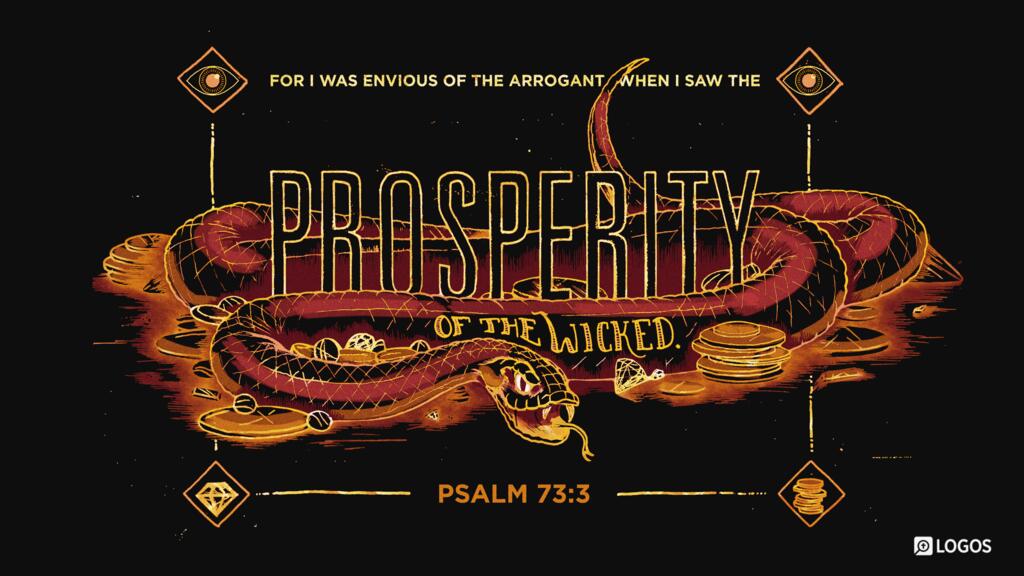
73:3For I envied those who are proud,
as I observed4 the prosperity5 of the wicked.
73:4For they suffer no pain;6
their bodies7 are strong and well-fed.8
73:5They are immune to the trouble common to men;
they do not suffer as other men do.9
73:6Arrogance is their necklace,10
and violence their clothing.11
73:7Their prosperity causes them to do wrong;12
their thoughts are sinful.13
Footnotes
- 4 The imperfect verbal form here depicts the action as continuing in a past time frame.
- 5 Heb “peace” (שָׁלוֹם, shalom).
- 6 In Isa 58:6, the only other occurrence of this word in the OT, the term refers to “bonds” or “ropes.” In Ps 73:4 it is used metaphorically of pain and suffering that restricts one’s enjoyment of life.
- 7 Or “bellies.”
- 8 Or “fat.” The of v. 4 reads as follows: “for there are no pains at their death, and fat [is] their body.” Since a reference to the death of the wicked seems incongruous in the immediate context (note v. 5) and premature in the argument of the psalm (see vv. 18–20, 27), some prefer to emend the text by redividing it. The term לְמוֹתָם (lémotam,“at their death”) is changed to לָמוֹ תָּם (lamo tam, “[there are no pains] to them, strong [and fat are their bodies]”). The term תָּם (tam, “complete; sound”) is used of physical beauty in Song 5:2; 6:9. This emendation is the basis for the present translation. However, in defense of the (the traditional Hebrew text), one may point to an Aramaic inscription from Nerab which views a painful death as a curse and a nonpainful death in one’s old age as a sign of divine favor. See 661.
- 9 Heb “in the trouble of man they are not, and with mankind they are not afflicted.”
- 10 Arrogance is their necklace. The metaphor suggests that their arrogance is something the wicked “wear” proudly. It draws attention to them, just as a beautiful necklace does to its owner.
- 11 Heb “a garment of violence covers them.” The metaphor suggests that violence is habitual for the wicked. They “wear” it like clothing; when one looks at them, violence is what one sees.
- 12 The reads “it goes out from fatness their eye,” which might be paraphrased, “their eye protrudes [or “bulges”] because of fatness.” This in turn might refer to their greed; their eyes “bug out” when they see rich food or produce (the noun חֵלֶב [khelev, “fatness”] sometimes refers to such food or produce). However, when used with the verb יָצָא (yatsa’, “go out”) the preposition מִן (“from”) more naturally indicates source. For this reason it is preferable to emend עֵינֵמוֹ (’enemo, “their eye”) to עֲוֹנָמוֹ, (’avonamo, “their sin”) and read, “and their sin proceeds forth from fatness,” that is, their prosperity gives rise to their sinful attitudes. If one follows this textual reading, another interpretive option is to take חֵלֶב (“fatness”) in the sense of “unreceptive, insensitive” (see its use in Ps 17:10). In this case, the sin of the wicked proceeds forth from their spiritual insensitivity.
- 13 Heb “the thoughts of [their] heart [i.e., mind] cross over” (i.e., violate God’s moral boundary, see Ps 17:3).
The NET Bible First Edition, Copyright 1996-2005 by Biblical Studies Press
In other versions
ESVEnglish Standard Version
For I was envious of the arrogant
when I saw the prosperity of the wicked.
For they have no pangs until death;
their bodies are fat and sleek.
They are not in trouble as others are;
they are not stricken like the rest of mankind.
Therefore pride is their necklace;
violence covers them as a garment.
Their eyes swell out through fatness;
their hearts overflow with follies.
Copyright 2001 Crossway Bibles
NIVNew International Version (2011)
For I envied the arrogant
when I saw the prosperity of the wicked.
They have no struggles;
their bodies are healthy and strong.
They are free from common human burdens;
they are not plagued by human ills.
Therefore pride is their necklace;
they clothe themselves with violence.
From their callous hearts comes iniquity;
their evil imaginations have no limits.
Copyright 1973, 1978, 1984, 2011 Biblica, Inc.
CSBChristian Standard Bible
For I envied the arrogant;
I saw the prosperity of the wicked.
They have an easy time until they die,
and their bodies are well fed.
They are not in trouble like others;
they are not afflicted like most people.
Therefore, pride is their necklace,
and violence covers them like a garment.
Their eyes bulge out from fatness;
the imaginations of their hearts run wild.
Copyright 2017 Holman Bible Publishers
NLTNew Living Translation
For I envied the proud
when I saw them prosper despite their wickedness.
They seem to live such painless lives;
their bodies are so healthy and strong.
They don’t have troubles like other people;
they’re not plagued with problems like everyone else.
They wear pride like a jeweled necklace
and clothe themselves with cruelty.
These fat cats have everything
their hearts could ever wish for!
Holy Bible, New Living Translation, copyright © 1996, 2004, 2015 by Tyndale House Foundation. Used by permission of Tyndale House Publishers. All rights reserved.
LEBThe Lexham English Bible
because I envied the boastful
when I saw the well-being of the wicked.
For there are no pains up to their death,
and their bodies are healthy.
They do not have ordinary trouble,
and they are not plagued as other people.
Therefore pride is their necklace;
an outfit of violence covers them.
Their eye bulges from fat.
Imaginings overflow their heart.
Copyright 2012 Lexham Press
KJV 1900King James Version
For I was envious at the foolish,
When I saw the prosperity of the wicked.
For there are no bands in their death:
But their strength is firm.
They are not in trouble as other men;
Neither are they plagued like other men.
Therefore pride compasseth them about as a chain;
Violence covereth them as a garment.
Their eyes stand out with fatness:
They have more than heart could wish.
Public Domain