Psalm 32:title–2
The NET BibleOther versions
English
- NET The NET Bible
- DARBY 1890 Darby Bible
- ASV American Standard Version
- AV 1873 The Cambridge Paragraph Bible of the Authorized English Version
- CSB Christian Standard Bible
- D-R Douay-Rheims Bible
- ESV English Standard Version
- GW GOD’S WORD Translation
- GNB Good News Translation
- HCSB The Holman Christian Standard Bible
- KJV 1900 King James Version
- LSB Legacy Standard Bible
- LEB The Lexham English Bible
- MSG The Message: The Bible in Contemporary Language
- NASB95 New American Standard Bible (1995)
- NCV New Century Version
- NIrV New International Reader’s Version (1998)
- NIV New International Version (2011)
- NKJV The New King James Version
- NLT New Living Translation
- NRSVue New Revised Standard Version: Updated Edition
- RSV The Revised Standard Version
- RSVCE The Revised Standard Version, Catholic Edition
- TNIV Today’s New International Version
- YLT Young’s Literal Translation
Arabic
Czech
French
German
Hebrew
Hungarian
Italian
Korean
Latin
Portuguese
Russian
Simplified Chinese
Spanish
Traditional Chinese
By David; a well-written song.47
32:1How blessed1 is the one whose rebellious acts are forgiven,2
whose sin is pardoned!3
32:2How blessed is the one4 whose wrongdoing the Lord does not punish,5
in whose spirit there is no deceit.6
Footnotes
- 47 The meaning of the Hebrew term מַשְׂכִּיל (maskil) is uncertain. The word is derived from a verb meaning “to be prudent; to be wise.” Various options are: “a contemplative song,” “a song imparting moral wisdom,” or “a skillful [i.e., well-written] song.” The term occurs in the superscriptions of Pss 32, 42, 44, 45, 52–55, 74, 78, 88, 89, and 142, as well as in Ps 47:7.
- 1 The Hebrew noun is an abstract plural. The word often refers metonymically to the happiness that God-given security and prosperity produce (see Pss 1:1, 3; 2:12; 34:9; 41:1; 65:4; 84:12; 89:15; 106:3; 112:1; 127:5; 128:1; 144:15). Here it refers to the relief that one experiences when one’s sins are forgiven.
- 2 Heb “lifted up.”
- 3 Heb “covered over.”
- 4 Heb “man.” The word choice reflects the perspective of the psalmist, who is male. The principle of the psalm is certainly applicable to all people, regardless of their gender or age. To facilitate modern application, the gender and age specific “man” has been translated with the more neutral “one.”
- 5 Heb “blessed [is] the man to whom the Lord does not impute wrongdoing.”
- 6 In whose spirit there is no deceit. The point is not that the individual is sinless and pure. In this context, which focuses on confession and forgiveness of sin, the psalmist refers to one who refuses to deny or hide his sin, but instead honestly confesses it to God.
The NET Bible First Edition, Copyright 1996-2005 by Biblical Studies Press
In other versions
ESVEnglish Standard Version
A Maskil of David.
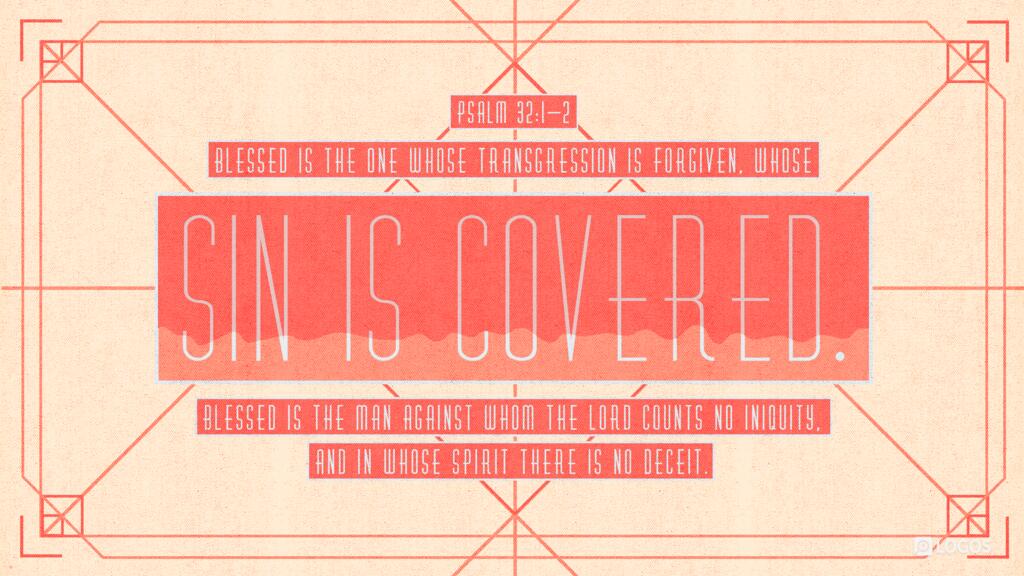
Blessed is the one whose transgression is forgiven,
whose sin is covered.
Blessed is the man against whom the Lord counts no iniquity,
and in whose spirit there is no deceit.
Copyright 2001 Crossway Bibles
NIVNew International Version (2011)
Of David. A maskil.
Blessed is the one
whose transgressions are forgiven,
whose sins are covered.
Blessed is the one
whose sin the Lord does not count against them
and in whose spirit is no deceit.
Copyright 1973, 1978, 1984, 2011 Biblica, Inc.
CSBChristian Standard Bible
Of David. A Maskil.
How joyful is the one
whose transgression is forgiven,
whose sin is covered!
How joyful is a person whom
the Lord does not charge with iniquity
and in whose spirit is no deceit!
Copyright 2017 Holman Bible Publishers
NLTNew Living Translation
A psalm of David.
Oh, what joy for those
whose disobedience is forgiven,
whose sin is put out of sight!
Yes, what joy for those
whose record the Lord has cleared of guilt,
whose lives are lived in complete honesty!
Holy Bible, New Living Translation, copyright © 1996, 2004, 2015 by Tyndale House Foundation. Used by permission of Tyndale House Publishers. All rights reserved.
LEBThe Lexham English Bible
Of David. A maskil.
Happy is he whose transgression is taken away,
whose sin is covered.
Happy is a person to whom Yahweh does not impute iniquity
and in whose spirit there is not deceit.
Copyright 2012 Lexham Press
KJV 1900King James Version
A Psalm of David, Maschil.
Blessed is he whose transgression is forgiven, whose sin is covered.
Blessed is the man unto whom the Lord imputeth not iniquity,
And in whose spirit there is no guile.
Public Domain