Psalm 29:1–11
The NET BibleOther versions
English
- NET The NET Bible
- DARBY 1890 Darby Bible
- ASV American Standard Version
- AV 1873 The Cambridge Paragraph Bible of the Authorized English Version
- CSB Christian Standard Bible
- D-R Douay-Rheims Bible
- ESV English Standard Version
- GW GOD’S WORD Translation
- GNB Good News Translation
- HCSB The Holman Christian Standard Bible
- KJV 1900 King James Version
- LSB Legacy Standard Bible
- LEB The Lexham English Bible
- MSG The Message: The Bible in Contemporary Language
- NASB95 New American Standard Bible (1995)
- NCV New Century Version
- NIrV New International Reader’s Version (1998)
- NIV New International Version (2011)
- NKJV The New King James Version
- NLT New Living Translation
- NRSVue New Revised Standard Version: Updated Edition
- RSV The Revised Standard Version
- RSVCE The Revised Standard Version, Catholic Edition
- TNIV Today’s New International Version
- YLT Young’s Literal Translation
Arabic
Czech
French
German
Hebrew
Hungarian
Italian
Korean
Latin
Portuguese
Russian
Simplified Chinese
Spanish
Traditional Chinese
29:1Acknowledge the Lord, you heavenly beings,1
acknowledge the Lord’s majesty and power!2
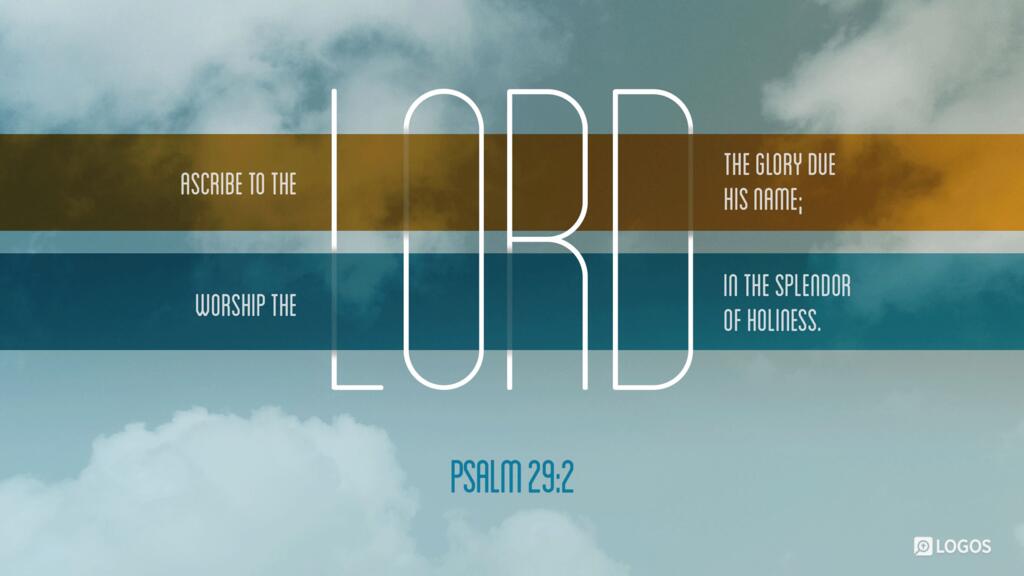
29:2Acknowledge the majesty of the Lord’s reputation!3
Worship the Lord in holy attire!4
29:3The Lord’s shout is heard over the water;5
the majestic God thunders,6
the Lord appears over the surging water.7
29:4The Lord’s shout is powerful,8
the Lord’s shout is majestic.9
29:5The Lord’s shout breaks10 the cedars,
the Lord shatters11 the cedars of Lebanon.12
29:6He makes Lebanon skip like a calf
and Sirion13 like a young ox.14
29:7The Lord’s shout strikes15 with flaming fire.16
29:8The Lord’s shout shakes17 the wilderness,
the Lord shakes the wilderness of Kadesh.18
29:9The Lord’s shout bends19 the large trees20
and strips21 the leaves from the forests.22
Everyone in his temple says, “Majestic!”23
29:10The Lord sits enthroned over the engulfing waters,24
the Lord sits enthroned25 as the eternal king.
29:11The Lord gives26 his people strength;27
the Lord grants his people security.28
Footnotes
- 1 Heb “sons of gods,” or “sons of God.” Though אֵלִים (’elim) is vocalized as a plural form (“gods”) in the , it is likely that the final mem is actually enclitic, rather than a plural marker. In this case one may read “God.” Some, following a Qumran text and the , also propose the phrase occurred in the original text of Deut 32:8. The phrase בְּנֵי אֵלִים (béney ’elim, “sons of gods” or “sons of God”) occurs only here and in Ps 89:6 (89:7 ). In Ps 89 the “sons of gods/God” are also called “the assembly of the holy ones” and “council of the holy ones.” The heavenly assembly, comprised of so-called “angels” and other supernatural beings, appears to be in view. See Job 5:1; 15:15 and Zech 14:5, where these supernatural beings are referred to as “holy ones.” In Canaanite mythological texts the divine council of the high god El is referred to as “the sons of El.” The OT apparently borrows the Canaanite phrase and applies it to the supernatural beings that surround the heavenly throne.
- 2 Or “ascribe to the Lord glory and strength.”
- 3 Heb “ascribe to the Lord the glory of his name.” The Hebrew term שֵׁם (shem, “name”) refers here to the Lord’s reputation. (The English term “name” is often used the same way.)
- 4 That is, properly dressed for the occasion.
- 5 Heb “the voice of the Lord [is] over the water.” As the next line makes clear, the “voice of the Lord” is here the thunder that accompanies a violent storm. The psalm depicts the Lord in the role of a warrior-king, so the thunder is his battle cry, as it were.
- 6 The Hebrew perfect verbal form is probably descriptive. In dramatic fashion the psalmist portrays the Lord coming in the storm to do battle with his enemies and to vindicate his people.
- 7 Traditionally “many waters.” The geographical references in the psalm (Lebanon, Sirion, Kadesh) suggest this is a reference to the Mediterranean Sea (see Ezek 26:19; 27:26). The psalmist describes a powerful storm moving in from the sea and sweeping over the mountainous areas north of Israel. The “surging waters” may symbolize the hostile enemies of God who seek to destroy his people (see Pss 18:17; 32:6; 77:20; 93:4; 144:7; Isa 17:13; Jer 51:55; Ezek 26:19; Hab 3:15). In this case the Lord is depicted as elevated above and sovereign over the raging waters.
- 8 Heb “the voice of the Lord [is] accompanied by strength.”
- 9 Heb “the voice of the Lord [is] accompanied by majesty.”
- 10 The Hebrew participial form draws attention to the durative nature of the action being described.
- 11 The prefixed verbal forms with vav (ו) consecutive here and in v. 6a carry on the descriptive function of the preceding participle (see §111.u). The verb שָׁבַר (shavar) appears in the Qal in the first line of the verse, and in the Piel in the second line. The verb, which means “break” in the Qal, appears thirty-six times in the Piel, always with multiple objects (the object is either a collective singular or grammatically plural or dual form). The Piel may highlight the repetition of the pluralative action, or it may suggest an intensification of action, indicating repeated action comprising a whole, perhaps with the nuance “break again and again, break in pieces.” Another option is to understand the form as resultative: “make broken” (see §24.3).
- 12 The cedars of the Lebanon forest were well-known in ancient Israel for their immense size. Here they may symbolize the arrogant enemies of God (see Isa 2:12–13).
- 13 Sirion is another name for Mount Hermon (Deut 3:9).
- 14 Lebanon and Sirion are compared to frisky young animals (a calf … a young ox) who skip and jump. The thunderous shout of the Lord is so powerful, one can see the very mountains shake on the horizon.
- 15 The verb normally means “to hew [stone or wood],” or “to hew out.” In Hos 6:5 it seems to mean “cut in pieces,” “knock down,” or perhaps “hack” (see F. I. Andersen and D. N. Freedman, Hosea [], ). The Ugaritic cognate can mean “assault.” In v. 7 the verb seems to have a similar meaning, perhaps “attack, strike.” The phrase “flames of fire” is an adverbial accusative; the Lord’s shout is accompanied by “flames of fire,” that is, lightning bolts.
- 16 The Lord’s shout strikes with flaming fire. The short line has invited textual emendation, but its distinct, brief form may highlight the statement, which serves as the axis of a chiastic structure encompassing vv. 5–9: (A) the Lord’s shout destroys the forest (v. 5); (B) the Lord’s shout shakes the terrain (v. 6); (C) the Lord’s shout is accompanied by destructive lightning (v. 7); (B´) the Lord’s shout shakes the terrain (v. 8); (A´) the Lord’s shout destroys the forest (v. 9).
- 17 The Hebrew imperfect verbal forms are descriptive in function; the psalmist depicts the action as underway.
- 18 Kadesh. The references to Lebanon and Sirion in v. 6 suggest this is a reference to the northern Kadesh, located north of Damascus, not the southern Kadesh mentioned so often in the OT. See M. Dahood, Psalms (), 1:.
- 19 The Hebrew imperfect verbal form is descriptive in function; the psalmist depicts the action as underway.
- 20 Heb “the deer.” Preserving this reading, some translate the preceding verb, “causes [the deer] to give premature birth” (cf. , ). But the Polel of חוּל/חִיל (khul/khil) means “give birth,” not “cause to give birth,” and the statement “the Lord’s shout gives birth to deer” is absurd. In light of the parallelism (note “forests” in the next line) and v. 5, it is preferable to emend אַיָּלוֹת (’ayyalot, “deer”) to אֵילוֹת (’elot, “large trees”) understanding the latter as an alternate form of the usual plural form אַיָּלִים (’ayyalim).
- 21 The verb is used in Joel 1:7 of locusts stripping the leaves from a tree. The prefixed verbal form with vav (ו) consecutive here carries the descriptive function of the preceding imperfect. See §111.t.
- 22 The usual form of the plural of יַעַר (ya’ar, “forest”) is יְעָרִים (yé’arim). For this reason some propose an emendation to יְעָלוֹת (yé’alot, “female mountain goats”) which would fit nicely in the parallelism with “deer” (cf. “brings kids early to birth”). In this case one would have to understand the verb חָשַׂף (khasaf) to mean “cause premature birth,” an otherwise unattested homonym of the more common חָשַׂף (“strip bare”). The Lord’s thunderous shout is accompanied by high winds which damage the trees of the forest.
- 23 Heb “In his temple, all of it says, ‘Glory.’ ”
- 24 The noun מַּבּוּל (mabbul, “flood”) appears only here and in Gen 6–11, where it refers to the Noahic flood. Some see a reference to that event here. The presence of the article (perhaps indicating uniqueness) and the switch to the perfect verbal form (which could be taken as describing a past situation) might support this. However, the immediate context indicates that the referent of מַּבּוּל is the “surging waters” mentioned in v. 3. The article indicates waters that are definite in the mind of the speaker and the perfect is probably descriptive in function, like “thunders” in v. 3. However, even though the historical flood is not the primary referent here, there may be a literary allusion involved. The psalmist views the threatening chaotic sea as a contemporary manifestation of the destructive waters of old.
- 25 The prefixed verbal form with vav (ו) consecutive here carries the descriptive function of the preceding perfect.
- 26 The imperfect verbal forms in v. 11 are either descriptive or generalizing.
- 27 Strength. This probably refers to military power; see the use of the noun in 1 Sam 2:10 and Ps 86:16.
- 28 Heb “blesses his people with peace.” The Hebrew term שָׁלוֹם (shalom, “peace”) probably refers here to the protection and prosperity experienced by God’s people after the Lord intervenes in battle on their behalf.
The NET Bible First Edition, Copyright 1996-2005 by Biblical Studies Press
In other versions
ESVEnglish Standard Version
Ascribe to the Lord, O heavenly beings,
ascribe to the Lord glory and strength.
Ascribe to the Lord the glory due his name;
worship the Lord in the splendor of holiness.
The voice of the Lord is over the waters;
the God of glory thunders,
the Lord, over many waters.
The voice of the Lord is powerful;
the voice of the Lord is full of majesty.
The voice of the Lord breaks the cedars;
the Lord breaks the cedars of Lebanon.
He makes Lebanon to skip like a calf,
and Sirion like a young wild ox.
The voice of the Lord flashes forth flames of fire.
The voice of the Lord shakes the wilderness;
the Lord shakes the wilderness of Kadesh.
The voice of the Lord makes the deer give birth
and strips the forests bare,
and in his temple all cry, “Glory!”
The Lord sits enthroned over the flood;
the Lord sits enthroned as king forever.
May the Lord give strength to his people!
May the Lord bless his people with peace!
Copyright 2001 Crossway Bibles
NIVNew International Version (2011)
Ascribe to the Lord, you heavenly beings,
ascribe to the Lord glory and strength.
Ascribe to the Lord the glory due his name;
worship the Lord in the splendor of his holiness.
The voice of the Lord is over the waters;
the God of glory thunders,
the Lord thunders over the mighty waters.
The voice of the Lord is powerful;
the voice of the Lord is majestic.
The voice of the Lord breaks the cedars;
the Lord breaks in pieces the cedars of Lebanon.
He makes Lebanon leap like a calf,
Sirion like a young wild ox.
The voice of the Lord strikes
with flashes of lightning.
The voice of the Lord shakes the desert;
the Lord shakes the Desert of Kadesh.
The voice of the Lord twists the oaks
and strips the forests bare.
And in his temple all cry, “Glory!”
The Lord sits enthroned over the flood;
the Lord is enthroned as King forever.
The Lord gives strength to his people;
the Lord blesses his people with peace.
Copyright 1973, 1978, 1984, 2011 Biblica, Inc.
CSBChristian Standard Bible
Ascribe to the Lord, you heavenly beings,
ascribe to the Lord glory and strength.
Ascribe to the Lord the glory due his name;
worship the Lord
in the splendor of his holiness.
The voice of the Lord is above the waters.
The God of glory thunders—
the Lord, above the vast water,
the voice of the Lord in power,
the voice of the Lord in splendor.
The voice of the Lord breaks the cedars;
the Lord shatters the cedars of Lebanon.
He makes Lebanon skip like a calf,
and Sirion, like a young wild ox.
The voice of the Lord flashes flames of fire.
The voice of the Lord shakes the wilderness;
the Lord shakes the wilderness of Kadesh.
The voice of the Lord makes the deer give birth
and strips the woodlands bare.
In his temple all cry, “Glory!”
The Lord sits enthroned over the flood;
the Lord sits enthroned, King forever.
The Lord gives his people strength;
the Lord blesses his people with peace.
Copyright 2017 Holman Bible Publishers
NLTNew Living Translation
Honor the Lord, you heavenly beings;
honor the Lord for his glory and strength.
Honor the Lord for the glory of his name.
Worship the Lord in the splendor of his holiness.
The voice of the Lord echoes above the sea.
The God of glory thunders.
The Lord thunders over the mighty sea.
The voice of the Lord is powerful;
the voice of the Lord is majestic.
The voice of the Lord splits the mighty cedars;
the Lord shatters the cedars of Lebanon.
He makes Lebanon’s mountains skip like a calf;
he makes Mount Hermon leap like a young wild ox.
The voice of the Lord strikes
with bolts of lightning.
The voice of the Lord makes the barren wilderness quake;
the Lord shakes the wilderness of Kadesh.
The voice of the Lord twists mighty oaks
and strips the forests bare.
In his Temple everyone shouts, “Glory!”
The Lord rules over the floodwaters.
The Lord reigns as king forever.
The Lord gives his people strength.
The Lord blesses them with peace.
Holy Bible, New Living Translation, copyright © 1996, 2004, 2015 by Tyndale House Foundation. Used by permission of Tyndale House Publishers. All rights reserved.
LEBThe Lexham English Bible
Ascribe to Yahweh, O sons of God,
ascribe to Yahweh glory and strength.
Ascribe to Yahweh the glory due his name.
Worship Yahweh in holy array.
The voice of Yahweh is over the waters;
the God of glory thunders.
Yahweh is over many waters.
The voice of Yahweh is powerful.
The voice of Yahweh is majestic.
The voice of Yahweh breaks the cedars.
Yahweh shatters even the cedars of Lebanon.
And he makes them skip like a calf;
Lebanon and Sirion like a young wild ox.
The voice of Yahweh flashes flames of fire.
The voice of Yahweh shakes the wilderness.
Yahweh shakes the wilderness of Kadesh.
The voice of Yahweh causes deer to give birth
and strips the forests bare.
And at his temple all in it say, “Glory!”
Yahweh sits enthroned at the flood,
and Yahweh sits as king forever.
May Yahweh give strength to his people.
May Yahweh bless his people with peace.
Copyright 2012 Lexham Press
KJV 1900King James Version
Give unto the Lord, O ye mighty,
Give unto the Lord glory and strength.
Give unto the Lord the glory due unto his name;
Worship the Lord in the beauty of holiness.
The voice of the Lord is upon the waters:
The God of glory thundereth:
The Lord is upon many waters.
The voice of the Lord is powerful;
The voice of the Lord is full of majesty.
The voice of the Lord breaketh the cedars;
Yea, the Lord breaketh the cedars of Lebanon.
He maketh them also to skip like a calf;
Lebanon and Sirion like a young unicorn.
The voice of the Lord divideth the flames of fire.
The voice of the Lord shaketh the wilderness;
The Lord shaketh the wilderness of Kadesh.
The voice of the Lord maketh the hinds to calve,
And discovereth the forests:
And in his temple doth every one speak of his glory.
The Lord sitteth upon the flood;
Yea, the Lord sitteth King for ever.
The Lord will give strength unto his people;
The Lord will bless his people with peace.
Public Domain