Psalm 20:6–8
The NET BibleOther versions
English
- NET The NET Bible
- DARBY 1890 Darby Bible
- ASV American Standard Version
- AV 1873 The Cambridge Paragraph Bible of the Authorized English Version
- CSB Christian Standard Bible
- D-R Douay-Rheims Bible
- ESV English Standard Version
- GW GOD’S WORD Translation
- GNB Good News Translation
- HCSB The Holman Christian Standard Bible
- KJV 1900 King James Version
- LSB Legacy Standard Bible
- LEB The Lexham English Bible
- MSG The Message: The Bible in Contemporary Language
- NASB95 New American Standard Bible (1995)
- NCV New Century Version
- NIrV New International Reader’s Version (1998)
- NIV New International Version (2011)
- NKJV The New King James Version
- NLT New Living Translation
- NRSVue New Revised Standard Version: Updated Edition
- RSV The Revised Standard Version
- RSVCE The Revised Standard Version, Catholic Edition
- TNIV Today’s New International Version
- YLT Young’s Literal Translation
Arabic
Czech
French
German
Hebrew
Hungarian
Italian
Korean
Latin
Portuguese
Russian
Simplified Chinese
Spanish
Traditional Chinese
20:6Now I am sure12 that the Lord will deliver13 his chosen king;14
he will intervene for him15 from his holy heavenly temple,16
and display his mighty ability to deliver.17
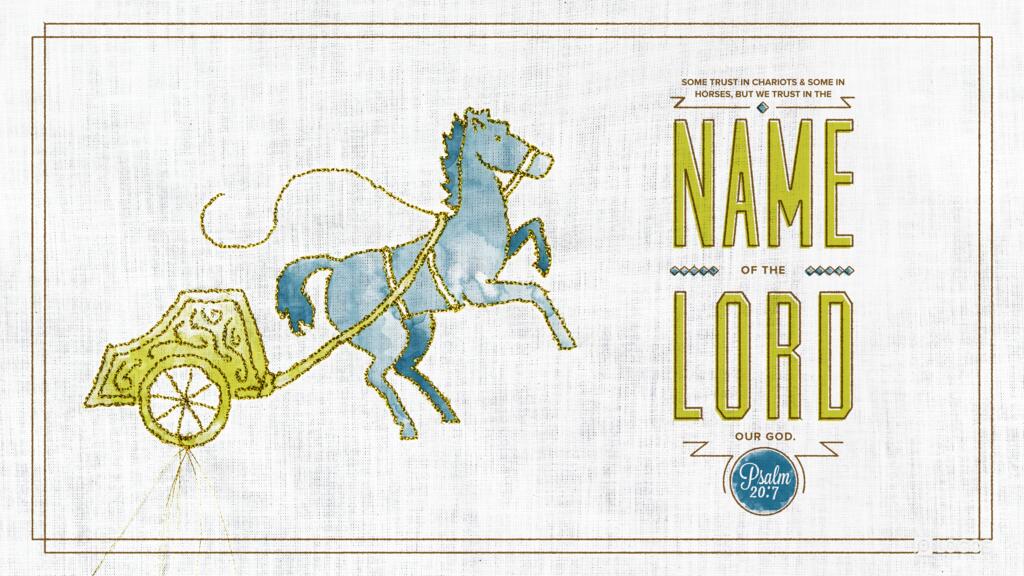
20:7Some trust in chariots and others in horses,18
but we19 depend on20 the Lord our God.
20:8They will fall down,21
Footnotes
- 12 Or “know.” Now I am sure. The speaker is not identified. It is likely that the king, referring to himself in the third person (note “his chosen king”), responds to the people’s prayer. Perhaps his confidence is due to the reception of a divine oracle of salvation.
- 13 The perfect verbal form is probably used rhetorically to state that the deliverance is as good as done. In this way the speaker emphasizes the certainty of the deliverance. Another option is to take the statement as generalizing; the psalmist affirms that the Lord typically delivers the king.
- 14 Heb “his anointed one.” This title refers to the Davidic king. See Pss 2:2 and 18:50.
- 15 Heb “he will answer him.”
- 16 Heb “from his holy heavens.”
- 17 Heb “with mighty acts of deliverance of his right hand.” The Lord’s “right hand” here symbolizes his power to protect and deliver (see Ps 17:7).
- 18 Heb “these in chariots and these in horses.” No verb appears; perhaps the verb “invoke” is to be supplied from the following line. In this case the idea would be that some “invoke” (i.e., trust in) their military might for victory (cf. “boast”; “trust”; “take pride”). Verse 8 suggests that the “some/others” mentioned here are the nation’s enemies.
- 19 The grammatical construction (conjunction + pronominal subject) highlights the contrast between God’s faithful people and the others mentioned in the previous line.
- 20 Heb “we invoke the name of.” The Hiphil of זָכַר (zakhar), when combined with the phrase “in the name,” means “to invoke” (see Josh 23:7; Isa 48:1; Amos 6:10). By invoking the Lord’s name in prayer, the people demonstrate their trust in him.
- 21 Or “stumble and fall down.”
- 22 The grammatical construction (conjunction + pronominal subject) highlights the contrast between God’s victorious people and the defeated enemies mentioned in the previous line. The perfect verbal forms either generalize or, more likely, state rhetorically the people’s confidence as they face the approaching battle. They describe the demise of the enemy as being as good as done.
- 23 Or “rise up and remain upright.” On the meaning of the Hitpolel of עוּד (’ud), see I עוד. The verbal forms (a perfect followed by a prefixed form with vav [ו] consecutive) either generalize or, more likely, state rhetorically the people’s confidence as they face the approaching battle.
The NET Bible First Edition, Copyright 1996-2005 by Biblical Studies Press
In other versions
ESVEnglish Standard Version
Now I know that the Lord saves his anointed;
he will answer him from his holy heaven
with the saving might of his right hand.
Some trust in chariots and some in horses,
but we trust in the name of the Lord our God.
They collapse and fall,
but we rise and stand upright.
Copyright 2001 Crossway Bibles
NIVNew International Version (2011)
Now this I know:
The Lord gives victory to his anointed.
He answers him from his heavenly sanctuary
with the victorious power of his right hand.
Some trust in chariots and some in horses,
but we trust in the name of the Lord our God.
They are brought to their knees and fall,
but we rise up and stand firm.
Copyright 1973, 1978, 1984, 2011 Biblica, Inc.
CSBChristian Standard Bible
Now I know that the Lord gives victory to his anointed;
he will answer him from his holy heaven
with mighty victories from his right hand.
Some take pride in chariots, and others in horses,
but we take pride in the name of the Lord our God.
They collapse and fall,
but we rise and stand firm.
Copyright 2017 Holman Bible Publishers
NLTNew Living Translation
Now I know that the Lord rescues his anointed king.
He will answer him from his holy heaven
and rescue him by his great power.
Some nations boast of their chariots and horses,
but we boast in the name of the Lord our God.
Those nations will fall down and collapse,
but we will rise up and stand firm.
Holy Bible, New Living Translation, copyright © 1996, 2004, 2015 by Tyndale House Foundation. Used by permission of Tyndale House Publishers. All rights reserved.
LEBThe Lexham English Bible
Now I know that Yahweh will help his anointed.
He will answer him from his holy heaven
with the victorious power of his right hand.
Some boast in chariots and others in horses,
but we boast in the name of Yahweh, our God.
They will collapse and fall,
and we will rise and stand firm.
Copyright 2012 Lexham Press
KJV 1900King James Version
Now know I that the Lord saveth his anointed;
He will hear him from his holy heaven
With the saving strength of his right hand.
Some trust in chariots, and some in horses:
But we will remember the name of the Lord our God.
They are brought down and fallen:
But we are risen, and stand upright.
Public Domain