Psalm 18:title–2
The NET BibleOther versions
English
- NET The NET Bible
- DARBY 1890 Darby Bible
- ASV American Standard Version
- AV 1873 The Cambridge Paragraph Bible of the Authorized English Version
- CSB Christian Standard Bible
- D-R Douay-Rheims Bible
- ESV English Standard Version
- GW GOD’S WORD Translation
- GNB Good News Translation
- HCSB The Holman Christian Standard Bible
- KJV 1900 King James Version
- LSB Legacy Standard Bible
- LEB The Lexham English Bible
- MSG The Message: The Bible in Contemporary Language
- NASB95 New American Standard Bible (1995)
- NCV New Century Version
- NIrV New International Reader’s Version (1998)
- NIV New International Version (2011)
- NKJV The New King James Version
- NLT New Living Translation
- NRSVue New Revised Standard Version: Updated Edition
- RSV The Revised Standard Version
- RSVCE The Revised Standard Version, Catholic Edition
- TNIV Today’s New International Version
- YLT Young’s Literal Translation
Arabic
Czech
French
German
Hebrew
Hungarian
Italian
Korean
Latin
Portuguese
Russian
Simplified Chinese
Spanish
Traditional Chinese
For the music director; by the Lord’s servant David, who sang40 to the Lord the words of this song when41 the Lord rescued him from the power42 of all his enemies, including Saul.43
18:1He said:1
“I love2 you, Lord, my source of strength!3
18:2The Lord is my high ridge,4 my stronghold,5 my deliverer.
Footnotes
- 40 Heb “spoke.”
- 41 Heb “in the day,” or “at the time.”
- 42 Heb “hand.”
- 43 Heb “and from the hand of Saul.”
- 1 A number of translations (e.g., , , ) assign the words “he said” to the superscription, in which case the entire psalm is in first person. Other translations (e.g., ) include the introductory “he said” at the beginning of v. 1.
- 2 The verb רָחַם (rakham) elsewhere appears in the Piel (or Pual) verbal stem with the basic meaning, “have compassion.” The verb occurs only here in the basic (Qal) stem. The basic stem of the verbal root also occurs in Aramaic with the meaning “love” (see 2:1068–69; 1467 רָחַם; G. Schmuttermayr, “rhm: eine lexikalische Studie,” 51 [1970]: 515–21). Since this introductory statement does not appear in the parallel version in 2 Sam 22:1–51, it is possible that it is a later addition to the psalm, made when the poem was revised for use in worship.
- 3 Heb “my strength.” “Strength” is metonymic here, referring to the Lord as the one who bestows strength to the psalmist; thus the translation “my source of strength.”
- 4 My high ridge. This metaphor pictures God as a rocky, relatively inaccessible summit, where one would be able to find protection from enemies. See 1 Sam 23:25, 28.
- 5 My stronghold. David often found safety in such strongholds. See 1 Sam 22:4–5; 24:22; 2 Sam 5:9, 17; 23:14.
- 6 Or “in whom.”
- 7 Take shelter. “Taking shelter” in the Lord is an idiom for seeking his protection. Seeking his protection presupposes and even demonstrates the subject’s loyalty to the Lord. In the psalms those who “take shelter” in the Lord are contrasted with the wicked and equated with those who love, fear and serve the Lord (Pss 5:11–12; 31:17–20; 34:21–22).
- 8 Heb “the horn of my salvation”; or “my saving horn.” Though some see “horn” as referring to a horn-shaped peak of a hill, or to the “horns” of an altar where one could find refuge, it is more likely that the horn of an ox underlies the metaphor (cf. Deut 33:17; 1 Kgs 22:11; Ps 92:10). The horn of the wild ox is frequently a metaphor for military strength; the idiom “exalt the horn” signifies military victory (see 1 Sam 2:10; Pss 89:17, 24; 92:10; Lam 2:17). In the ancient Near East powerful warrior-kings would sometimes compare themselves to a goring bull that uses its horns to kill its enemies. For examples, see P. Miller, “El the Warrior,” 60 (1967): 422–25, and R. B. Chisholm, “An Exegetical and Theological Study of Psalm 18/2 Samuel 22” (Th.D. diss., Dallas Theological Seminary, 1983), 135–36. Ps 18:2 uses the metaphor of the horn in a slightly different manner. Here the Lord himself is compared to a horn. He is to the psalmist what the horn is to the ox, a source of defense and victory.
- 9 Or “my elevated place.” The parallel version of this psalm in 2 Sam 22:3 adds at this point, “my refuge, my savior, [you who] save me from violence.”
The NET Bible First Edition, Copyright 1996-2005 by Biblical Studies Press
In other versions
ESVEnglish Standard Version
To the choirmaster. A Psalm of David, the servant of the Lord, who addressed the words of this song to the Lord on the day when the Lord delivered him from the hand of all his enemies, and from the hand of Saul. He said:
I love you, O Lord, my strength.
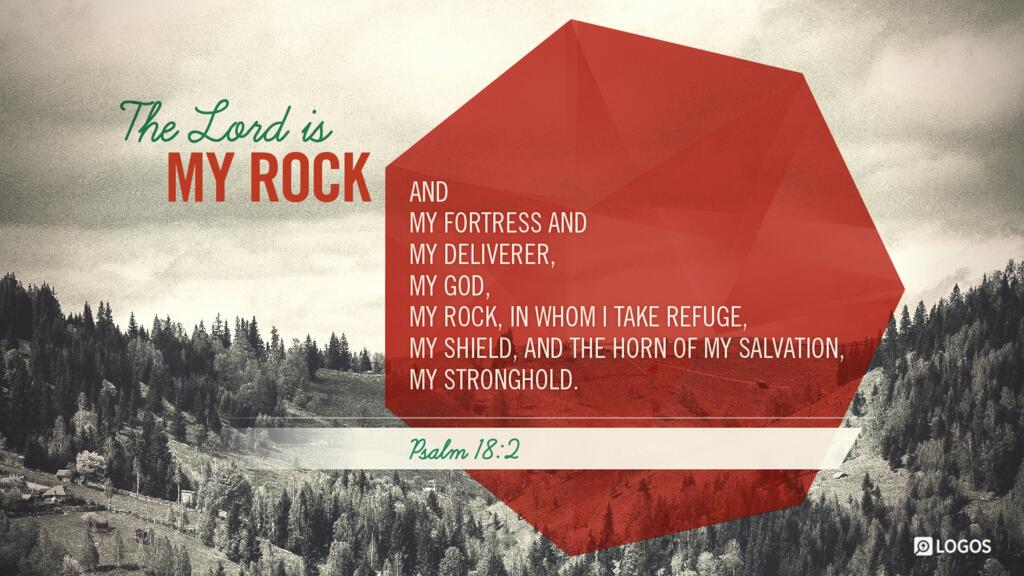
The Lord is my rock and my fortress and my deliverer,
my God, my rock, in whom I take refuge,
my shield, and the horn of my salvation, my stronghold.
Copyright 2001 Crossway Bibles
NIVNew International Version (2011)
For the director of music. Of David the servant of the Lord. He sang to the Lord the words of this song when the Lord delivered him from the hand of all his enemies and from the hand of Saul. He said:
I love you, Lord, my strength.
The Lord is my rock, my fortress and my deliverer;
my God is my rock, in whom I take refuge,
my shield and the horn of my salvation, my stronghold.
Copyright 1973, 1978, 1984, 2011 Biblica, Inc.
CSBChristian Standard Bible
For the choir director. Of the servant of the Lord, David, who spoke the words of this song to the Lord on the day the Lord rescued him from the grasp of all his enemies and from the power of Saul. He said:
I love you, Lord, my strength.
The Lord is my rock,
my fortress, and my deliverer,
my God, my rock where I seek refuge,
my shield and the horn of my salvation,
my stronghold.
Copyright 2017 Holman Bible Publishers
NLTNew Living Translation
For the choir director: A psalm of David, the servant of the Lord. He sang this song to the Lord on the day the Lord rescued him from all his enemies and from Saul. He sang:
I love you, Lord;
you are my strength.
The Lord is my rock, my fortress, and my savior;
my God is my rock, in whom I find protection.
He is my shield, the power that saves me,
and my place of safety.
Holy Bible, New Living Translation, copyright © 1996, 2004, 2015 by Tyndale House Foundation. Used by permission of Tyndale House Publishers. All rights reserved.
LEBThe Lexham English Bible
For the music director. Of David, the servant of Yahweh,
who spoke to Yahweh the words of this song
when Yahweh delivered him from the hand of all his enemies,
and from the hand of Saul.
And he said:
“I love you, O Yahweh, my strength.”
Yahweh is my rock and my fortress and my deliverer,
my God, my rock in whom I have taken refuge,
my shield and the horn of my deliverance, my stronghold.
Copyright 2012 Lexham Press
KJV 1900King James Version
To the chief Musician, A Psalm of David, the servant of the Lord, who spake unto the Lord the words of this song in the day that the Lord delivered him from the hand of all his enemies, and from the hand of Saul: And he said,
I will love thee, O Lord, my strength.
The Lord is my rock, and my fortress, and my deliverer;
My God, my strength, in whom I will trust;
My buckler, and the horn of my salvation, and my high tower.
Public Domain