Proverbs 8:13
The NET BibleOther versions
English
- NET The NET Bible
- DARBY 1890 Darby Bible
- ASV American Standard Version
- AV 1873 The Cambridge Paragraph Bible of the Authorized English Version
- CSB Christian Standard Bible
- D-R Douay-Rheims Bible
- ESV English Standard Version
- GW GOD’S WORD Translation
- GNB Good News Translation
- HCSB The Holman Christian Standard Bible
- KJV 1900 King James Version
- LSB Legacy Standard Bible
- LEB The Lexham English Bible
- MSG The Message: The Bible in Contemporary Language
- NASB95 New American Standard Bible (1995)
- NCV New Century Version
- NIrV New International Reader’s Version (1998)
- NIV New International Version (2011)
- NKJV The New King James Version
- NLT New Living Translation
- NRSVue New Revised Standard Version: Updated Edition
- RSV The Revised Standard Version
- RSVCE The Revised Standard Version, Catholic Edition
- TNIV Today’s New International Version
- YLT Young’s Literal Translation
Arabic
Czech
French
German
Hebrew
Hungarian
Italian
Korean
Latin
Portuguese
Russian
Simplified Chinese
Spanish
Traditional Chinese
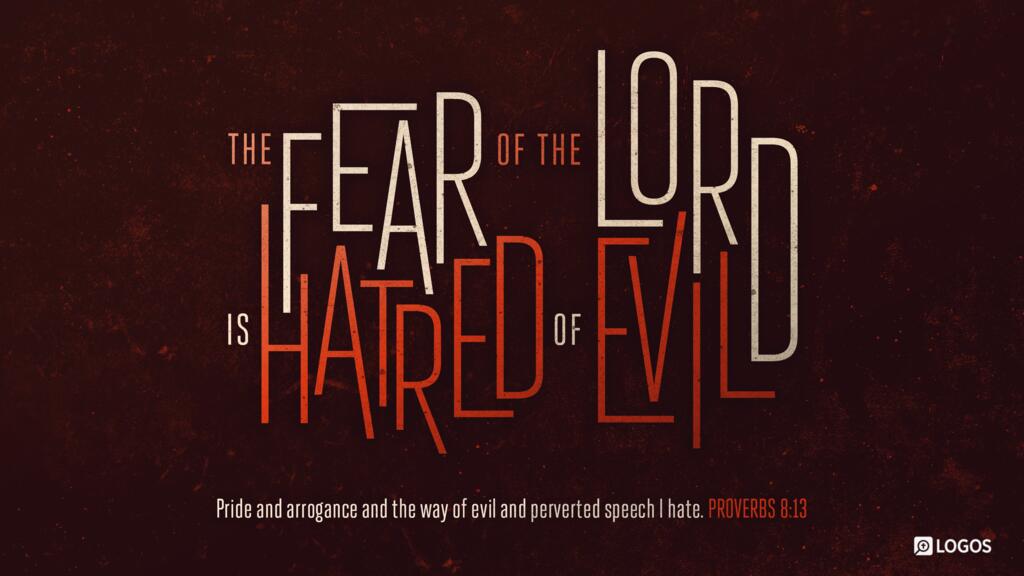
8:13The fear of the Lord is to hate24 evil;
I hate arrogant pride25 and the evil way
and perverse utterances.26
Footnotes
- 24 The verb שָׂנֵא (sane’) means “to hate.” In this sentence it functions nominally as the predicate. Fearing the Lord is hating evil. The verb translated “hate” has the basic idea of rejecting something spontaneously. For example, “Jacob have I loved, but Esau have I hated” (Mal 1:2b, 3a). It frequently has the idea of disliking or loathing (as English does), but almost always with an additional aspect of rejection. To “hate evil” is not only to dislike it, but to reject it and have nothing to do with it.
- 25 Since both גֵּאָה (ge’ah, “pride”) and גָּאוֹן (ga’on, “arrogance; pride”) are both from the same verbal root גָּאָה (ga’ah, “to rise up”), they should here be interpreted as one idea, forming a nominal hendiadys: “arrogant pride.”
- 26 Heb “and a mouth of perverse things.” The word “mouth” is a metonymy of cause for what is said; and the noun תַהְפֻּכוֹת (tahpukhot, “perverse things”) means destructive things (the related verb is used for the overthrowing of Sodom).
The NET Bible First Edition, Copyright 1996-2005 by Biblical Studies Press
In other versions
ESVEnglish Standard Version
The fear of the Lord is hatred of evil.
Pride and arrogance and the way of evil
and perverted speech I hate.
Copyright 2001 Crossway Bibles
NIVNew International Version (2011)
To fear the Lord is to hate evil;
I hate pride and arrogance,
evil behavior and perverse speech.
Copyright 1973, 1978, 1984, 2011 Biblica, Inc.
CSBChristian Standard Bible
To fear the Lord is to hate evil.
I hate arrogant pride, evil conduct,
and perverse speech.
Copyright 2017 Holman Bible Publishers
NLTNew Living Translation
All who fear the Lord will hate evil.
Therefore, I hate pride and arrogance,
corruption and perverse speech.
Holy Bible, New Living Translation, copyright © 1996, 2004, 2015 by Tyndale House Foundation. Used by permission of Tyndale House Publishers. All rights reserved.
LEBThe Lexham English Bible
The fear of Yahweh is hatred of evil,
pride, and arrogance and an evil way.
And I hate a mouth of perversity.
Copyright 2012 Lexham Press
KJV 1900King James Version
The fear of the Lord is to hate evil:
Pride, and arrogancy, and the evil way,
And the froward mouth, do I hate.
Public Domain