Proverbs 3:27–30
The NET BibleOther versions
English
- NET The NET Bible
- DARBY 1890 Darby Bible
- ASV American Standard Version
- AV 1873 The Cambridge Paragraph Bible of the Authorized English Version
- CSB Christian Standard Bible
- D-R Douay-Rheims Bible
- ESV English Standard Version
- GW GOD’S WORD Translation
- GNB Good News Translation
- HCSB The Holman Christian Standard Bible
- KJV 1900 King James Version
- LSB Legacy Standard Bible
- LEB The Lexham English Bible
- MSG The Message: The Bible in Contemporary Language
- NASB95 New American Standard Bible (1995)
- NCV New Century Version
- NIrV New International Reader’s Version (1998)
- NIV New International Version (2011)
- NKJV The New King James Version
- NLT New Living Translation
- NRSVue New Revised Standard Version: Updated Edition
- RSV The Revised Standard Version
- RSVCE The Revised Standard Version, Catholic Edition
- TNIV Today’s New International Version
- YLT Young’s Literal Translation
Arabic
Czech
French
German
Hebrew
Hungarian
Italian
Korean
Latin
Portuguese
Russian
Simplified Chinese
Spanish
Traditional Chinese
Wisdom Demonstrated in Relationships with People
3:27Do not withhold good from those who need it,82
when83 you84 have the ability85 to help.86
3:28Do not say to your neighbor, “Go! Return tomorrow
and I will give it,” when87 you have it with you at the time.88
3:29Do not plot89 evil against your neighbor
when90 he dwells by you unsuspectingly.
3:30Do not accuse91 anyone92 without legitimate cause,93
if he has not treated you wrongly.
Footnotes
- 82 The has “from its possessors” and the simply has “from the poor.” C. H. Toy (Proverbs [], ) suggests emending the text to read “neighbors” (changing בְּעָלָיו [be’alav] to רֵעֶיךָ, re’ekha) but that is gratuitous. The idea can be explained as being those who need to possess it, or as 127 בַּעַל has it with an objective genitive, “the owner of it” = the one to whom it is due.
- 83 The infinitive construct with preposition ב (bet) introduces a temporal clause: “when.…”
- 84 The form יָדֶיךָ (yadekha) is a Kethib/Qere reading. The Kethib is the dual יָדֶיךָ (“your hands”) and the Qere is the singular יָדְךָ (yadékha, “your hand”). Normally the Qere is preferred because it represents an alternate textual tradition that the Masoretes viewed as superior to the received text. Heb “your hand.” The term יָדְךָ (“your hand”) functions as a synecdoche of part (= your hand) for the whole person (= you).
- 85 Heb “it is to the power of your hand.” This expression is idiomatic for “it is in your power” or “you have the ability” (Gen 31:29; Deut 28:23; Neh 5:5; Mic 2:1). The noun אֵל (’el) means “power” ( 43 7), and יָד (yad, “hand”) is used figuratively to denote “ability” ( 390 2). Several translations render this as “when it is in your power to do it” (, , , ) or “when it is in your power to act” (). W. McKane suggests, “when it is in your power to confer it” (Proverbs [], 215).
- 86 Heb “to do [it]” (cf. , , ).
- 87 Heb “and it is with you.” The prefixed vav introduces a circumstantial clause: “when …”
- 88 The words “at the time” are not in the Hebrew text, but are supplied in the translation for clarity.
- 89 The verb חָרַשׁ (kharash) means “to cut in; to engrave; to plough; to devise.” The idea of plotting is metaphorical for working, practicing or fabricating ( 360 ).
- 90 The vav (ו) prefixed to the pronoun introduces a disjunctive circumstantial clause: “when.…”
- 91 The term רִיב (riv) can mean “quarrel” or “legal accusation” ( 936 ). Both ideas would work but the more technical legal accusation fits the context better. This is a warning to not bring legal accusations against anyone without a legitimate reason.
- 92 Heb “a man.”
- 93 Heb “gratuitously”; , “for no (+ good ) reason.” The adverb חִנָּם (khinam) means “without cause, undeservedly,” especially of groundless hostility ( 3; 336 c).
The NET Bible First Edition, Copyright 1996-2005 by Biblical Studies Press
In other versions
ESVEnglish Standard Version
Do not withhold good from those to whom it is due,
when it is in your power to do it.
Do not say to your neighbor, “Go, and come again,
tomorrow I will give it”—when you have it with you.
Do not plan evil against your neighbor,
who dwells trustingly beside you.
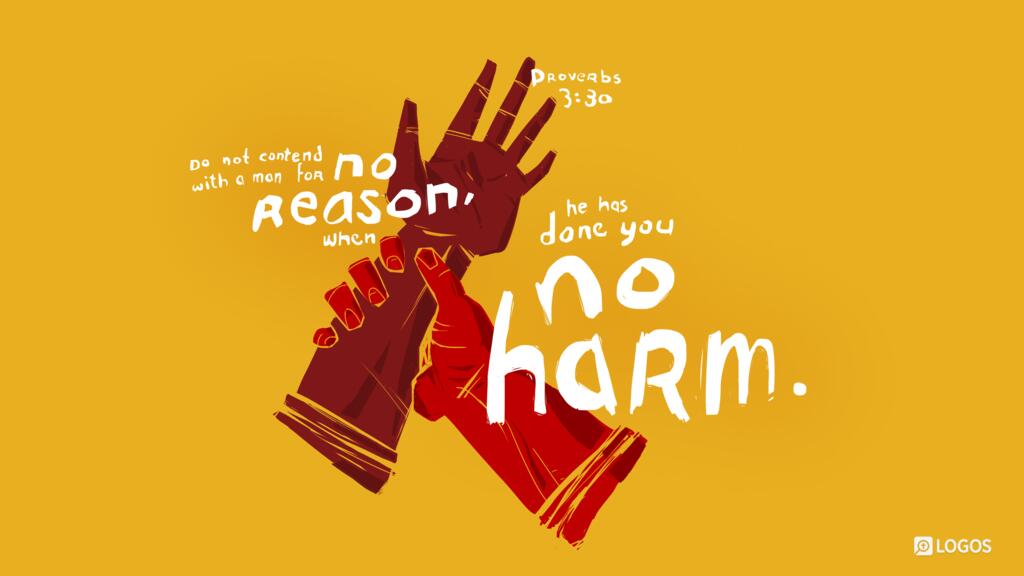
Do not contend with a man for no reason,
when he has done you no harm.
Copyright 2001 Crossway Bibles
NIVNew International Version (2011)
Do not withhold good from those to whom it is due,
when it is in your power to act.
Do not say to your neighbor,
“Come back tomorrow and I’ll give it to you”—
when you already have it with you.
Do not plot harm against your neighbor,
who lives trustfully near you.
Do not accuse anyone for no reason—
when they have done you no harm.
Copyright 1973, 1978, 1984, 2011 Biblica, Inc.
CSBChristian Standard Bible
When it is in your power,
don’t withhold good from the one to whom it belongs.
Don’t say to your neighbor, “Go away! Come back later.
I’ll give it tomorrow”—when it is there with you.
Don’t plan any harm against your neighbor,
for he trusts you and lives near you.
Don’t accuse anyone without cause,
when he has done you no harm.
Copyright 2017 Holman Bible Publishers
NLTNew Living Translation
Do not withhold good from those who deserve it
when it’s in your power to help them.
If you can help your neighbor now, don’t say,
“Come back tomorrow, and then I’ll help you.”
Don’t plot harm against your neighbor,
for those who live nearby trust you.
Don’t pick a fight without reason,
when no one has done you harm.
Holy Bible, New Living Translation, copyright © 1996, 2004, 2015 by Tyndale House Foundation. Used by permission of Tyndale House Publishers. All rights reserved.
LEBThe Lexham English Bible
Do not withhold good from its owner
when it is in the power of your hand to do.
Do not say to your neighbor,
“Go and return and tomorrow I will give it,”
when it is with you.
Do not plot harm against your neighbor
who dwells in confidence beside you.
Do not quarrel with anyone without cause,
when he did not do you harm.
Copyright 2012 Lexham Press
KJV 1900King James Version
Withhold not good from them to whom it is due,
When it is in the power of thine hand to do it.
Say not unto thy neighbour,
Go, and come again, and to morrow I will give;
When thou hast it by thee.
Devise not evil against thy neighbour,
Seeing he dwelleth securely by thee.
Strive not with a man without cause,
If he have done thee no harm.
Public Domain