Proverbs 1:8
The NET BibleOther versions
English
- NET The NET Bible
- DARBY 1890 Darby Bible
- ASV American Standard Version
- AV 1873 The Cambridge Paragraph Bible of the Authorized English Version
- CSB Christian Standard Bible
- D-R Douay-Rheims Bible
- ESV English Standard Version
- GW GOD’S WORD Translation
- GNB Good News Translation
- HCSB The Holman Christian Standard Bible
- KJV 1900 King James Version
- LSB Legacy Standard Bible
- LEB The Lexham English Bible
- MSG The Message: The Bible in Contemporary Language
- NASB95 New American Standard Bible (1995)
- NCV New Century Version
- NIrV New International Reader’s Version (1998)
- NIV New International Version (2011)
- NKJV The New King James Version
- NLT New Living Translation
- NRSVue New Revised Standard Version: Updated Edition
- RSV The Revised Standard Version
- RSVCE The Revised Standard Version, Catholic Edition
- TNIV Today’s New International Version
- YLT Young’s Literal Translation
Arabic
Czech
French
German
Hebrew
Hungarian
Italian
Korean
Latin
Portuguese
Russian
Simplified Chinese
Spanish
Traditional Chinese
Footnotes
- 45 The imperative שְׁמַע (shéma’, “Listen!”) forms an urgent exhortation which expects immediate compliance with parental instruction.
- 46 Heb “my son.” It is likely that collections of proverbs grew up in the royal courts and were designed for the training of the youthful prince. But once the collection was included in the canon, the term “son” would be expanded to mean a disciple, for all the people were to learn wisdom when young. It would not be limited to sons alone but would include daughters—as the expression “the children of (בְּנֵי, béne) Israel” (including males and females) clearly shows. Several passages in the and Talmud record instructions to teach daughters the Mosaic law so that they will be righteous and avoid sin as well. The translation “my child,” although not entirely satisfactory, will be used here.
- 47 Heb “training” or “discipline.” See note on .
- 48 Heb “of.” The noun אָבִיךָ (’avikha, “of your father”) may be classified as a genitive of source.
- 49 Heb “instruction.” In Proverbs the noun תּוֹרַה (torah) often means “instruction” or “moral direction” rather than “law” ( 435 1.a). It is related to יָרָה (yarah, “to point [or, show] the way” in the Hiphil ( 435). Instruction attempts to point a person in the right direction (e.g., Gen 46:28).
- 50 Heb “of.” The noun אִמֶּךָ (’immekha, “of your mother”) may be classified as a genitive of source.
The NET Bible First Edition, Copyright 1996-2005 by Biblical Studies Press
In other versions
ESVEnglish Standard Version
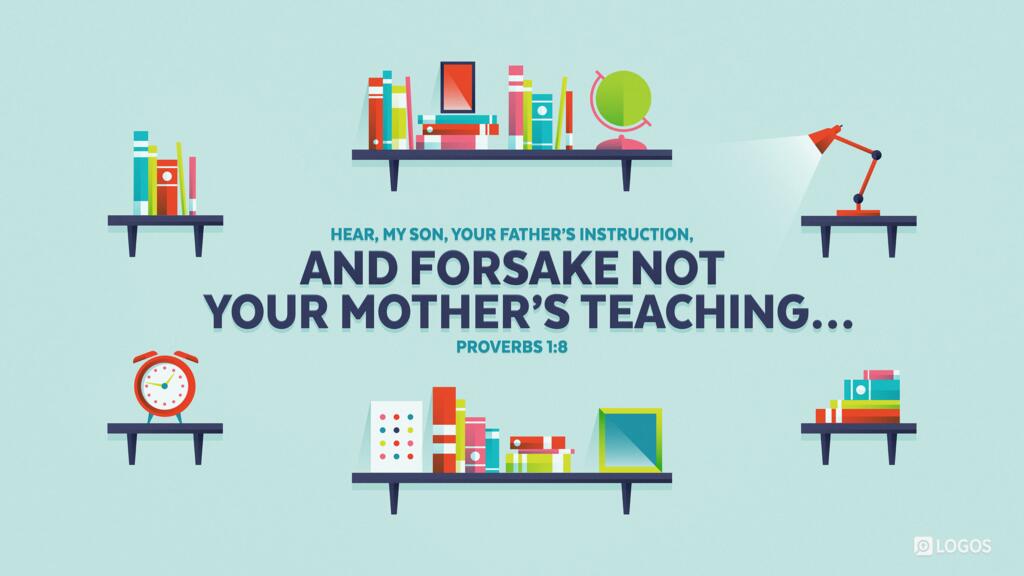
Hear, my son, your father’s instruction,
and forsake not your mother’s teaching,
Copyright 2001 Crossway Bibles
NIVNew International Version (2011)
Listen, my son, to your father’s instruction
and do not forsake your mother’s teaching.
Copyright 1973, 1978, 1984, 2011 Biblica, Inc.
CSBChristian Standard Bible
Listen, my son, to your father’s instruction,
and don’t reject your mother’s teaching,
Copyright 2017 Holman Bible Publishers
NLTNew Living Translation
My child, listen when your father corrects you.
Don’t neglect your mother’s instruction.
Holy Bible, New Living Translation, copyright © 1996, 2004, 2015 by Tyndale House Foundation. Used by permission of Tyndale House Publishers. All rights reserved.
LEBThe Lexham English Bible
My child, may you keep your father’s instruction,
and do not reject your mother’s teachings,
Copyright 2012 Lexham Press
KJV 1900King James Version
My son, hear the instruction of thy father,
And forsake not the law of thy mother:
Public Domain