Philippians 2:6–11
The NET BibleOther versions
English
- NET The NET Bible
- DARBY 1890 Darby Bible
- ASV American Standard Version
- AV 1873 The Cambridge Paragraph Bible of the Authorized English Version
- CSB Christian Standard Bible
- D-R Douay-Rheims Bible
- ESV English Standard Version
- GW GOD’S WORD Translation
- GNB Good News Translation
- HCSB The Holman Christian Standard Bible
- KJV 1900 King James Version
- LSB Legacy Standard Bible
- LEB The Lexham English Bible
- MSG The Message: The Bible in Contemporary Language
- NASB95 New American Standard Bible (1995)
- NCV New Century Version
- NIrV New International Reader’s Version (1998)
- NIV New International Version (2011)
- NKJV The New King James Version
- NLT New Living Translation
- NRSVue New Revised Standard Version: Updated Edition
- RSV The Revised Standard Version
- RSVCE The Revised Standard Version, Catholic Edition
- TNIV Today’s New International Version
- YLT Young’s Literal Translation
Arabic
Czech
French
German
Greek
Hungarian
Italian
Korean
Latin
Portuguese
Russian
Simplified Chinese
Spanish
Traditional Chinese
2:610 who though he existed in the form of God11
did not regard equality with God
as something to be grasped,
2:7but emptied himself
by taking on the form of a slave,12
by looking like other men,13
and by sharing in human nature.14
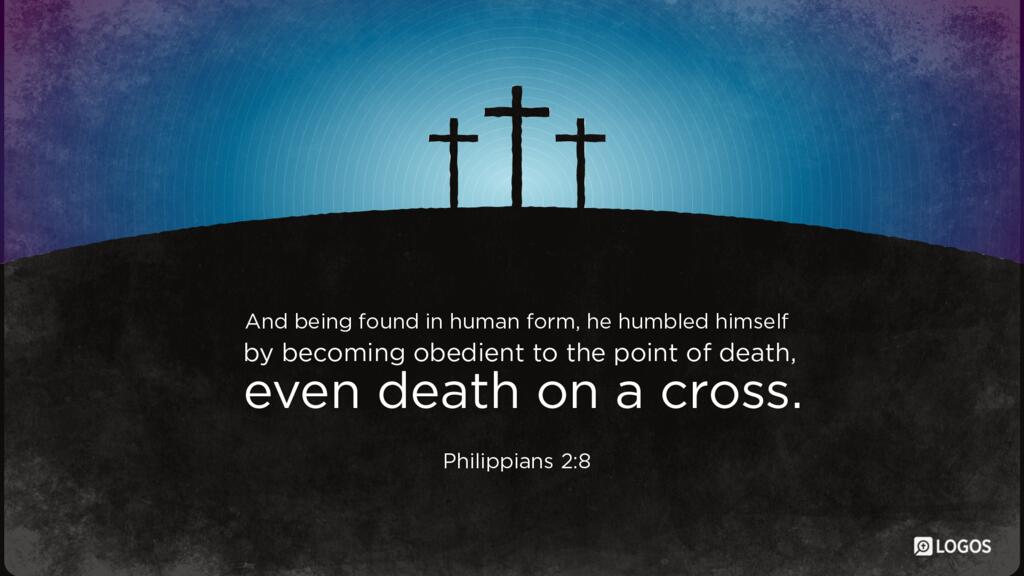
2:8He humbled himself,
by becoming obedient to the point of death
—even death on a cross!
2:9As a result God exalted him
and gave him the name
that is above every name,
2:10so that at the name of Jesus
every knee will bow
—in heaven and on earth and under the earth—
2:11and every tongue confess
that Jesus Christ is Lord
to the glory of God the Father.
Footnotes
- 10 This passage has been typeset as poetry because many scholars regard this passage as poetic or hymnic. These terms are used broadly to refer to the genre of writing, not to the content. There are two broad criteria for determining if a passage is poetic or hymnic: “(a) stylistic: a certain rhythmical lilt when the passages are read aloud, the presence of parallelismus membrorum (i.e., an arrangement into couplets), the semblance of some metre, and the presence of rhetorical devices such as alliteration, chiasmus, and antithesis; and (b) linguistic: an unusual vocabulary, particularly the presence of theological terms, which is different from the surrounding context” (P. T. O’Brien, Philippians [], ). Classifying a passage as hymnic or poetic is important because understanding this genre can provide keys to interpretation. However, not all scholars agree that the above criteria are present in this passage, so the decision to typeset it as poetry should be viewed as a tentative decision about its genre.
- 11 The Greek term translated form indicates a correspondence with reality. Thus the meaning of this phrase is that Christ was truly God.
- 12 See the note on the word “slaves” in .
- 13 Grk “by coming in the likeness of people.” The expression the likeness of men is similar to Paul’s wording in Rom 8:3 (“in the likeness of sinful flesh”). The same word “likeness” is used in both passages. It implies that there is a form that does not necessarily correspond to reality. In Rom 8:3, the meaning is that Christ looked like sinful humanity. Here the meaning is similar: Jesus looked like other men (note anthrōpoi), but was in fact different from them in that he did not have a sin nature.
- 14 Grk “and by being found in form as a man.” The versification of vv. 7 and 8 (so also ) is according to the versification in the and editions of the Greek text. Some translations, however, break the verses in front of this phrase (, , , ). The same material has been translated in each case; the only difference is the versification of that material. By sharing in human nature. This last line of v. 7 (line d) stands in tension with the previous line, line c (“by looking like other men”). Both lines have a word indicating form or likeness. Line c, as noted above, implies that Christ only appeared to be like other people. Line d, however, uses a different term that implies a correspondence between form and reality. Further, line c uses the plural “men” while line d uses the singular “man.” The theological point being made is that Christ looked just like other men, but he was not like other men (in that he was not sinful), though he was fully human.
The NET Bible First Edition, Copyright 1996-2005 by Biblical Studies Press
In other versions
ESVEnglish Standard Version
who, though he was in the form of God, did not count equality with God a thing to be grasped, but emptied himself, by taking the form of a servant, being born in the likeness of men. And being found in human form, he humbled himself by becoming obedient to the point of death, even death on a cross. Therefore God has highly exalted him and bestowed on him the name that is above every name, so that at the name of Jesus every knee should bow, in heaven and on earth and under the earth, and every tongue confess that Jesus Christ is Lord, to the glory of God the Father.
Copyright 2001 Crossway Bibles
NIVNew International Version (2011)
Who, being in very nature God,
did not consider equality with God something to be used to his own advantage;
rather, he made himself nothing
by taking the very nature of a servant,
being made in human likeness.
And being found in appearance as a man,
he humbled himself
by becoming obedient to death—
even death on a cross!
Therefore God exalted him to the highest place
and gave him the name that is above every name,
that at the name of Jesus every knee should bow,
in heaven and on earth and under the earth,
and every tongue acknowledge that Jesus Christ is Lord,
to the glory of God the Father.
Copyright 1973, 1978, 1984, 2011 Biblica, Inc.
CSBChristian Standard Bible
who, existing in the form of God,
did not consider equality with God
as something to be exploited.
Instead he emptied himself
by assuming the form of a servant,
taking on the likeness of humanity.
And when he had come as a man,
he humbled himself by becoming obedient
to the point of death—
even to death on a cross.
For this reason God highly exalted him
and gave him the name
that is above every name,
so that at the name of Jesus
every knee will bow—
in heaven and on earth
and under the earth—
and every tongue will confess
that Jesus Christ is Lord,
to the glory of God the Father.
Copyright 2017 Holman Bible Publishers
NLTNew Living Translation
Though he was God,
he did not think of equality with God
as something to cling to.
Instead, he gave up his divine privileges;
he took the humble position of a slave
and was born as a human being.
When he appeared in human form,
he humbled himself in obedience to God
and died a criminal’s death on a cross.
Therefore, God elevated him to the place of highest honor
and gave him the name above all other names,
that at the name of Jesus every knee should bow,
in heaven and on earth and under the earth,
and every tongue declare that Jesus Christ is Lord,
to the glory of God the Father.
Holy Bible, New Living Translation, copyright © 1996, 2004, 2015 by Tyndale House Foundation. Used by permission of Tyndale House Publishers. All rights reserved.
LEBThe Lexham English Bible
who, existing in the form of God,
did not consider being equal with God something to be grasped,
but emptied himself
by taking the form of a slave,
by becoming in the likeness of people.
And being found in appearance like a man,
he humbled himself
by becoming obedient to the point of death,
that is, death on a cross.
Therefore also God exalted him
and graciously granted him the name above every name,
so that at the name of Jesus
every knee should bow,
of those in heaven and of those on earth and of those under the earth,
and every tongue confess
that Jesus Christ is Lord,
to the glory of God the Father.
Copyright 2012 Lexham Press
KJV 1900King James Version
Who, being in the form of God, thought it not robbery to be equal with God: But made himself of no reputation, and took upon him the form of a servant, and was made in the likeness of men: And being found in fashion as a man, he humbled himself, and became obedient unto death, even the death of the cross. Wherefore God also hath highly exalted him, and given him a name which is above every name: That at the name of Jesus every knee should bow, of things in heaven, and things in earth, and things under the earth; And that every tongue should confess that Jesus Christ is Lord, to the glory of God the Father.
Public Domain