Micah 7:18b–19a
The NET BibleOther versions
English
- NET The NET Bible
- DARBY 1890 Darby Bible
- ASV American Standard Version
- AV 1873 The Cambridge Paragraph Bible of the Authorized English Version
- CSB Christian Standard Bible
- D-R Douay-Rheims Bible
- ESV English Standard Version
- GW GOD’S WORD Translation
- GNB Good News Translation
- HCSB The Holman Christian Standard Bible
- KJV 1900 King James Version
- LSB Legacy Standard Bible
- LEB The Lexham English Bible
- MSG The Message: The Bible in Contemporary Language
- NASB95 New American Standard Bible (1995)
- NCV New Century Version
- NIrV New International Reader’s Version (1998)
- NIV New International Version (2011)
- NKJV The New King James Version
- NLT New Living Translation
- NRSVue New Revised Standard Version: Updated Edition
- RSV The Revised Standard Version
- RSVCE The Revised Standard Version, Catholic Edition
- TNIV Today’s New International Version
- YLT Young’s Literal Translation
Arabic
Czech
French
German
Hebrew
Hungarian
Italian
Korean
Latin
Portuguese
Russian
Simplified Chinese
Spanish
Traditional Chinese
7:18There is no other God like you!52
You53 forgive sin
and pardon54 the rebellion
of those who remain among your people.55
You do not remain angry forever,56
but delight in showing loyal love.
7:19You will once again57 have mercy on us;
you will conquer58 our evil deeds;
Footnotes
- 52 Heb “Who is a God like you?” The rhetorical question expects the answer, “No one!”
- 53 Heb “one who.” The prayer moves from direct address (second person) in v. 18a to a descriptive (third person) style in vv. 18b–19a and then back to direct address (second person) in vv. 19b–20. Due to considerations of English style and the unfamiliarity of the modern reader with alternation of persons in Hebrew poetry, the entire section has been rendered as direct address (second person) in the translation.
- 54 Heb “pass over.”
- 55 Heb “of the remnant of his inheritance.”
- 56 Heb “he does not keep hold of his anger forever.”
- 57 The verb יָשׁוּב (yashuv, “he will return”) is here used adverbially in relation to the following verb, indicating that the Lord will again show mercy.
- 58 Some prefer to read יִכְבֹּס (yikhbos, “he will cleanse”; see כבס pi). If the is taken as it stands, sin is personified as an enemy that the Lord subdues.
- 59 Heb “their sins,” but the final mem (ם) may be enclitic rather than a pronominal suffix. In this case the suffix from the preceding line (“our”) may be understood as doing double duty.
- 60 In this metaphor the Lord disposes of Israel’s sins by throwing them into the waters of the sea (here symbolic of chaos).
The NET Bible First Edition, Copyright 1996-2005 by Biblical Studies Press
In other versions
ESVEnglish Standard Version
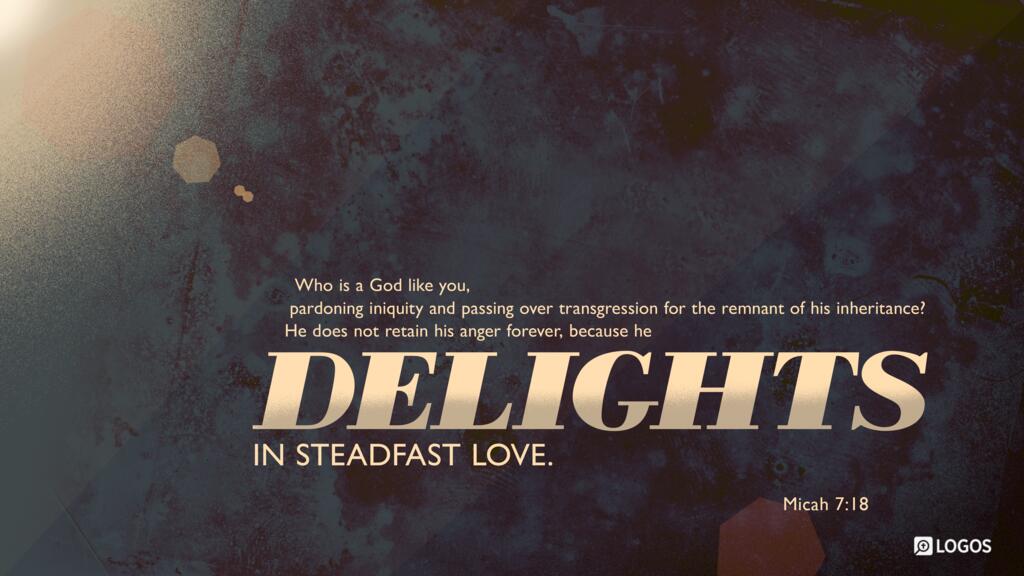
Who is a God like you, pardoning iniquity
and passing over transgression
for the remnant of his inheritance?
He does not retain his anger forever,
because he delights in steadfast love.
He will again have compassion on us;
he will tread our iniquities underfoot.
You will cast all our sins
into the depths of the sea.
Copyright 2001 Crossway Bibles
NIVNew International Version (2011)
Who is a God like you,
who pardons sin and forgives the transgression
of the remnant of his inheritance?
You do not stay angry forever
but delight to show mercy.
You will again have compassion on us;
you will tread our sins underfoot
and hurl all our iniquities into the depths of the sea.
Copyright 1973, 1978, 1984, 2011 Biblica, Inc.
CSBChristian Standard Bible
Who is a God like you,
forgiving iniquity and passing over rebellion
for the remnant of his inheritance?
He does not hold on to his anger forever
because he delights in faithful love.
He will again have compassion on us;
he will vanquish our iniquities.
You will cast all our sins
into the depths of the sea.
Copyright 2017 Holman Bible Publishers
NLTNew Living Translation
Where is another God like you,
who pardons the guilt of the remnant,
overlooking the sins of his special people?
You will not stay angry with your people forever,
because you delight in showing unfailing love.
Once again you will have compassion on us.
You will trample our sins under your feet
and throw them into the depths of the ocean!
Holy Bible, New Living Translation, copyright © 1996, 2004, 2015 by Tyndale House Foundation. Used by permission of Tyndale House Publishers. All rights reserved.
LEBThe Lexham English Bible
Who is a God like you, forgiving sin
and passing over rebellion for the remnant of his inheritance?
He does not retain his anger forever,
for he delights in loyal love.
He will again have compassion on us;
he will trample our iniquities.
And you will hurl all their sins
in the depths of the sea.
Copyright 2012 Lexham Press
KJV 1900King James Version
Who is a God like unto thee, that pardoneth iniquity,
And passeth by the transgression of the remnant of his heritage?
He retaineth not his anger for ever,
Because he delighteth in mercy.
He will turn again, he will have compassion upon us;
He will subdue our iniquities;
And thou wilt cast all their sins into the depths of the sea.
Public Domain