Matthew 9:9–13
The NET BibleOther versions
English
- NET The NET Bible
- DARBY 1890 Darby Bible
- ASV American Standard Version
- AV 1873 The Cambridge Paragraph Bible of the Authorized English Version
- CSB Christian Standard Bible
- D-R Douay-Rheims Bible
- ESV English Standard Version
- GW GOD’S WORD Translation
- GNB Good News Translation
- HCSB The Holman Christian Standard Bible
- KJV 1900 King James Version
- LSB Legacy Standard Bible
- LEB The Lexham English Bible
- MSG The Message: The Bible in Contemporary Language
- NASB95 New American Standard Bible (1995)
- NCV New Century Version
- NIrV New International Reader’s Version (1998)
- NIV New International Version (2011)
- NKJV The New King James Version
- NLT New Living Translation
- NRSVue New Revised Standard Version: Updated Edition
- RSV The Revised Standard Version
- RSVCE The Revised Standard Version, Catholic Edition
- TNIV Today’s New International Version
- YLT Young’s Literal Translation
Arabic
Czech
French
German
Greek
Hungarian
Italian
Korean
Latin
Portuguese
Russian
Simplified Chinese
Spanish
Traditional Chinese
The Call of Matthew; Eating with Sinners
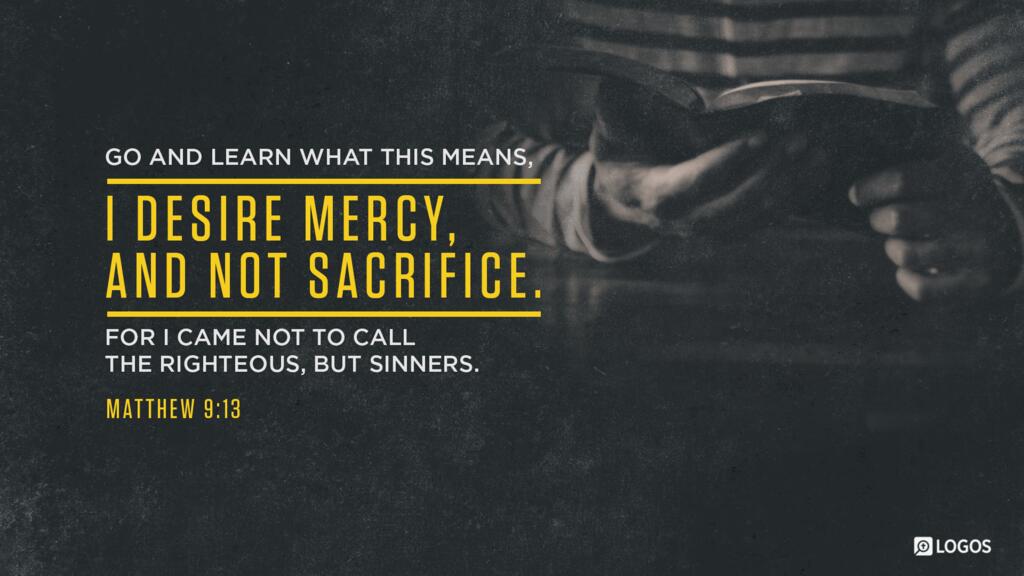
9:9As Jesus went on from there, he saw a man named Matthew sitting at the tax booth.19 “Follow me,” he said to him. And he got up and followed him. 9:10As20 Jesus21 was having a meal22 in Matthew’s23 house, many tax collectors24 and sinners came and ate with Jesus and his disciples. 9:11When the Pharisees25 saw this they said to his disciples, “Why does your teacher eat with tax collectors and sinners?”269:12When27 Jesus heard this he said, “Those who are healthy don’t need a physician, but those who are sick do.289:13Go and learn what this saying means: ‘I want mercy and not sacrifice.’29 For I did not come to call the righteous, but sinners.”
Footnotes
- 19 While “tax office” is sometimes given as a translation for τελώνιον (telōnion, so L&N 57.183), this could give the modern reader a false impression of an indoor office with all its associated furnishings. The tax booth was a booth located on the edge of a city or town to collect taxes for trade. There was a tax booth in Capernaum, which was on the trade route from Damascus to Galilee and the Mediterranean. The “taxes” were collected on produce and goods brought into the area for sale, and were a sort of “sales tax” paid by the seller but obviously passed on to the purchaser in the form of increased prices (L&N 57.183). It was here that Jesus met Matthew (also named Levi [see Mark 2:14, Luke 5:27]) who was ultimately employed by the Romans, though perhaps more directly responsible to Herod Antipas. It was his job to collect taxes for Rome and he was thus despised by Jews who undoubtedly regarded him as a traitor.
- 20 Grk “And it happened that while.” The introductory phrase καὶ ἐγένετο (kai egeneto, “it happened that”) is redundant in contemporary English and has not been translated.
- 21 Grk “he”; the referent (Jesus) has been supplied in the translation for clarity.
- 22 Grk “was reclining at table.” As Jesus was having a meal. 1st century middle eastern meals were not eaten while sitting at a table, but while reclining on one’s side on the floor with the head closest to the low table and the feet farthest away.
- 23 Grk “in the house.” The Greek article is used here in a context that implies possession, and the referent of the implied possessive pronoun (Matthew) has been specified in the translation for clarity.
- 24 See the note on tax collectors in .
- 25 See the note on Pharisees in .
- 26 The issue here is inappropriate associations. Jews were very careful about personal associations and contact as a matter of ritual cleanliness. Their question borders on an accusation that Jesus is ritually unclean.
- 27 Here δέ (de) has not been translated.
- 28 Jesus’ point is that he associates with those who are sick because they have the need and will respond to the offer of help. A person who is healthy (or who thinks mistakenly that he is) will not seek treatment.
- 29 A quotation from Hos 6:6 (see also Matt 12:7).
The NET Bible First Edition, Copyright 1996-2005 by Biblical Studies Press
In other versions
ESVEnglish Standard Version
As Jesus passed on from there, he saw a man called Matthew sitting at the tax booth, and he said to him, “Follow me.” And he rose and followed him.
And as Jesus reclined at table in the house, behold, many tax collectors and sinners came and were reclining with Jesus and his disciples. And when the Pharisees saw this, they said to his disciples, “Why does your teacher eat with tax collectors and sinners?” But when he heard it, he said, “Those who are well have no need of a physician, but those who are sick. Go and learn what this means: ‘I desire mercy, and not sacrifice.’ For I came not to call the righteous, but sinners.”
Copyright 2001 Crossway Bibles
NIVNew International Version (2011)
As Jesus went on from there, he saw a man named Matthew sitting at the tax collector’s booth. “Follow me,” he told him, and Matthew got up and followed him.
While Jesus was having dinner at Matthew’s house, many tax collectors and sinners came and ate with him and his disciples. When the Pharisees saw this, they asked his disciples, “Why does your teacher eat with tax collectors and sinners?”
On hearing this, Jesus said, “It is not the healthy who need a doctor, but the sick. But go and learn what this means: ‘I desire mercy, not sacrifice.’ For I have not come to call the righteous, but sinners.”
Copyright 1973, 1978, 1984, 2011 Biblica, Inc.
CSBChristian Standard Bible
As Jesus went on from there, he saw a man named Matthew sitting at the tax office, and he said to him, “Follow me,” and he got up and followed him.
While he was reclining at the table in the house, many tax collectors and sinners came to eat with Jesus and his disciples. When the Pharisees saw this, they asked his disciples, “Why does your teacher eat with tax collectors and sinners?”
Now when he heard this, he said, “It is not those who are well who need a doctor, but those who are sick. Go and learn what this means: I desire mercy and not sacrifice. For I didn’t come to call the righteous, but sinners.”
Copyright 2017 Holman Bible Publishers
NLTNew Living Translation
As Jesus was walking along, he saw a man named Matthew sitting at his tax collector’s booth. “Follow me and be my disciple,” Jesus said to him. So Matthew got up and followed him.
Later, Matthew invited Jesus and his disciples to his home as dinner guests, along with many tax collectors and other disreputable sinners. But when the Pharisees saw this, they asked his disciples, “Why does your teacher eat with such scum?”
When Jesus heard this, he said, “Healthy people don’t need a doctor—sick people do.” Then he added, “Now go and learn the meaning of this Scripture: ‘I want you to show mercy, not offer sacrifices.’ For I have come to call not those who think they are righteous, but those who know they are sinners.”
Holy Bible, New Living Translation, copyright © 1996, 2004, 2015 by Tyndale House Foundation. Used by permission of Tyndale House Publishers. All rights reserved.
LEBThe Lexham English Bible
And as Jesus was going away from there, he saw a man called Matthew sitting at the tax booth and said to him, “Follow me!” And he stood up and followed him.
And it happened as he was dining in the house, behold, many tax collectors and sinners were coming and dining with Jesus and his disciples. And when they saw it, the Pharisees began to say to his disciples, “Why does your teacher eat with tax collectors and sinners?” And when he heard it, he said, “Those who are healthy do not have need of a physician, but those who are sick. But go and learn what it means, “I want mercy and not sacrifice.” For I did not come to call the righteous, but sinners.”
Copyright 2012 Lexham Press
KJV 1900King James Version
And as Jesus passed forth from thence, he saw a man, named Matthew, sitting at the receipt of custom: and he saith unto him, Follow me. And he arose, and followed him. And it came to pass, as Jesus sat at meat in the house, behold, many publicans and sinners came and sat down with him and his disciples. And when the Pharisees saw it, they said unto his disciples, Why eateth your Master with publicans and sinners? But when Jesus heard that, he said unto them, They that be whole need not a physician, but they that are sick. But go ye and learn what that meaneth, I will have mercy, and not sacrifice: for I am not come to call the righteous, but sinners to repentance.
Public Domain