Matthew 6:25–34
The NET BibleOther versions
English
- NET The NET Bible
- DARBY 1890 Darby Bible
- ASV American Standard Version
- AV 1873 The Cambridge Paragraph Bible of the Authorized English Version
- CSB Christian Standard Bible
- D-R Douay-Rheims Bible
- ESV English Standard Version
- GW GOD’S WORD Translation
- GNB Good News Translation
- HCSB The Holman Christian Standard Bible
- KJV 1900 King James Version
- LSB Legacy Standard Bible
- LEB The Lexham English Bible
- MSG The Message: The Bible in Contemporary Language
- NASB95 New American Standard Bible (1995)
- NCV New Century Version
- NIrV New International Reader’s Version (1998)
- NIV New International Version (2011)
- NKJV The New King James Version
- NLT New Living Translation
- NRSVue New Revised Standard Version: Updated Edition
- RSV The Revised Standard Version
- RSVCE The Revised Standard Version, Catholic Edition
- TNIV Today’s New International Version
- YLT Young’s Literal Translation
Arabic
Czech
French
German
Greek
Hungarian
Italian
Korean
Latin
Portuguese
Russian
Simplified Chinese
Spanish
Traditional Chinese
Do Not Worry
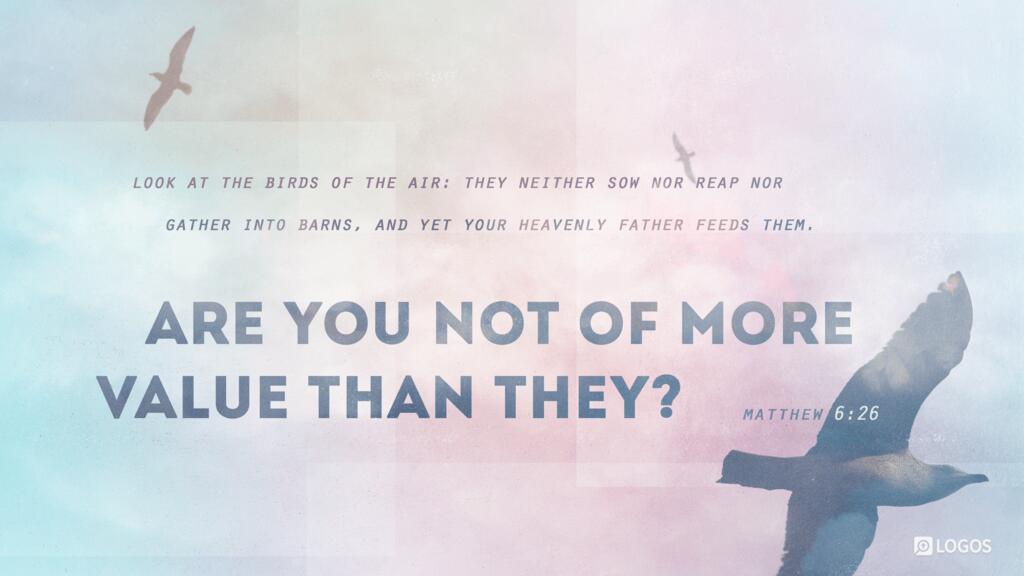
6:25“Therefore I tell you, do not worry33 about your life, what you will eat or drink, or about your body, what you will wear. Isn’t there more to life than food and more to the body than clothing? 6:26Look at the birds in the sky:34 They do not sow, or reap, or gather into barns, yet your heavenly Father feeds35 them. Aren’t you more valuable36 than they are? 6:27And which of you by worrying can add even one hour to his life?376:28Why do you worry about clothing? Think about how the flowers38 of the field grow; they do not work39 or spin. 6:29Yet I tell you that not even Solomon in all his glory was clothed like one of these! 6:30And if this is how God clothes the wild grass,40 which is here today and tomorrow is tossed into the fire to heat the oven,41 won’t he clothe you even more,42 you people of little faith? 6:31So then, don’t worry saying, ‘What will we eat?’ or ‘What will we drink?’ or ‘What will we wear?’ 6:32For the unconverted43 pursue these things, and your heavenly Father knows that you need them. 6:33But above all pursue his kingdom44 and righteousness, and all these things will be given to you as well. 6:34So then, do not worry about tomorrow, for tomorrow will worry about itself. Today has enough trouble of its own.45
Footnotes
- 33 Or “do not be anxious,” and so throughout the rest of this paragraph.
- 34 Grk “the birds of the sky” or “the birds of the heaven”; the Greek word οὐρανός (ouranos) may be translated either “sky” or “heaven,” depending on the context. The idiomatic expression “birds of the sky” refers to wild birds as opposed to domesticated fowl (cf. πετεινόν).
- 35 Or “God gives them food to eat.” L&N 23.6 has both “to provide food for” and “to give food to someone to eat.”
- 36 Grk “of more value.”
- 37 Or “a cubit to his height.” A cubit (πῆχυς, pēchus) can measure length (normally about 45 cm or 18 inches) or time (a small unit, “hour” is usually used [ ] although “day” has been suggested [L&N 67.151]). The term ἡλικία (hēlikia) is ambiguous in the same way as πῆχυς (pēchus). Most scholars take the term to describe age or length of life here, although a few refer it to bodily stature (see 3 for discussion). Worry about length of life seems a more natural figure than worry about height. However, the point either way is clear: Worrying adds nothing to life span or height.
- 38 Traditionally, “lilies.” According to L&N 3.32, “Though traditionally κρίνον has been regarded as a type of lily, scholars have suggested several other possible types of flowers, including an anemone, a poppy, a gladiolus, and a rather inconspicuous type of daisy.” In view of the uncertainty, the more generic “flowers” has been used in the translation.
- 39 Or, traditionally, “toil.” Although it might be argued that “work hard” would be a more precise translation of κοπιάω (kopiaō) here, the line in English reads better in terms of cadence with a single syllable.
- 40 Grk “grass of the field.”
- 41 Grk “into the oven.” The expanded translation “into the fire to heat the oven” has been used to avoid misunderstanding; most items put into modern ovens are put there to be baked, not burned. The oven was most likely a rounded clay oven used for baking bread, which was heated by burning wood and dried grass.
- 42 The phrase even more is a typical form of rabbinic argumentation, from the lesser to the greater. If God cares for the little things, surely he will care for the more important things.
- 43 Or “unbelievers”; Grk “Gentiles.”
- 44 Most (L W Θ 0233 f1, 13 33 𝔐 lat sy mae) read τὴν βασιλείαν τοῦ θεοῦ καὶ τὴν δικαιοσύνην αὐτοῦ (tēn basileian tou theou kai tēn dikaiosunēn aujtou, “the kingdom of God and his righteousness”) here, but the words “of God” are lacking in א B sa bo Eus. On the one hand, there is the possibility of accidental omission on the part of these Alexandrian witnesses, but it seems unlikely that the scribe’s eye would skip over both words (especially since τοῦ θεοῦ is bracketed by first declension nouns). Intrinsically, the author generally has a genitive modifier with βασιλεία—especially θεοῦ or οὐρανῶν (ouranōn)—but this argument cuts both ways: Although he might be expected to use such an adjunct here, scribes might also be familiar with his practice and would thus naturally insert it if it were missing in their copy of Matthew. Although a decision is difficult, the omission of τοῦ θεοῦ is considered most likely to be original. includes the words in brackets, indicating doubt as to their authenticity. God’s kingdom is a major theme of Jesus. It is a realm in which Jesus rules and to which those who trust him belong.
- 45 Grk “Sufficient for the day is its evil.”
The NET Bible First Edition, Copyright 1996-2005 by Biblical Studies Press