Matthew 5:13
The NET BibleOther versions
English
- NET The NET Bible
- DARBY 1890 Darby Bible
- ASV American Standard Version
- AV 1873 The Cambridge Paragraph Bible of the Authorized English Version
- CSB Christian Standard Bible
- D-R Douay-Rheims Bible
- ESV English Standard Version
- GW GOD’S WORD Translation
- GNB Good News Translation
- HCSB The Holman Christian Standard Bible
- KJV 1900 King James Version
- LSB Legacy Standard Bible
- LEB The Lexham English Bible
- MSG The Message: The Bible in Contemporary Language
- NASB95 New American Standard Bible (1995)
- NCV New Century Version
- NIrV New International Reader’s Version (1998)
- NIV New International Version (2011)
- NKJV The New King James Version
- NLT New Living Translation
- NRSVue New Revised Standard Version: Updated Edition
- RSV The Revised Standard Version
- RSVCE The Revised Standard Version, Catholic Edition
- TNIV Today’s New International Version
- YLT Young’s Literal Translation
Arabic
Czech
French
German
Greek
Hungarian
Italian
Korean
Latin
Portuguese
Russian
Simplified Chinese
Spanish
Traditional Chinese
Salt and Light
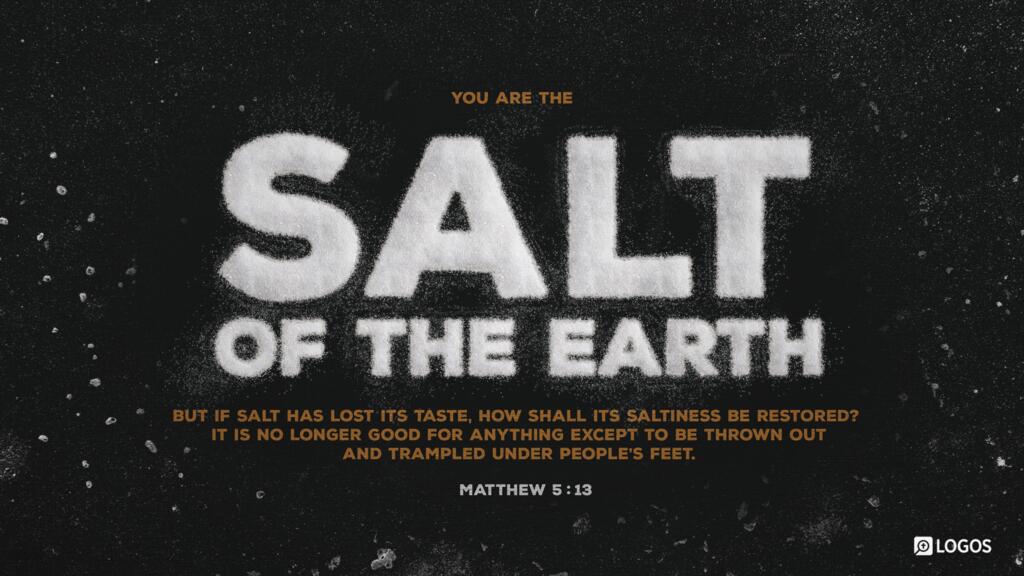
5:13“You are the salt13 of the earth. But if salt loses its flavor,14 how can it be made salty again? It is no longer good for anything except to be thrown out and trampled on by people.
Footnotes
- 13 Salt was used as seasoning or fertilizer ( ἅλας a), or as a preservative. If salt ceased to be useful, it was thrown away. With this illustration Jesus warned about a disciple who ceased to follow him.
- 14 The difficulty of this saying is understanding how salt could lose its flavor since its chemical properties cannot change. It is thus often assumed that Jesus was referring to chemically impure salt, perhaps a natural salt which, when exposed to the elements, had all the genuine salt leached out, leaving only the sediment or impurities behind. Others have suggested that the background of the saying is the use of salt blocks by Arab bakers to line the floor of their ovens; under the intense heat these blocks would eventually crystallize and undergo a change in chemical composition, finally being thrown out as unserviceable. A saying in the Talmud (b. Bekhorot 8b) attributed to R. Joshua ben Chananja ( a.d. 90), when asked the question “When salt loses its flavor, how can it be made salty again?” is said to have replied, “By salting it with the afterbirth of a mule.” He was then asked, “Then does the mule (being sterile) bear young?” to which he replied: “Can salt lose its flavor?” The point appears to be that both are impossible. The saying, while admittedly late, suggests that culturally the loss of flavor by salt was regarded as an impossibility. Genuine salt can never lose its flavor. In this case the saying by Jesus here may be similar to Matt 19:24, where it is likewise impossible for the camel to go through the eye of a sewing needle.
The NET Bible First Edition, Copyright 1996-2005 by Biblical Studies Press
In other versions
ESVEnglish Standard Version
“You are the salt of the earth, but if salt has lost its taste, how shall its saltiness be restored? It is no longer good for anything except to be thrown out and trampled under people’s feet.
Copyright 2001 Crossway Bibles
NIVNew International Version (2011)
“You are the salt of the earth. But if the salt loses its saltiness, how can it be made salty again? It is no longer good for anything, except to be thrown out and trampled underfoot.
Copyright 1973, 1978, 1984, 2011 Biblica, Inc.
CSBChristian Standard Bible
“You are the salt of the earth. But if the salt should lose its taste, how can it be made salty? It’s no longer good for anything but to be thrown out and trampled under people’s feet.
Copyright 2017 Holman Bible Publishers
NLTNew Living Translation
“You are the salt of the earth. But what good is salt if it has lost its flavor? Can you make it salty again? It will be thrown out and trampled underfoot as worthless.
Holy Bible, New Living Translation, copyright © 1996, 2004, 2015 by Tyndale House Foundation. Used by permission of Tyndale House Publishers. All rights reserved.
LEBThe Lexham English Bible
“You are the salt of the earth. But if salt becomes tasteless, by what will it be made salty? It is good for nothing any longer except to be thrown outside and trampled under foot by people.
Copyright 2012 Lexham Press
KJV 1900King James Version
Ye are the salt of the earth: but if the salt have lost his savour, wherewith shall it be salted? it is thenceforth good for nothing, but to be cast out, and to be trodden under foot of men.
Public Domain