Matthew 21:9
The NET BibleOther versions
English
- NET The NET Bible
- DARBY 1890 Darby Bible
- ASV American Standard Version
- AV 1873 The Cambridge Paragraph Bible of the Authorized English Version
- CSB Christian Standard Bible
- D-R Douay-Rheims Bible
- ESV English Standard Version
- GW GOD’S WORD Translation
- GNB Good News Translation
- HCSB The Holman Christian Standard Bible
- KJV 1900 King James Version
- LSB Legacy Standard Bible
- LEB The Lexham English Bible
- MSG The Message: The Bible in Contemporary Language
- NASB95 New American Standard Bible (1995)
- NCV New Century Version
- NIrV New International Reader’s Version (1998)
- NIV New International Version (2011)
- NKJV The New King James Version
- NLT New Living Translation
- NRSVue New Revised Standard Version: Updated Edition
- RSV The Revised Standard Version
- RSVCE The Revised Standard Version, Catholic Edition
- TNIV Today’s New International Version
- YLT Young’s Literal Translation
Arabic
Czech
French
German
Greek
Hungarian
Italian
Korean
Latin
Portuguese
Russian
Simplified Chinese
Spanish
Traditional Chinese
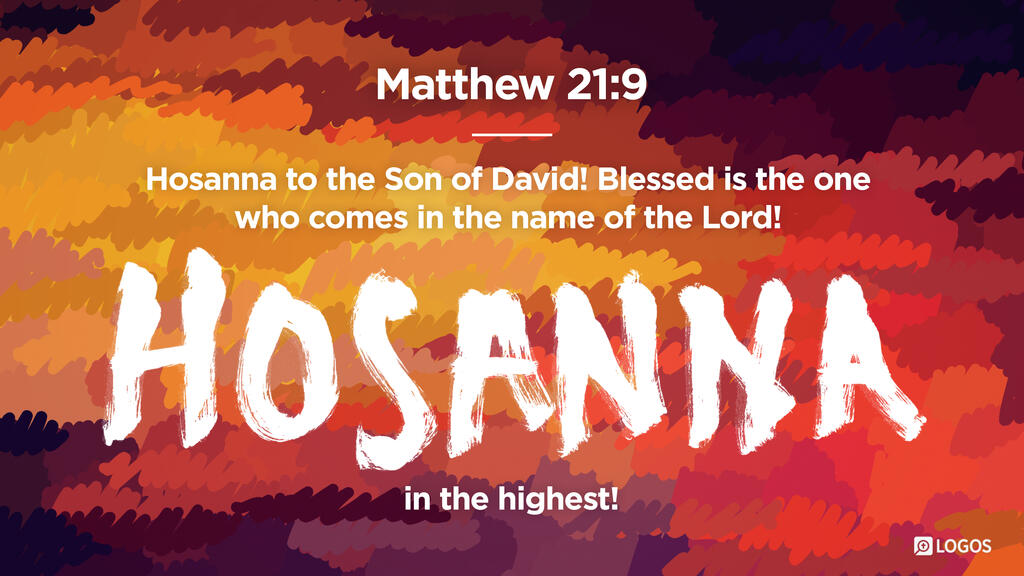
21:9The crowds that went ahead of him and those following kept shouting,14 “Hosanna15 to the Son of David! Blessed is the one who comes in the name of the Lord!16 Hosanna in the highest!”
Footnotes
- 14 Grk “were shouting, saying.” The participle λέγοντας (legontas) is redundant here in contemporary English and has not been translated.
- 15 The expression Ὡσαννά (hōsanna, literally in Hebrew, “O Lord, save”) in the quotation from Ps 118:25–26 was probably by this time a familiar liturgical expression of praise, on the order of “Hail to the king,” although both the underlying Aramaic and Hebrew expressions meant “O Lord, save us.” In words familiar to every Jew, the author is indicating that at this point every messianic expectation is now at the point of realization. It is clear from the words of the psalm shouted by the crowd that Jesus is being proclaimed as messianic king. See E. Lohse, 9:682–84. Hosanna is an Aramaic expression that literally means, “help, I pray,” or “save, I pray.” By Jesus’ time it had become a strictly liturgical formula of praise, however, and was used as an exclamation of praise to God.
- 16 A quotation from Ps 118:25–26.
The NET Bible First Edition, Copyright 1996-2005 by Biblical Studies Press
In other versions
ESVEnglish Standard Version
And the crowds that went before him and that followed him were shouting, “Hosanna to the Son of David! Blessed is he who comes in the name of the Lord! Hosanna in the highest!”
Copyright 2001 Crossway Bibles
NIVNew International Version (2011)
The crowds that went ahead of him and those that followed shouted,
“Hosanna to the Son of David!”
“Blessed is he who comes in the name of the Lord!”
“Hosanna in the highest heaven!”
Copyright 1973, 1978, 1984, 2011 Biblica, Inc.
CSBChristian Standard Bible
Then the crowds who went ahead of him and those who followed shouted:
Hosanna to the Son of David!
Blessed is he who comes in the name
of the Lord!
Hosanna in the highest heaven!
Copyright 2017 Holman Bible Publishers
NLTNew Living Translation
Jesus was in the center of the procession, and the people all around him were shouting,
“Praise God for the Son of David!
Blessings on the one who comes in the name of the Lord!
Praise God in highest heaven!”
Holy Bible, New Living Translation, copyright © 1996, 2004, 2015 by Tyndale House Foundation. Used by permission of Tyndale House Publishers. All rights reserved.
LEBThe Lexham English Bible
And the crowds who went ahead of him and the ones who followed were shouting, saying,
“Hosanna to the Son of David!
Blessed is the one who comes in the name of the Lord!
Hosanna in the highest heaven!”
Copyright 2012 Lexham Press
KJV 1900King James Version
And the multitudes that went before, and that followed, cried, saying, Hosanna to the Son of David: Blessed is he that cometh in the name of the Lord; Hosanna in the highest.
Public Domain