Luke 4:14–19
The NET BibleOther versions
English
- NET The NET Bible
- DARBY 1890 Darby Bible
- ASV American Standard Version
- AV 1873 The Cambridge Paragraph Bible of the Authorized English Version
- CSB Christian Standard Bible
- D-R Douay-Rheims Bible
- ESV English Standard Version
- GW GOD’S WORD Translation
- GNB Good News Translation
- HCSB The Holman Christian Standard Bible
- KJV 1900 King James Version
- LSB Legacy Standard Bible
- LEB The Lexham English Bible
- MSG The Message: The Bible in Contemporary Language
- NASB95 New American Standard Bible (1995)
- NCV New Century Version
- NIrV New International Reader’s Version (1998)
- NIV New International Version (2011)
- NKJV The New King James Version
- NLT New Living Translation
- NRSVue New Revised Standard Version: Updated Edition
- RSV The Revised Standard Version
- RSVCE The Revised Standard Version, Catholic Edition
- TNIV Today’s New International Version
- YLT Young’s Literal Translation
Arabic
Czech
French
German
Greek
Hungarian
Italian
Korean
Latin
Portuguese
Russian
Simplified Chinese
Spanish
Traditional Chinese
The Beginning of Jesus’ Ministry in Galilee
4:14Then45 Jesus, in the power of the Spirit,46 returned to Galilee, and news about him spread47 throughout the surrounding countryside.484:15He49 began to teach50 in their synagogues51 and was praised52 by all.
Rejection at Nazareth
4:16Now53 Jesus54 came to Nazareth,55 where he had been brought up, and went into the synagogue56 on the Sabbath day, as was his custom.57 He58 stood up to read,594:17and the scroll of the prophet Isaiah was given to him. He60 unrolled61 the scroll and found the place where it was written,
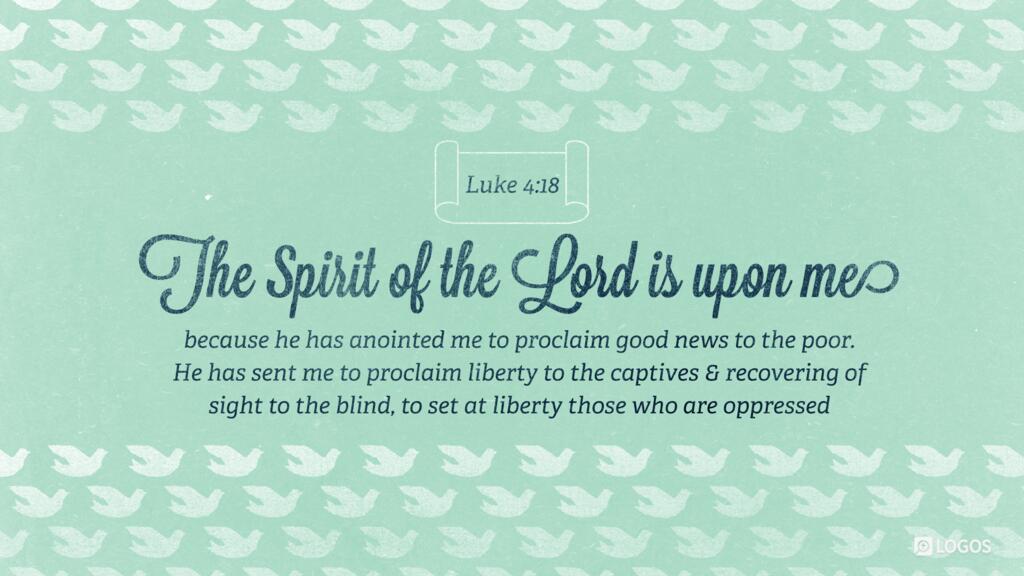
4:18“The Spirit of the Lord is upon me,
because he has anointed62 me to proclaim good news63 to the poor.64
He has sent me65 to proclaim release66 to the captives
and the regaining of sight67 to the blind,
Footnotes
- 45 Here καί (kai) has been translated as “then” to indicate the implied sequence of events within the narrative.
- 46 Once again Jesus is directed by the Spirit. Luke makes a point about Jesus’ association with the Spirit early in his ministry (3:22, 4:1 [2×]; 4:18).
- 47 Grk “went out.”
- 48 Grk “all the surrounding region.”
- 49 Grk “And he.” Here καί (kai) has not been translated because of differences between Greek and English style.
- 50 The imperfect verb has been translated ingressively.
- 51 The next incident in Luke 4:16–30 is probably to be seen as an example of this ministry of teaching in their synagogues in Galilee. Synagogues were places for Jewish prayer and worship, with recognized leadership (cf. Luke 8:41). Though the origin of the synagogue is not entirely clear, it seems to have arisen in the postexilic community during the intertestamental period. A town could establish a synagogue if there were at least ten men. In normative Judaism of the NT period, the OT scripture was read and discussed in the synagogue by the men who were present (see the , Megillah 3–4; Berakhot 2).
- 52 Grk “being glorified.” The participle δοξαζόμενος (doxazomenos) has been translated as a finite verb due to requirements of contemporary English style. This is the only place Luke uses the verb δοξάζω (doxazō) of Jesus.
- 53 Here καί (kai) has been translated as “now” to indicate the transition to a new topic.
- 54 Grk “he”; the referent (Jesus) has been specified in the translation for clarity.
- 55 Nazareth was Jesus’ hometown (which is why he is known as Jesus of Nazareth) about 20 miles (30 km) southwest from Capernaum. For location see ; ; ; ; .
- 56 See the note on synagogues in .
- 57 Grk “according to his custom.”
- 58 Grk “And he.” Here καί (kai) has not been translated because of differences between Greek and English style.
- 59 In normative Judaism of the period, the OT scripture was read and discussed in the synagogue by the men who were present. See the , Megillah 3–4; Berakhot 2. First came the law, then the prophets, then someone was asked to speak on the texts. Normally one stood up to read out of respect for the scriptures, and then sat down (v. 20) to expound them.
- 60 Grk “And unrolling the scroll he found.” Here καί (kai) has not been translated because of differences between Greek and English style. Instead a new sentence has been started in the translation.
- 61 Grk “opening,” but a scroll of this period would have to be unrolled. The participle ἀναπτύξας (anaptuxas) has been translated as a finite verb due to the requirements of contemporary English style.
- 62 The phrase he has anointed me is an allusion back to Jesus’ baptism in Luke 3:21–22.
- 63 Grk “to evangelize,” “to preach the gospel.”
- 64 The poor is a key term in Luke. It refers to the pious poor and indicates Jesus’ desire to reach out to those the world tends to forget or mistreat. It is like 1:52 in force and also will be echoed in 6:20 (also 1 Pet 2:11–25). Jesus is commissioned to do this.
- 65 The majority of , especially the later Byzantines, include the phrase “to heal the brokenhearted” at this point (A Θ Ψ 0102 f1 𝔐). The phrase is lacking in several weighty (א B D L W Ξ f13 33 579 700 892* lat sys co), including representatives from both the Alexandrian and Western texttypes. From the standpoint of external evidence, the omission of the phrase is more likely original. When internal evidence is considered, the shorter reading becomes almost certain. Scribes would be much more prone to add the phrase here to align the text with Isa 61:1, the source of the quotation, than to remove it from the original.
- 66 The release in view here is comprehensive, both at a physical level and a spiritual one, as the entire ministry of Jesus makes clear (Luke 1:77–79; 7:47; 24:47; Acts 2:38; 5:31; 10:43).
- 67 Again, as with the previous phrase, regaining of sight may well mean more than simply miraculously restoring physical sight, which itself pictures a deeper reality (Luke 1:77–79; 18:35–43).
- 68 The essence of Jesus’ messianic work is expressed in the phrase to set free. This line from Isa 58 says that Jesus will do what the nation had failed to do. It makes the proclamation messianic, not merely prophetic, because Jesus doesn’t just proclaim the message—he brings the deliverance. The word translated set free is the same Greek word (ἄφεσις, aphesis) translated release earlier in the verse.
- 69 Again, as with the previous phrases, oppressed may well mean more than simply political or economic oppression, but a deeper reality of oppression by sin (Luke 1:77–79; 18:35–43).
- 70 The year of the Lord’s favor (Grk “the acceptable year of the Lord”) is a description of the year of Jubilee (Lev 25:10). The year of the total forgiveness of debt is now turned into a metaphor for salvation. Jesus had come to proclaim that God was ready to forgive sin totally.
- 71 A quotation from Isa 61:1–2a. Within the citation is a line from Isa 58:6, with its reference to setting the oppressed free.
The NET Bible First Edition, Copyright 1996-2005 by Biblical Studies Press
In other versions
ESVEnglish Standard Version
And Jesus returned in the power of the Spirit to Galilee, and a report about him went out through all the surrounding country. And he taught in their synagogues, being glorified by all.
And he came to Nazareth, where he had been brought up. And as was his custom, he went to the synagogue on the Sabbath day, and he stood up to read. And the scroll of the prophet Isaiah was given to him. He unrolled the scroll and found the place where it was written,
“The Spirit of the Lord is upon me,
because he has anointed me
to proclaim good news to the poor.
He has sent me to proclaim liberty to the captives
and recovering of sight to the blind,
to set at liberty those who are oppressed,
to proclaim the year of the Lord’s favor.”
Copyright 2001 Crossway Bibles
NIVNew International Version (2011)
Jesus returned to Galilee in the power of the Spirit, and news about him spread through the whole countryside. He was teaching in their synagogues, and everyone praised him.
He went to Nazareth, where he had been brought up, and on the Sabbath day he went into the synagogue, as was his custom. He stood up to read, and the scroll of the prophet Isaiah was handed to him. Unrolling it, he found the place where it is written:
“The Spirit of the Lord is on me,
because he has anointed me
to proclaim good news to the poor.
He has sent me to proclaim freedom for the prisoners
and recovery of sight for the blind,
to set the oppressed free,
to proclaim the year of the Lord’s favor.”
Copyright 1973, 1978, 1984, 2011 Biblica, Inc.
CSBChristian Standard Bible
Then Jesus returned to Galilee in the power of the Spirit, and news about him spread throughout the entire vicinity. He was teaching in their synagogues, being praised by everyone.
He came to Nazareth, where he had been brought up. As usual, he entered the synagogue on the Sabbath day and stood up to read. The scroll of the prophet Isaiah was given to him, and unrolling the scroll, he found the place where it was written:
The Spirit of the Lord is on me,
because he has anointed me
to preach good news to the poor.
He has sent me
to proclaim release to the captives
and recovery of sight to the blind,
to set free the oppressed,
to proclaim the year of the Lord’s favor.
Copyright 2017 Holman Bible Publishers
NLTNew Living Translation
Then Jesus returned to Galilee, filled with the Holy Spirit’s power. Reports about him spread quickly through the whole region. He taught regularly in their synagogues and was praised by everyone.
When he came to the village of Nazareth, his boyhood home, he went as usual to the synagogue on the Sabbath and stood up to read the Scriptures. The scroll of Isaiah the prophet was handed to him. He unrolled the scroll and found the place where this was written:
“The Spirit of the Lord is upon me,
for he has anointed me to bring Good News to the poor.
He has sent me to proclaim that captives will be released,
that the blind will see,
that the oppressed will be set free,
and that the time of the Lord’s favor has come.”
Holy Bible, New Living Translation, copyright © 1996, 2004, 2015 by Tyndale House Foundation. Used by permission of Tyndale House Publishers. All rights reserved.
LEBThe Lexham English Bible
And Jesus returned in the power of the Spirit to Galilee, and news about him went out throughout all the surrounding region. And he began to teach in their synagogues, and was praised by all.
And he came to Nazareth, where he had been brought up, and according to his custom he entered into the synagogue on the day of the Sabbath and stood up to read. And the scroll of the prophet Isaiah was given to him, and unrolling the scroll he found the place where it was written,
“The Spirit of the Lord is upon me,
because of which he has anointed me
to proclaim good news to the poor.
He has sent me
to proclaim release to the captives,
and recovery of sight to the blind,
to send out in freedom those who are oppressed,
to proclaim the favorable year of the Lord.”
Copyright 2012 Lexham Press
KJV 1900King James Version
And Jesus returned in the power of the Spirit into Galilee: and there went out a fame of him through all the region round about. And he taught in their synagogues, being glorified of all. And he came to Nazareth, where he had been brought up: and, as his custom was, he went into the synagogue on the sabbath day, and stood up for to read. And there was delivered unto him the book of the prophet Esaias. And when he had opened the book, he found the place where it was written, The Spirit of the Lord is upon me, because he hath anointed me to preach the gospel to the poor; he hath sent me to heal the brokenhearted, to preach deliverance to the captives, and recovering of sight to the blind, to set at liberty them that are bruised, To preach the acceptable year of the Lord.
Public Domain