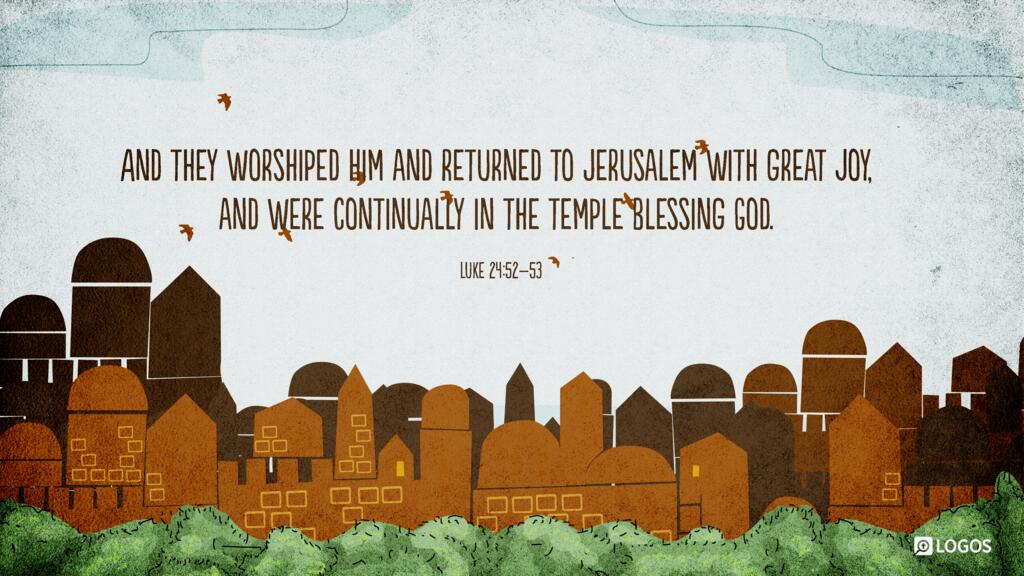
Luke 24:53
The NET BibleOther versions
English
- NET The NET Bible
- DARBY 1890 Darby Bible
- ASV American Standard Version
- AV 1873 The Cambridge Paragraph Bible of the Authorized English Version
- CSB Christian Standard Bible
- D-R Douay-Rheims Bible
- ESV English Standard Version
- GW GOD’S WORD Translation
- GNB Good News Translation
- HCSB The Holman Christian Standard Bible
- KJV 1900 King James Version
- LSB Legacy Standard Bible
- LEB The Lexham English Bible
- MSG The Message: The Bible in Contemporary Language
- NASB95 New American Standard Bible (1995)
- NCV New Century Version
- NIrV New International Reader’s Version (1998)
- NIV New International Version (2011)
- NKJV The New King James Version
- NLT New Living Translation
- NRSVue New Revised Standard Version: Updated Edition
- RSV The Revised Standard Version
- RSVCE The Revised Standard Version, Catholic Edition
- TNIV Today’s New International Version
- YLT Young’s Literal Translation
Arabic
Czech
French
German
Greek
Hungarian
Italian
Korean
Latin
Portuguese
Russian
Simplified Chinese
Spanish
Traditional Chinese
Footnotes
- 136 Grk “in the temple.” Luke’s gospel story proper ends where it began, in the temple courts (Luke 1:4–22). The conclusion is open-ended, because the story continues in Acts with what happened from Jerusalem onwards, once the promise of the Father (v. 49) came.
- 137 The Western text (D it) has αἰνοῦντες (ainountes, “praising”) here, while the Alexandrian (𝔓75 א B C* L) have εὐλογοῦντες (eulogountes, “blessing”). Most , especially the later Byzantine , evidently combine these two readings with αἰνοῦντες καὶ εὐλογοῦντες (A C2 W Θ Ψ f1, 13 33 𝔐 lat). It is more difficult to decide between the two earlier readings. Internal arguments can go either way, but what seems decisive in this instance are the superior witnesses for εὐλογοῦντες.
- 138 The majority of Greek , some of which are important witnesses (A B C2 Θ Ψ f13 𝔐 lat), add “Amen” to note the Gospel’s end. Such a conclusion is routinely added by scribes to NT books because a few of these books originally had such an ending (cf. Rom 16:27; Gal 6:18; Jude 25). A majority of Greek witnesses have the concluding ἀμήν in every NT book except Acts, James, and 3 John (and even in these books, ἀμήν is found in some witnesses). It is thus a predictable variant. Further, since significant witnesses lack the word (𝔓75 א C* D L W 1 33 it co), it is evidently not original.
The NET Bible First Edition, Copyright 1996-2005 by Biblical Studies Press
In other versions
ESVEnglish Standard Version
and were continually in the temple blessing God.
Copyright 2001 Crossway Bibles
NIVNew International Version (2011)
And they stayed continually at the temple, praising God.
Copyright 1973, 1978, 1984, 2011 Biblica, Inc.
CSBChristian Standard Bible
And they were continually in the temple praising God.
Copyright 2017 Holman Bible Publishers
NLTNew Living Translation
And they spent all of their time in the Temple, praising God.
Holy Bible, New Living Translation, copyright © 1996, 2004, 2015 by Tyndale House Foundation. Used by permission of Tyndale House Publishers. All rights reserved.
LEBThe Lexham English Bible
And they were continually in the temple courts praising God.
Copyright 2012 Lexham Press
KJV 1900King James Version
And were continually in the temple, praising and blessing God. Amen.
Public Domain