Luke 10:40–42
The NET BibleOther versions
English
- NET The NET Bible
- DARBY 1890 Darby Bible
- ASV American Standard Version
- AV 1873 The Cambridge Paragraph Bible of the Authorized English Version
- CSB Christian Standard Bible
- D-R Douay-Rheims Bible
- ESV English Standard Version
- GW GOD’S WORD Translation
- GNB Good News Translation
- HCSB The Holman Christian Standard Bible
- KJV 1900 King James Version
- LSB Legacy Standard Bible
- LEB The Lexham English Bible
- MSG The Message: The Bible in Contemporary Language
- NASB95 New American Standard Bible (1995)
- NCV New Century Version
- NIrV New International Reader’s Version (1998)
- NIV New International Version (2011)
- NKJV The New King James Version
- NLT New Living Translation
- NRSVue New Revised Standard Version: Updated Edition
- RSV The Revised Standard Version
- RSVCE The Revised Standard Version, Catholic Edition
- TNIV Today’s New International Version
- YLT Young’s Literal Translation
Arabic
Czech
French
German
Greek
Hungarian
Italian
Korean
Latin
Portuguese
Russian
Simplified Chinese
Spanish
Traditional Chinese
10:40But Martha was distracted133 with all the preparations she had to make,134 so135 she came up to him and said, “Lord, don’t you care136 that my sister has left me to do all the work137 alone? Tell138 her to help me.” 10:41But the Lord139 answered her,140 “Martha, Martha,141 you are worried and troubled142 about many things, 10:42but one thing143 is needed. Mary has chosen the best144 part; it will not be taken away from her.”
Footnotes
- 133 The term distracted means “to be pulled away” by something (L&N 25.238). It is a narrative comment that makes clear who is right in the account.
- 134 Grk “with much serving.”
- 135 Here δέ (de) has been translated as “so” to indicate that the following was a result of Martha’s distraction.
- 136 The negative οὐ (ou) used with the verb expects a positive reply. Martha expected Jesus to respond and rebuke Mary.
- 137 Grk “has left me to serve alone.”
- 138 The conjunction οὖν (oun, “then, therefore”) has not been translated here.
- 139 Most (A B* C D W Θ Ψ f1, 13 𝔐 it) read “Jesus” instead of “the Lord” here, but κύριος (kurios, “Lord”) has the support of some weighty papyri, uncials, and other witnesses (𝔓3, [45],75 א B2 L 579 892 lat sa).
- 140 Grk “answering, said to her.” This is redundant in contemporary English and has been simplified to “answered her.”
- 141 The double vocative Martha, Martha communicates emotion.
- 142 Or “upset.” Here the meanings of μεριμνάω (merimnaō) and θορυβάζομαι (thorubazomai) reinforce each other (L&N 25.234).
- 143 Or, with some (𝔓3 [א] B C2 L 070vid f1 33 [579] ), “few things are needed—or only one” (as well as other variants). The textual problem here is a difficult one to decide. The shorter reading is normally preferred, but it is not altogether clear how the variants would arise from it. However, the reading followed in the translation has good support (with some internal variations) from a number of witnesses (𝔓45, 75 A C* W Θ Ψ f13 𝔐 lat sa).
- 144 Or “better”; Grk “good.” This is an instance of the positive adjective used in place of the superlative adjective. According to , this could also be treated as a positive for comparative (“better”).
The NET Bible First Edition, Copyright 1996-2005 by Biblical Studies Press
In other versions
ESVEnglish Standard Version
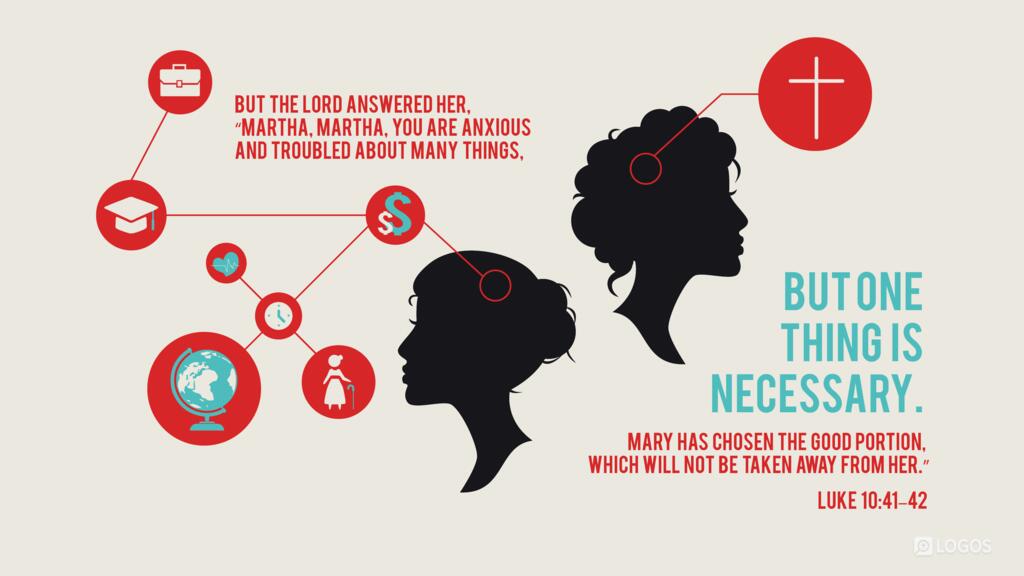
But Martha was distracted with much serving. And she went up to him and said, “Lord, do you not care that my sister has left me to serve alone? Tell her then to help me.” But the Lord answered her, “Martha, Martha, you are anxious and troubled about many things, but one thing is necessary. Mary has chosen the good portion, which will not be taken away from her.”
Copyright 2001 Crossway Bibles
NIVNew International Version (2011)
But Martha was distracted by all the preparations that had to be made. She came to him and asked, “Lord, don’t you care that my sister has left me to do the work by myself? Tell her to help me!”
“Martha, Martha,” the Lord answered, “you are worried and upset about many things, but few things are needed—or indeed only one. Mary has chosen what is better, and it will not be taken away from her.”
Copyright 1973, 1978, 1984, 2011 Biblica, Inc.
CSBChristian Standard Bible
But Martha was distracted by her many tasks, and she came up and asked, “Lord, don’t you care that my sister has left me to serve alone? So tell her to give me a hand.”
The Lord answered her, “Martha, Martha, you are worried and upset about many things, but one thing is necessary. Mary has made the right choice, and it will not be taken away from her.”
Copyright 2017 Holman Bible Publishers
NLTNew Living Translation
But Martha was distracted by the big dinner she was preparing. She came to Jesus and said, “Lord, doesn’t it seem unfair to you that my sister just sits here while I do all the work? Tell her to come and help me.”
But the Lord said to her, “My dear Martha, you are worried and upset over all these details! There is only one thing worth being concerned about. Mary has discovered it, and it will not be taken away from her.”
Holy Bible, New Living Translation, copyright © 1996, 2004, 2015 by Tyndale House Foundation. Used by permission of Tyndale House Publishers. All rights reserved.
LEBThe Lexham English Bible
But Martha was distracted with much preparation, so she approached and said, “Lord, is it not a concern to you that my sister has left me alone to make preparations? Then tell her that she should help me!” But the Lord answered and said to her, “Martha, Martha, you are anxious and troubled about many things! But few things are necessary, or only one thing, for Mary has chosen the better part, which will not be taken away from her.”
Copyright 2012 Lexham Press
KJV 1900King James Version
But Martha was cumbered about much serving, and came to him, and said, Lord, dost thou not care that my sister hath left me to serve alone? bid her therefore that she help me. And Jesus answered and said unto her, Martha, Martha, thou art careful and troubled about many things: But one thing is needful: and Mary hath chosen that good part, which shall not be taken away from her.
Public Domain