Leviticus 26:4–13
The NET BibleOther versions
English
- NET The NET Bible
- DARBY 1890 Darby Bible
- ASV American Standard Version
- AV 1873 The Cambridge Paragraph Bible of the Authorized English Version
- CSB Christian Standard Bible
- D-R Douay-Rheims Bible
- ESV English Standard Version
- GW GOD’S WORD Translation
- GNB Good News Translation
- HCSB The Holman Christian Standard Bible
- KJV 1900 King James Version
- LSB Legacy Standard Bible
- LEB The Lexham English Bible
- MSG The Message: The Bible in Contemporary Language
- NASB95 New American Standard Bible (1995)
- NCV New Century Version
- NIrV New International Reader’s Version (1998)
- NIV New International Version (2011)
- NKJV The New King James Version
- NLT New Living Translation
- NRSVue New Revised Standard Version: Updated Edition
- RSV The Revised Standard Version
- RSVCE The Revised Standard Version, Catholic Edition
- TNIV Today’s New International Version
- YLT Young’s Literal Translation
Arabic
Czech
French
German
Hebrew
Hungarian
Italian
Korean
Latin
Portuguese
Russian
Simplified Chinese
Spanish
Traditional Chinese
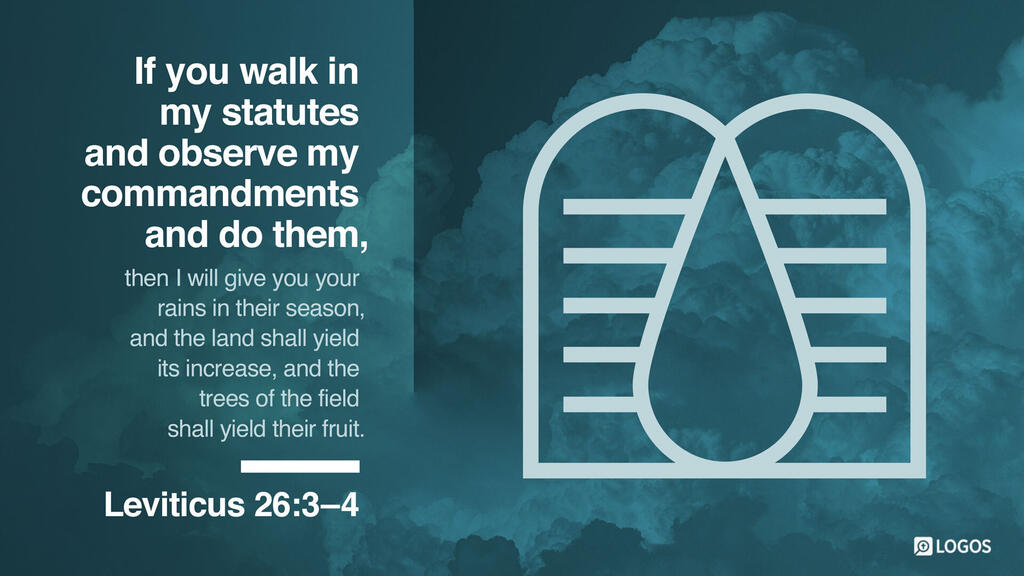
26:4I will give you your rains in their time so that5 the land will give its yield and the trees of the field will produce their fruit.626:5Threshing season will extend for you until the season for harvesting grapes,7 and the season for harvesting grapes will extend until sowing season, so8 you will eat your bread until you are satisfied,9 and you will live securely in your land. 26:6I will grant peace in the land so that10 you will lie down to sleep without anyone terrifying you.11 I will remove harmful animals12 from the land, and no sword of war13 will pass through your land. 26:7You will pursue your enemies and they will fall before you by the sword.1426:8Five of you will pursue a hundred, and a hundred of you will pursue ten thousand, and your enemies will fall before you by the sword. 26:9I will turn to you, make you fruitful, multiply you, and maintain15 my covenant with you. 26:10You will still be eating stored produce from the previous year16 and will have to clean out what is stored from the previous year to make room for new.17
26:11“ ‘I will put my tabernacle18 in your midst and I will not abhor you.1926:12I will walk among you, and I will be your God and you will be my people. 26:13I am the Lord your God who brought you out from the land of Egypt, from being their slaves,20 and I broke the bars of your yoke and caused you to walk upright.21
Footnotes
- 5 Heb “and.” The Hebrew conjunction ו (vav, “and”) can be considered to have resultative force here.
- 6 Heb “the tree of the field will give its fruit.” As a collective singular this has been translated as plural.
- 7 Heb “will reach for you the vintage season.”
- 8 Heb “and.” The Hebrew conjunction ו (vav, “and”) can be considered to have resultative force here.
- 9 Heb “to satisfaction”; , , “to the full.”
- 10 Heb “and.” The Hebrew conjunction ו (vav, “and”) can be considered to have resultative force here.
- 11 Heb “and there will be no one who terrifies.” The words “to sleep” have been supplied in the translation for clarity.
- 12 Heb “harmful animal,” singular, but taken here as a collective plural (so almost all English versions).
- 13 Heb “no sword”; the words “of war” are supplied in the translation to indicate what the metaphor of the sword represents.
- 14 Heb “to the sword.”
- 15 Heb “cause to arise,” but probably used here for the Lord’s intention of confirming or maintaining the covenant commitment made at Sinai. Cf. “establish”; “will confirm”; “carry out”; “will keep.”
- 16 Heb “old [produce] growing old.”
- 17 Heb “and old from the presence of new you will bring out.”
- 18 codexes Vaticanus and Alexandrinus have “my covenant” rather than “my tabernacle.” Cf. , , “my dwelling.”
- 19 Heb “and my soul [נֶפֶשׁ, nefesh] will not abhor you.”
- 20 Heb “from being to them slaves.”
- 21 In other words, to walk as free people and not as slaves. Cf. “with (+ your , ) heads held high”; “proudly.”
The NET Bible First Edition, Copyright 1996-2005 by Biblical Studies Press