Joshua 24:14–28
The NET BibleOther versions
English
- NET The NET Bible
- DARBY 1890 Darby Bible
- ASV American Standard Version
- AV 1873 The Cambridge Paragraph Bible of the Authorized English Version
- CSB Christian Standard Bible
- D-R Douay-Rheims Bible
- ESV English Standard Version
- GW GOD’S WORD Translation
- GNB Good News Translation
- HCSB The Holman Christian Standard Bible
- KJV 1900 King James Version
- LSB Legacy Standard Bible
- LEB The Lexham English Bible
- MSG The Message: The Bible in Contemporary Language
- NASB95 New American Standard Bible (1995)
- NCV New Century Version
- NIrV New International Reader’s Version (1998)
- NIV New International Version (2011)
- NKJV The New King James Version
- NLT New Living Translation
- NRSVue New Revised Standard Version: Updated Edition
- RSV The Revised Standard Version
- RSVCE The Revised Standard Version, Catholic Edition
- YLT Young’s Literal Translation
Arabic
Czech
French
German
Hebrew
Hungarian
Italian
Korean
Latin
Portuguese
Russian
Simplified Chinese
Spanish
Traditional Chinese
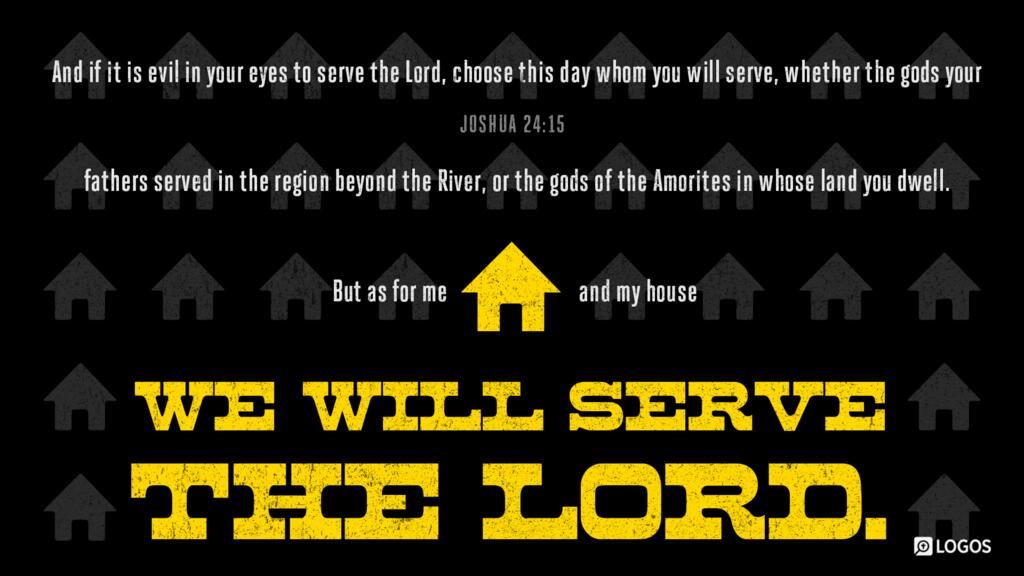
24:14Now27 obey28 the Lord and worship29 him with integrity and loyalty. Put aside the gods your ancestors30 worshiped31 beyond the Euphrates32 and in Egypt and worship33 the Lord. 24:15If you have no desire34 to worship35 the Lord, choose today whom you will worship,36 whether it be the gods whom your ancestors37 worshiped38 beyond the Euphrates,39 or the gods of the Amorites in whose land you are living. But I and my family40 will worship41 the Lord!”
24:16The people responded, “Far be it from us to abandon the Lord so we can42 worship43 other gods! 24:17For the Lord our God took us and our fathers out of slavery44 in the land of Egypt45 and performed these awesome miracles46 before our very eyes. He continually protected us as we traveled and when we passed through nations.4724:18The Lord drove out from before us all the nations, including the Amorites who lived in the land. So we too will worship48 the Lord, for he is our God!”
24:19Joshua warned49 the people, “You will not keep worshiping50 the Lord, for51 he is a holy God.52 He is a jealous God who will not forgive53 your rebellion or your sins. 24:20If54 you abandon the Lord and worship55 foreign gods, he will turn against you;56 he will bring disaster on you and destroy you,57 though he once treated you well.”58
24:21The people said to Joshua, “No! We really will59 worship60 the Lord!” 24:22Joshua said to the people, “Do you agree to be witnesses against yourselves that you have chosen to worship the Lord?”61 They replied, “We are witnesses!”6224:23Joshua said,63 “Now put aside the foreign gods that are among you and submit to64 the Lord God of Israel.”
24:24The people said to Joshua, “We will worship65 the Lord our God and obey him.”66
24:25That day Joshua drew up an agreement67 for the people, and he established rules and regulations68 for them in Shechem. 24:26Joshua wrote these words in the Law Scroll of God. He then took a large stone and set it up there under the oak tree near the Lord’s shrine. 24:27Joshua said to all the people, “Look, this stone will be a witness against you, for it has heard everything the Lord said to us.69 It will be a witness against you if70 you deny your God.” 24:28When Joshua dismissed the people, they went to their allotted portions of land.71
Footnotes
- 27 Joshua quotes the Lord’s words in vv. 2b–13 (note that the Lord speaks in the first person in these verses); in vv. 14–15 Joshua himself exhorts the people (note the third person references to the Lord).
- 28 Heb “fear.”
- 29 Or “and serve.”
- 30 Heb “your fathers.”
- 31 Or “served.”
- 32 Heb “the river,” referring to the Euphrates. This has been specified in the translation for clarity; see v. 3.
- 33 Or “and serve.”
- 34 Heb “if it is bad in your eyes.”
- 35 Or “to serve.”
- 36 Or “will serve.”
- 37 Heb “your fathers.”
- 38 Or “served.”
- 39 Heb “the river,” referring to the Euphrates. This has been specified in the translation for clarity; see v. 3.
- 40 Heb “house.”
- 41 Or “will serve.”
- 42 Heb “to.”
- 43 Or “can serve.”
- 44 Heb “of the house of slavery.”
- 45 Heb “for the Lord our God, he is the one who brought up us and our fathers from the land of Egypt, from the house of slaves.”
- 46 Or “great signs.”
- 47 Heb “and he guarded us in all the way in which we walked and among all the peoples through whose midst we passed.”
- 48 Or “will serve.”
- 49 Heb “said to.”
- 50 Heb “you are not able to serve.”
- 51 For an excellent discussion of Joshua’s logical argument here, see T. C. Butler, Joshua (), .
- 52 In the Hebrew text both the divine name (אֱלֹהִים, ’elohim) and the adjective (קְדֹשִׁים, qédoshim, “holy”) are plural. Normally the divine name, when referring to the one true God, takes singular modifiers, but this is a rare exception where the adjective agrees grammatically with the honorific plural noun. See §124.i and .
- 53 Heb “lift up” or “take away.” This assertion obviously needs qualification, for the OT elsewhere affirms that God does forgive. Joshua is referring to the persistent national rebellion against the Mosaic covenant that eventually cause God to decree unconditionally the nation’s exile.
- 54 Or “when.”
- 55 Or “and serve.”
- 56 The words “against you” are added for clarification.
- 57 Heb “bring you to an end.”
- 58 Heb “after he did good for you.”
- 59 The translation assumes that כִּי (ki) is emphatic. Another option is to take it as explanatory, “No, for we will.…”
- 60 Or “will serve.”
- 61 Heb “You are witnesses against yourselves that you have chosen for yourselves the Lord to serve him.”
- 62 Like witnesses in a court of law, Israel’s solemn vow to worship the Lord will testify against them in the divine court if the nation ever violates its commitment.
- 63 The words “Joshua said” are supplied for clarification.
- 64 Heb “bend your heart toward.” The term לֵבָב (levav, “heart”) probably here refers to the people’s volition or will.
- 65 Or “will serve.”
- 66 Heb “and listen to his voice.”
- 67 Heb “cut a covenant.”
- 68 Heb “a statute and a judgment.”
- 69 Heb “all the words of the Lord which he spoke with us.”
- 70 Or “lest,” “so that you might not.”
- 71 Heb “And Joshua sent the people away, each to his inheritance.”
The NET Bible First Edition, Copyright 1996-2005 by Biblical Studies Press