John 3:14–16
The NET BibleOther versions
English
- NET The NET Bible
- DARBY 1890 Darby Bible
- ASV American Standard Version
- AV 1873 The Cambridge Paragraph Bible of the Authorized English Version
- CSB Christian Standard Bible
- D-R Douay-Rheims Bible
- ESV English Standard Version
- GW GOD’S WORD Translation
- GNB Good News Translation
- HCSB The Holman Christian Standard Bible
- KJV 1900 King James Version
- LSB Legacy Standard Bible
- LEB The Lexham English Bible
- MSG The Message: The Bible in Contemporary Language
- NASB95 New American Standard Bible (1995)
- NCV New Century Version
- NIrV New International Reader’s Version (1998)
- NIV New International Version (2011)
- NKJV The New King James Version
- NLT New Living Translation
- NRSVue New Revised Standard Version: Updated Edition
- RSV The Revised Standard Version
- RSVCE The Revised Standard Version, Catholic Edition
- TNIV Today’s New International Version
- YLT Young’s Literal Translation
Arabic
Czech
French
German
Greek
Hungarian
Italian
Korean
Latin
Portuguese
Russian
Simplified Chinese
Spanish
Traditional Chinese
3:14Just as31 Moses lifted up the serpent32 in the wilderness,33 so must the Son of Man be lifted up,343:15so that everyone who believes in him may have eternal life.”35
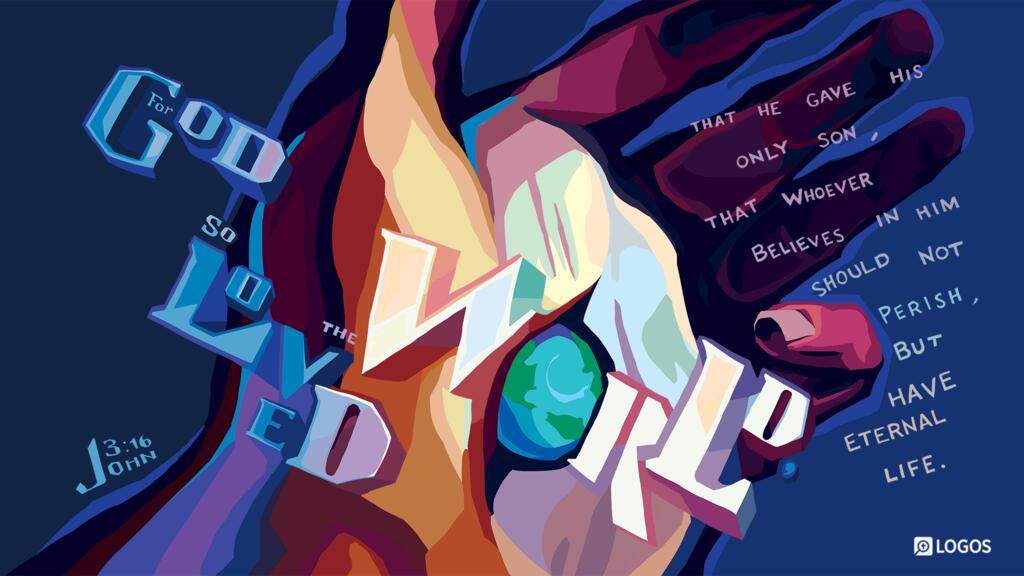
3:16For this is the way36 God loved the world: He gave his one and only37 Son, so that everyone who believes in him will not perish38 but have eternal life.39
Footnotes
- 31 Grk “And just as.”
- 32 Or the snake, referring to the bronze serpent mentioned in Num 21:9.
- 33 An allusion to Num 21:5–9.
- 34 So must the Son of Man be lifted up. This is ultimately a prediction of Jesus’ crucifixion. Nicodemus could not have understood this, but John’s readers, the audience to whom the Gospel is addressed, certainly could have (compare the wording of John 12:32). In John, being lifted up refers to one continuous action of ascent, beginning with the cross but ending at the right hand of the Father. Step 1 is Jesus’ death; step 2 is his resurrection; and step 3 is the ascension back to heaven. It is the upward swing of the “pendulum” which began with the incarnation, the descent of the Word become flesh from heaven to earth (cf. Paul in Phil 2:5–11). See also the note on the title Son of Man in .
- 35 This is the first use of the term ζωὴν αἰώνιον (zōēn aiōnion) in the Gospel, although ζωή (zōē) in chap. 1 is to be understood in the same way without the qualifying αἰώνιος (aiōnios). Some interpreters extend the quotation of Jesus’ words through v. 21.
- 36 Or “this is how much”; or “in this way.” The Greek adverb οὕτως (houtōs) can refer (1) to the degree to which God loved the world, that is, to such an extent or so much that he gave his own Son (see R. E. Brown, John [], 1:; D. A. Carson, John, 204) or (2) simply to the manner in which God loved the world, i.e., by sending his own son (see R. H. Gundry and R. W. Howell, “The Sense and Syntax of John 3:14–17 with Special Reference to the Use of οὕτως … ὥστε in John 3:16,” 41 [1999]: 24–39). Though the term more frequently refers to the manner in which something is done (see οὕτω/οὕτως), the following clause involving ὥστε (hōste) plus the indicative (which stresses actual, but [usually] unexpected result) emphasizes the greatness of the gift God has given. With this in mind, then, it is likely (3) that John is emphasizing both the degree to which God loved the world as well as the manner in which He chose to express that love. This is in keeping with John’s style of using double entendre or double meaning. Thus, the focus of the Greek construction here is on the nature of God’s love, addressing its mode, intensity, and extent.
- 37 Although this word is often translated “only begotten,” such a translation is misleading, since in English it appears to express a metaphysical relationship. The word in Greek was used of an only child (a son [Luke 7:12, 9:38] or a daughter [Luke 8:42]). It was also used of something unique (only one of its kind) such as the mythological Phoenix (1 Clement 25:2). From here it passes easily to a description of Isaac (Heb 11:17 and Josephus, 1.13.1 [1.222]) who was not Abraham’s only son, but was one-of-a-kind because he was the child of the promise. Thus the word means “one-of-a-kind” and is reserved for Jesus in the Johannine literature of the NT. While all Christians are children of God (τέκνα θεοῦ, tekna theou), Jesus is God’s Son in a unique, one-of-a-kind sense. The word is used in this way in all its uses in the Gospel of John (1:14, 1:18, 3:16, and 3:18).
- 38 In John the word ἀπόλλυμι (apollumi) can mean either (1) to be lost (2) to perish or be destroyed, depending on the context.
- 39 The alternatives presented are only two (again, it is typical of Johannine thought for this to be presented in terms of polar opposites): perish or have eternal life.
The NET Bible First Edition, Copyright 1996-2005 by Biblical Studies Press
In other versions
ESVEnglish Standard Version
And as Moses lifted up the serpent in the wilderness, so must the Son of Man be lifted up, that whoever believes in him may have eternal life.
“For God so loved the world, that he gave his only Son, that whoever believes in him should not perish but have eternal life.
Copyright 2001 Crossway Bibles
NIVNew International Version (2011)
Just as Moses lifted up the snake in the wilderness, so the Son of Man must be lifted up, that everyone who believes may have eternal life in him.”
For God so loved the world that he gave his one and only Son, that whoever believes in him shall not perish but have eternal life.
Copyright 1973, 1978, 1984, 2011 Biblica, Inc.
CSBChristian Standard Bible
“Just as Moses lifted up the snake in the wilderness, so the Son of Man must be lifted up, so that everyone who believes in him may have eternal life. For God loved the world in this way: He gave his one and only Son, so that everyone who believes in him will not perish but have eternal life.
Copyright 2017 Holman Bible Publishers
NLTNew Living Translation
And as Moses lifted up the bronze snake on a pole in the wilderness, so the Son of Man must be lifted up, so that everyone who believes in him will have eternal life.
“For this is how God loved the world: He gave his one and only Son, so that everyone who believes in him will not perish but have eternal life.
Holy Bible, New Living Translation, copyright © 1996, 2004, 2015 by Tyndale House Foundation. Used by permission of Tyndale House Publishers. All rights reserved.
LEBThe Lexham English Bible
And just as Moses lifted up the snake in the wilderness, thus it is necessary that the Son of Man be lifted up, so that everyone who believes in him will have eternal life.”
For in this way God loved the world, so that he gave his one and only Son, in order that everyone who believes in him will not perish, but will have eternal life.
Copyright 2012 Lexham Press
KJV 1900King James Version
And as Moses lifted up the serpent in the wilderness, even so must the Son of man be lifted up: That whosoever believeth in him should not perish, but have eternal life. For God so loved the world, that he gave his only begotten Son, that whosoever believeth in him should not perish, but have everlasting life.
Public Domain