John 20:24–29
The NET BibleOther versions
English
- NET The NET Bible
- DARBY 1890 Darby Bible
- ASV American Standard Version
- AV 1873 The Cambridge Paragraph Bible of the Authorized English Version
- CSB Christian Standard Bible
- D-R Douay-Rheims Bible
- ESV English Standard Version
- GW GOD’S WORD Translation
- GNB Good News Translation
- HCSB The Holman Christian Standard Bible
- KJV 1900 King James Version
- LSB Legacy Standard Bible
- LEB The Lexham English Bible
- MSG The Message: The Bible in Contemporary Language
- NASB95 New American Standard Bible (1995)
- NCV New Century Version
- NIrV New International Reader’s Version (1998)
- NIV New International Version (2011)
- NKJV The New King James Version
- NLT New Living Translation
- NRSVue New Revised Standard Version: Updated Edition
- RSV The Revised Standard Version
- RSVCE The Revised Standard Version, Catholic Edition
- TNIV Today’s New International Version
- YLT Young’s Literal Translation
Arabic
Czech
French
German
Greek
Hungarian
Italian
Korean
Latin
Portuguese
Russian
Simplified Chinese
Spanish
Traditional Chinese
The Response of Thomas
20:24Now Thomas (called Didymus),40 one of the twelve, was not with them when Jesus came. 20:25The other disciples told him, “We have seen the Lord!” But he replied,41 “Unless I see the wounds42 from the nails in his hands, and put my finger into the wounds from the nails, and put my hand into his side, I will never believe it!”43
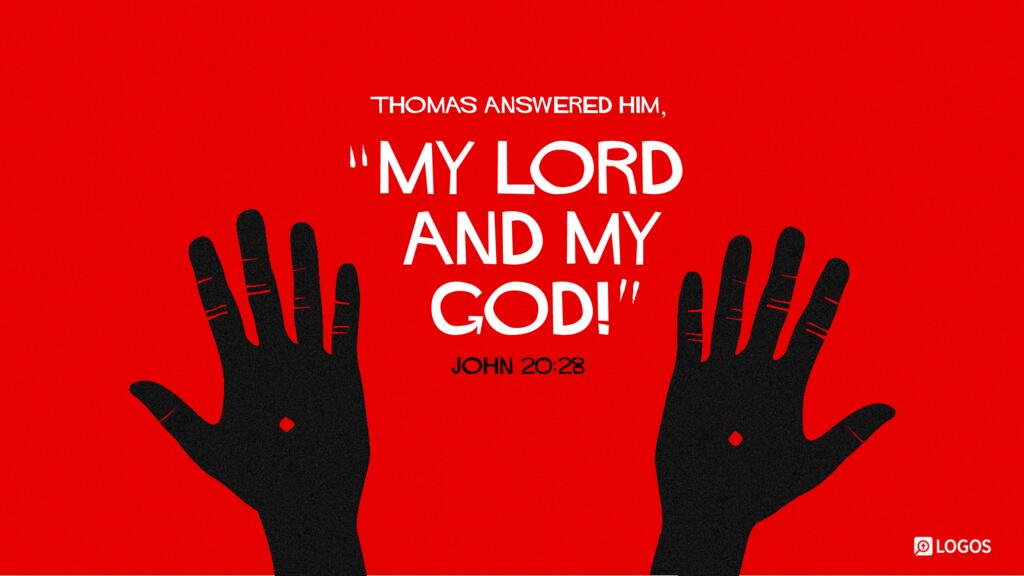
20:26Eight days later the disciples were again together in the house,44 and Thomas was with them. Although the doors were locked,45 Jesus came and stood among them and said, “Peace be with you!” 20:27Then he said to Thomas, “Put46 your finger here, and examine47 my hands. Extend48 your hand and put it49 into my side. Do not continue in your unbelief, but believe.”5020:28Thomas replied to him,51 “My Lord and my God!”5220:29Jesus said to him, “Have you believed because you have seen me? Blessed are the people53 who have not seen and yet have believed.”54
Footnotes
- 40 This is a parenthetical note by the author; Didymus means “the twin” in Greek.
- 41 Grk “but he said to them.”
- 42 Or “marks.”
- 43 The word “it” is not in the Greek text but is implied. Direct objects were often omitted in Greek when clear from the context. The use of “it” here as direct object of the verb πιστεύσω (pisteusō) specifies exactly what Thomas was refusing to believe: that Jesus had risen from the dead, as reported by his fellow disciples. Otherwise the English reader may be left with the impression Thomas was refusing to “believe in” Jesus, or “believe Jesus to be the Christ.” The dramatic tension in this narrative is heightened when Thomas, on seeing for himself the risen Christ, believes more than just the resurrection (see John 20:28).
- 44 Grk “were inside”; the word “together” is implied.
- 45 Grk “the doors were shut”; “locked” conveys a more appropriate idea for the modern English reader. See the note on the phrase locked the doors in .
- 46 Or “Extend” or “Reach out.” The translation “put” or “reach out” for φέρω (pherō) here is given in 4.
- 47 Grk “see.” The Greek verb ἵδε (ide) is often used like its cognate ἰδού (idou) in Hellenistic Greek (which is “used to emphasize the … importance of someth.” [ ἰδού 1.b.ε]).
- 48 Or “reach out” or “put.”
- 49 The word “it” is not in the Greek text but is implied. Direct objects were often omitted in Greek when clear from the context.
- 50 Grk “and do not be unbelieving, but believing.”
- 51 Grk “answered and said to him.”
- 52 Should Thomas’ exclamation be understood as two subjects with the rest of the sentence omitted (“My Lord and my God has truly risen from the dead”), as predicate nominatives (“You are my Lord and my God”), or as vocatives (“My Lord and my God!”)? Probably the most likely is something between the second and third alternatives. It seems that the second is slightly more likely here, because the context appears confessional. Thomas’ statement, while it may have been an exclamation, does in fact confess the faith which he had previously lacked, and Jesus responds to Thomas’ statement in the following verse as if it were a confession. With the proclamation by Thomas here, it is difficult to see how any more profound analysis of Jesus’ person could be given. It echoes 1:1 and 1:14 together: The Word was God, and the Word became flesh (Jesus of Nazareth). The Fourth Gospel opened with many other titles for Jesus: the Lamb of God (1:29, 36); the Son of God (1:34, 49); Rabbi (1:38); Messiah (1:41); the King of Israel (1:49); the Son of Man (1:51). Now the climax is reached with the proclamation by Thomas, “My Lord and my God,” and the reader has come full circle from 1:1, where the author had introduced him to who Jesus was, to 20:28, where the last of the disciples has come to the full realization of who Jesus was. What Jesus had predicted in John 8:28 had come to pass: “When you lift up the Son of Man, then you will know that I am he” (Grk “I am”). By being lifted up in crucifixion (which led in turn to his death, resurrection, and exaltation with the Father) Jesus has revealed his true identity as both Lord (κύριος [kurios], used by the to translate Yahweh) and God (θεός [theos], used by the to translate Elohim).
- 53 Grk “are those.”
- 54 Some translations treat πιστεύσαντες (pisteusantes) as a gnomic aorist (timeless statement) and thus equivalent to an English present tense: “and yet believe” (). This may create an effective application of the passage to the modern reader, but the author is probably thinking of those people who had already believed without the benefit of seeing the risen Jesus, on the basis of reports by others or because of circumstantial evidence (see John 20:8).
The NET Bible First Edition, Copyright 1996-2005 by Biblical Studies Press
In other versions
ESVEnglish Standard Version
Now Thomas, one of the twelve, called the Twin, was not with them when Jesus came. So the other disciples told him, “We have seen the Lord.” But he said to them, “Unless I see in his hands the mark of the nails, and place my finger into the mark of the nails, and place my hand into his side, I will never believe.”
Eight days later, his disciples were inside again, and Thomas was with them. Although the doors were locked, Jesus came and stood among them and said, “Peace be with you.” Then he said to Thomas, “Put your finger here, and see my hands; and put out your hand, and place it in my side. Do not disbelieve, but believe.” Thomas answered him, “My Lord and my God!” Jesus said to him, “Have you believed because you have seen me? Blessed are those who have not seen and yet have believed.”
Copyright 2001 Crossway Bibles
NIVNew International Version (2011)
Now Thomas (also known as Didymus), one of the Twelve, was not with the disciples when Jesus came. So the other disciples told him, “We have seen the Lord!”
But he said to them, “Unless I see the nail marks in his hands and put my finger where the nails were, and put my hand into his side, I will not believe.”
A week later his disciples were in the house again, and Thomas was with them. Though the doors were locked, Jesus came and stood among them and said, “Peace be with you!” Then he said to Thomas, “Put your finger here; see my hands. Reach out your hand and put it into my side. Stop doubting and believe.”
Thomas said to him, “My Lord and my God!”
Then Jesus told him, “Because you have seen me, you have believed; blessed are those who have not seen and yet have believed.”
Copyright 1973, 1978, 1984, 2011 Biblica, Inc.
CSBChristian Standard Bible
But Thomas (called “Twin”), one of the Twelve, was not with them when Jesus came. So the other disciples were telling him, “We’ve seen the Lord!”
But he said to them, “If I don’t see the mark of the nails in his hands, put my finger into the mark of the nails, and put my hand into his side, I will never believe.”
A week later his disciples were indoors again, and Thomas was with them. Even though the doors were locked, Jesus came and stood among them and said, “Peace be with you.”
Then he said to Thomas, “Put your finger here and look at my hands. Reach out your hand and put it into my side. Don’t be faithless, but believe.”
Thomas responded to him, “My Lord and my God!”
Jesus said, “Because you have seen me, you have believed. Blessed are those who have not seen and yet believe.”
Copyright 2017 Holman Bible Publishers
NLTNew Living Translation
One of the twelve disciples, Thomas (nicknamed the Twin), was not with the others when Jesus came. They told him, “We have seen the Lord!”
But he replied, “I won’t believe it unless I see the nail wounds in his hands, put my fingers into them, and place my hand into the wound in his side.”
Eight days later the disciples were together again, and this time Thomas was with them. The doors were locked; but suddenly, as before, Jesus was standing among them. “Peace be with you,” he said. Then he said to Thomas, “Put your finger here, and look at my hands. Put your hand into the wound in my side. Don’t be faithless any longer. Believe!”
“My Lord and my God!” Thomas exclaimed.
Then Jesus told him, “You believe because you have seen me. Blessed are those who believe without seeing me.”
Holy Bible, New Living Translation, copyright © 1996, 2004, 2015 by Tyndale House Foundation. Used by permission of Tyndale House Publishers. All rights reserved.
LEBThe Lexham English Bible
Now Thomas, one of the twelve, who was called Didymus, was not with them when Jesus came. So the other disciples said to him, “We have seen the Lord!” But he said to them, “Unless I see in his hands the mark of the nails, and put my finger into the mark of the nails, and put my hand into his side, I will never believe!”
And after eight days his disciples were again inside, and Thomas with them. Although the doors had been shut, Jesus came and stood in their midst and said, “Peace to you.” Then he said to Thomas, “Place your finger here and see my hands, and place your hand and put it into my side. And do not be unbelieving, but believing!” Thomas answered and said to him, “My Lord and my God!” Jesus said to him, “Because you have seen me, have you believed? Blessed are those who have not seen and have believed.”
Copyright 2012 Lexham Press
KJV 1900King James Version
But Thomas, one of the twelve, called Didymus, was not with them when Jesus came. The other disciples therefore said unto him, We have seen the Lord. But he said unto them, Except I shall see in his hands the print of the nails, and put my finger into the print of the nails, and thrust my hand into his side, I will not believe. And after eight days again his disciples were within, and Thomas with them: then came Jesus, the doors being shut, and stood in the midst, and said, Peace be unto you. Then saith he to Thomas, Reach hither thy finger, and behold my hands; and reach hither thy hand, and thrust it into my side: and be not faithless, but believing. And Thomas answered and said unto him, My Lord and my God. Jesus saith unto him, Thomas, because thou hast seen me, thou hast believed: blessed are they that have not seen, and yet have believed.
Public Domain