John 17:2–3
The NET BibleOther versions
English
- NET The NET Bible
- DARBY 1890 Darby Bible
- ASV American Standard Version
- AV 1873 The Cambridge Paragraph Bible of the Authorized English Version
- CSB Christian Standard Bible
- D-R Douay-Rheims Bible
- ESV English Standard Version
- GW GOD’S WORD Translation
- GNB Good News Translation
- HCSB The Holman Christian Standard Bible
- KJV 1900 King James Version
- LSB Legacy Standard Bible
- LEB The Lexham English Bible
- MSG The Message: The Bible in Contemporary Language
- NASB95 New American Standard Bible (1995)
- NCV New Century Version
- NIrV New International Reader’s Version (1998)
- NIV New International Version (2011)
- NKJV The New King James Version
- NLT New Living Translation
- NRSVue New Revised Standard Version: Updated Edition
- RSV The Revised Standard Version
- RSVCE The Revised Standard Version, Catholic Edition
- TNIV Today’s New International Version
- YLT Young’s Literal Translation
Arabic
Czech
French
German
Greek
Hungarian
Italian
Korean
Latin
Portuguese
Russian
Simplified Chinese
Spanish
Traditional Chinese
17:2just as you have given him authority over all humanity,5 so that he may give eternal life to everyone you have given him.617:3Now this7 is eternal life8—that they know you, the only true God, and Jesus Christ,9 whom you sent.
Footnotes
- 5 Or “all people”; Grk “all flesh.”
- 6 Grk “so that to everyone whom you have given to him, he may give to them eternal life.”
- 7 Using αὕτη δέ (hautē de) to introduce an explanation is typical Johannine style; it was used before in John 1:19, 3:19, and 15:12.
- 8 This is eternal life. The author here defines eternal life for the readers, although it is worked into the prayer in such a way that many interpreters do not regard it as another of the author’s parenthetical comments. It is not just unending life in the sense of prolonged duration. Rather it is a quality of life, with its quality derived from a relationship with God. Having eternal life is here defined as being in relationship with the Father, the one true God, and Jesus Christ whom the Father sent. Christ (χριστός, Christos) is not characteristically attached to Jesus’ name in John’s Gospel; it occurs elsewhere primarily as a title and is used with Jesus’ name only in 1:17. But that is connected to its use here: The statement here in 17:3 enables us to correlate the statement made in 1:18 of the prologue, that Jesus has fully revealed what God is like, with Jesus’ statement in 10:10 that he has come that people might have life, and have it abundantly. These two purposes are really one, according to 17:3, because (abundant) eternal life is defined as knowing (being in relationship with) the Father and the Son. The only way to gain this eternal life, that is, to obtain this knowledge of the Father, is through the Son (cf. 14:6). Although some have pointed to the use of know (γινώσκω, ginōskō) here as evidence of Gnostic influence in the Fourth Gospel, there is a crucial difference: For John this knowledge is not intellectual, but relational. It involves being in relationship.
- 9 Or “and Jesus the Messiah” (Both Greek “Christ” and Hebrew and Aramaic “Messiah” mean “one who has been anointed”).
The NET Bible First Edition, Copyright 1996-2005 by Biblical Studies Press
In other versions
ESVEnglish Standard Version
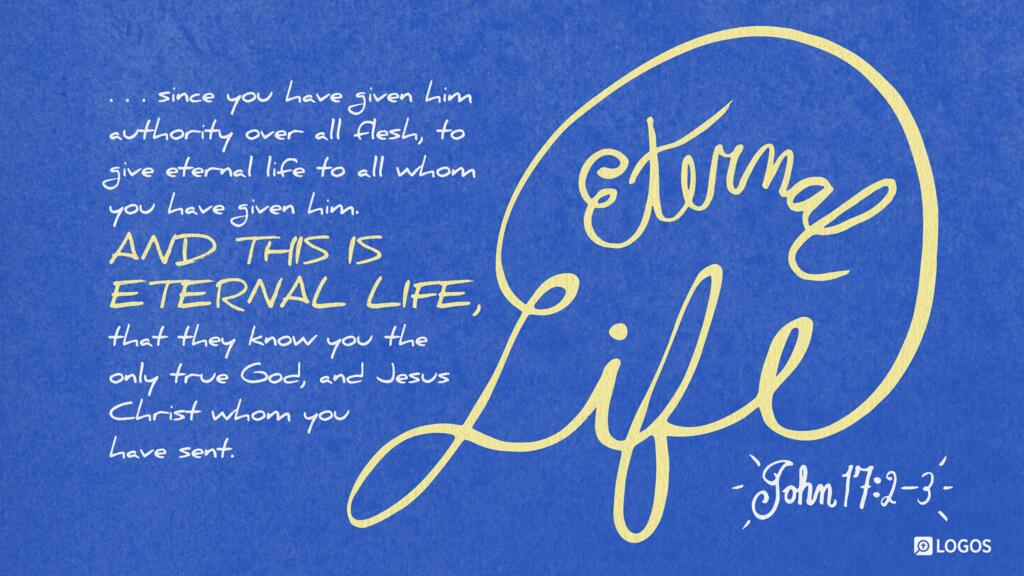
since you have given him authority over all flesh, to give eternal life to all whom you have given him. And this is eternal life, that they know you, the only true God, and Jesus Christ whom you have sent.
Copyright 2001 Crossway Bibles
NIVNew International Version (2011)
For you granted him authority over all people that he might give eternal life to all those you have given him. Now this is eternal life: that they know you, the only true God, and Jesus Christ, whom you have sent.
Copyright 1973, 1978, 1984, 2011 Biblica, Inc.
CSBChristian Standard Bible
since you gave him authority over all people, so that he may give eternal life to everyone you have given him. This is eternal life: that they may know you, the only true God, and the one you have sent—Jesus Christ.
Copyright 2017 Holman Bible Publishers
NLTNew Living Translation
For you have given him authority over everyone. He gives eternal life to each one you have given him. And this is the way to have eternal life—to know you, the only true God, and Jesus Christ, the one you sent to earth.
Holy Bible, New Living Translation, copyright © 1996, 2004, 2015 by Tyndale House Foundation. Used by permission of Tyndale House Publishers. All rights reserved.
LEBThe Lexham English Bible
just as you have given him authority over all flesh, in order that he would give eternal life to them—everyone whom you have given him. Now this is eternal life: that they know you, the only true God, and Jesus Christ, whom you have sent.
Copyright 2012 Lexham Press
KJV 1900King James Version
As thou hast given him power over all flesh, that he should give eternal life to as many as thou hast given him. And this is life eternal, that they might know thee the only true God, and Jesus Christ, whom thou hast sent.
Public Domain