John 17:15–16
The NET BibleOther versions
English
- NET The NET Bible
- DARBY 1890 Darby Bible
- ASV American Standard Version
- AV 1873 The Cambridge Paragraph Bible of the Authorized English Version
- CSB Christian Standard Bible
- D-R Douay-Rheims Bible
- ESV English Standard Version
- GW GOD’S WORD Translation
- GNB Good News Translation
- HCSB The Holman Christian Standard Bible
- KJV 1900 King James Version
- LSB Legacy Standard Bible
- LEB The Lexham English Bible
- MSG The Message: The Bible in Contemporary Language
- NASB95 New American Standard Bible (1995)
- NCV New Century Version
- NIrV New International Reader’s Version (1998)
- NIV New International Version (2011)
- NKJV The New King James Version
- NLT New Living Translation
- NRSVue New Revised Standard Version: Updated Edition
- RSV The Revised Standard Version
- RSVCE The Revised Standard Version, Catholic Edition
- TNIV Today’s New International Version
- YLT Young’s Literal Translation
Arabic
Czech
French
German
Greek
Hungarian
Italian
Korean
Latin
Portuguese
Russian
Simplified Chinese
Spanish
Traditional Chinese
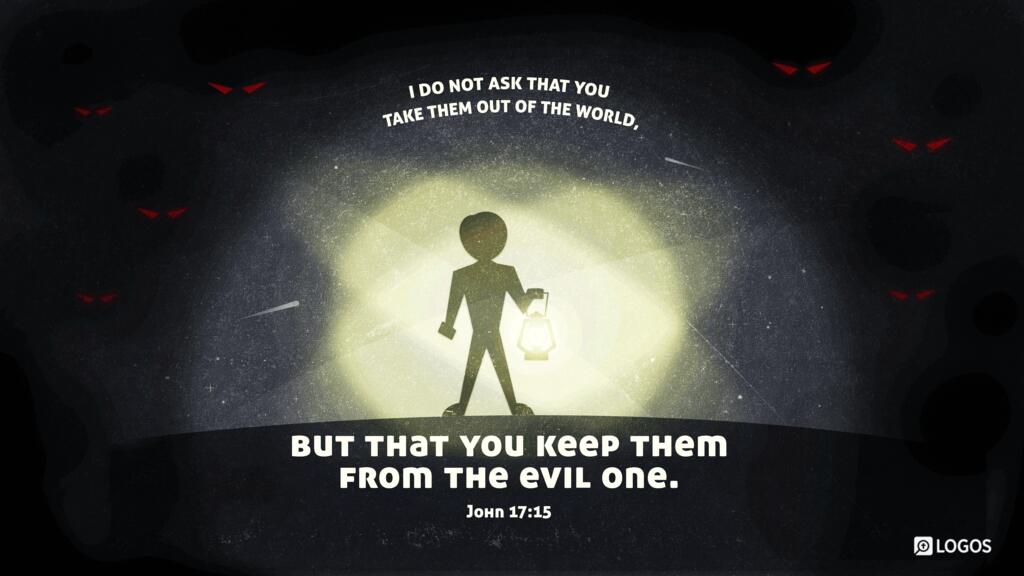
17:15I am not asking you to take them out of the world, but that you keep them safe48 from the evil one.4917:16They do not belong to the world50 just as I do not belong to the world.51
Footnotes
- 48 Or “that you protect them”; Grk “that you keep them.”
- 49 The phrase “the evil one” is a reference to Satan. The genitive noun τοῦ πονηροῦ (tou ponērou) is ambiguous with regard to gender: It may represent the neuter τὸ πονηρόν (to ponēron), “that which is evil,” or the masculine ὁ πονηρός (ho ponēros), “the evil one,” i.e., Satan. In view of the frequent use of the masculine in 1 John 2:13–14, 3:12, and 5:18–19 it seems much more probable that the masculine is to be understood here, and that Jesus is praying for his disciples to be protected from Satan. Cf. πονηρός 1.b.β and 1.b.γ.
- 50 Grk “they are not of the world.” This is a repetition of the second half of v. 14. The only difference is in word order: Verse 14 has οὐκ εἰσὶν ἐκ τοῦ κόσμου (ouk eisin ek tou kosmou), while here the prepositional phrase is stated first: ἐκ τοῦ κόσμου οὐκ εἰσίν (ek tou kosmou ouk eisin). This gives additional emphasis to the idea of the prepositional phrase, i.e., origin, source, or affiliation.
- 51 Grk “just as I am not of the world.”
The NET Bible First Edition, Copyright 1996-2005 by Biblical Studies Press
In other versions
ESVEnglish Standard Version
I do not ask that you take them out of the world, but that you keep them from the evil one. They are not of the world, just as I am not of the world.
Copyright 2001 Crossway Bibles
NIVNew International Version (2011)
My prayer is not that you take them out of the world but that you protect them from the evil one. They are not of the world, even as I am not of it.
Copyright 1973, 1978, 1984, 2011 Biblica, Inc.
CSBChristian Standard Bible
I am not praying that you take them out of the world but that you protect them from the evil one. They are not of the world, just as I am not of the world.
Copyright 2017 Holman Bible Publishers
NLTNew Living Translation
I’m not asking you to take them out of the world, but to keep them safe from the evil one. They do not belong to this world any more than I do.
Holy Bible, New Living Translation, copyright © 1996, 2004, 2015 by Tyndale House Foundation. Used by permission of Tyndale House Publishers. All rights reserved.
LEBThe Lexham English Bible
I do not ask that you take them out of the world, but that you protect them from the evil one. They are not of the world, just as I am not of the world.
Copyright 2012 Lexham Press
KJV 1900King James Version
I pray not that thou shouldest take them out of the world, but that thou shouldest keep them from the evil. They are not of the world, even as I am not of the world.
Public Domain