John 1:11–12
The NET BibleOther versions
English
- NET The NET Bible
- DARBY 1890 Darby Bible
- ASV American Standard Version
- AV 1873 The Cambridge Paragraph Bible of the Authorized English Version
- CSB Christian Standard Bible
- D-R Douay-Rheims Bible
- ESV English Standard Version
- GW GOD’S WORD Translation
- GNB Good News Translation
- HCSB The Holman Christian Standard Bible
- KJV 1900 King James Version
- LSB Legacy Standard Bible
- LEB The Lexham English Bible
- MSG The Message: The Bible in Contemporary Language
- NASB95 New American Standard Bible (1995)
- NCV New Century Version
- NIrV New International Reader’s Version (1998)
- NIV New International Version (2011)
- NKJV The New King James Version
- NLT New Living Translation
- NRSVue New Revised Standard Version: Updated Edition
- RSV The Revised Standard Version
- RSVCE The Revised Standard Version, Catholic Edition
- TNIV Today’s New International Version
- YLT Young’s Literal Translation
Arabic
Czech
French
German
Greek
Hungarian
Italian
Korean
Latin
Portuguese
Russian
Simplified Chinese
Spanish
Traditional Chinese
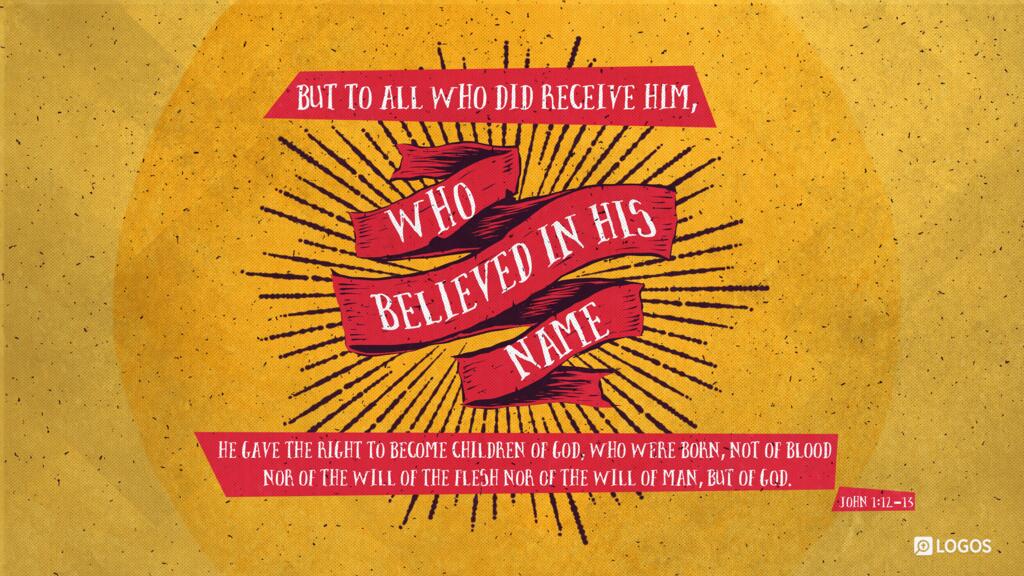
1:11He came to what was his own,24 but25 his own people26 did not receive him.271:12But to all who have received him—those who believe in his name28—he has given the right to become God’s children
Footnotes
- 24 Grk “to his own things.”
- 25 Grk “and,” but in context this is an adversative use of καί (kai) and is thus translated “but.”
- 26 “People” is not in the Greek text but is implied.
- 27 His own people did not receive him. There is a subtle irony here: When the λόγος (logos) came into the world, he came to his own (τὰ ἴδια, ta idia, literally “his own things”) and his own people (οἱ ἴδιοι, hoi idioi), who should have known and received him, but they did not. This time John does not say that “his own” did not know him, but that they did not receive him (παρέλαβον, parelabon). The idea is one not of mere recognition, but of acceptance and welcome.
- 28 On the use of the πιστεύω + εἰς (pisteuō + eis) construction in John: The verb πιστεύω occurs 98 times in John (compared to 11 times in Matthew, 14 times in Mark [including the longer ending], and 9 times in Luke). One of the unsolved mysteries is why the corresponding noun form πίστις (pistis) is never used at all. Many have held the noun was in use in some pre-Gnostic sects and this rendered it suspect for John. It might also be that for John, faith was an activity, something that men do (cf. W. Turner, “Believing and Everlasting Life—A Johannine Inquiry,” 64 [1952/53]: 50–52). John uses πιστεύω in 4 major ways: (1) of believing facts, reports, etc., 12 times; (2) of believing people (or the scriptures), 19 times; (3) of believing “in” Christ” (πιστεύω + εἰς + ), 36 times; (4) used absolutely without any person or object specified, 30 times (the one remaining passage is 2:24, where Jesus refused to “trust” himself to certain individuals). Of these, the most significant is the use of πιστεύω with εἰς + accusative. It is not unlike the Pauline ἐν Χριστῷ (en Christō) formula. Some have argued that this points to a Hebrew (more likely Aramaic) original behind the Fourth Gospel. But it probably indicates something else, as C. H. Dodd observed: “πιστεύειν with the dative so inevitably connoted simple credence, in the sense of an intellectual judgment, that the moral element of personal trust or reliance inherent in the Hebrew or Aramaic phrase—an element integral to the primitive Christian conception of faith in Christ—needed to be otherwise expressed” (The Interpretation of the Fourth Gospel, 183).
The NET Bible First Edition, Copyright 1996-2005 by Biblical Studies Press
In other versions
ESVEnglish Standard Version
He came to his own, and his own people did not receive him. But to all who did receive him, who believed in his name, he gave the right to become children of God,
Copyright 2001 Crossway Bibles
NIVNew International Version (2011)
He came to that which was his own, but his own did not receive him. Yet to all who did receive him, to those who believed in his name, he gave the right to become children of God—
Copyright 1973, 1978, 1984, 2011 Biblica, Inc.
CSBChristian Standard Bible
He came to his own, and his own people did not receive him. But to all who did receive him, he gave them the right to be children of God, to those who believe in his name,
Copyright 2017 Holman Bible Publishers
NLTNew Living Translation
He came to his own people, and even they rejected him. But to all who believed him and accepted him, he gave the right to become children of God.
Holy Bible, New Living Translation, copyright © 1996, 2004, 2015 by Tyndale House Foundation. Used by permission of Tyndale House Publishers. All rights reserved.
LEBThe Lexham English Bible
He came to his own things, and his own people did not receive him. But as many as received him—to those who believe in his name—he gave to them authority to become children of God,
Copyright 2012 Lexham Press
KJV 1900King James Version
He came unto his own, and his own received him not. But as many as received him, to them gave he power to become the sons of God, even to them that believe on his name:
Public Domain