James 3:8
The NET BibleOther versions
English
- NET The NET Bible
- DARBY 1890 Darby Bible
- ASV American Standard Version
- AV 1873 The Cambridge Paragraph Bible of the Authorized English Version
- CSB Christian Standard Bible
- D-R Douay-Rheims Bible
- ESV English Standard Version
- GW GOD’S WORD Translation
- GNB Good News Translation
- HCSB The Holman Christian Standard Bible
- KJV 1900 King James Version
- LSB Legacy Standard Bible
- LEB The Lexham English Bible
- MSG The Message: The Bible in Contemporary Language
- NASB95 New American Standard Bible (1995)
- NCV New Century Version
- NIrV New International Reader’s Version (1998)
- NIV New International Version (2011)
- NKJV The New King James Version
- NLT New Living Translation
- NRSVue New Revised Standard Version: Updated Edition
- RSV The Revised Standard Version
- RSVCE The Revised Standard Version, Catholic Edition
- TNIV Today’s New International Version
- YLT Young’s Literal Translation
Arabic
Czech
French
German
Greek
Hungarian
Italian
Korean
Latin
Portuguese
Russian
Simplified Chinese
Spanish
Traditional Chinese
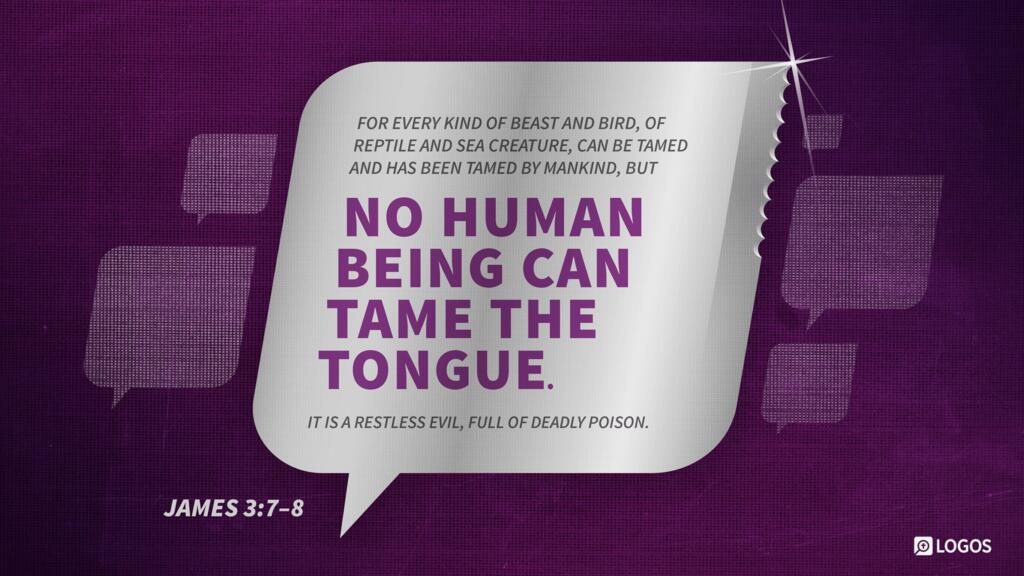
3:8But no human being can subdue the tongue; it is a restless16 evil, full of deadly poison.
Footnotes
- 16 Most (C Ψ 1739c 𝔐 as well as a few versions and fathers) read “uncontrollable” (ἀκατασχετόν, akatascheton), while the most important witnesses (א A B K P 1739* latt) have “restless” (ἀκατάστατον, akatastaton). Externally, the latter reading should be preferred. Internally, however, things get a bit more complex. The notion of being uncontrollable is well suited to the context, especially as a counterbalance to v. 8a, though for this very reason scribes may have been tempted to replace ἀκατάστατον with ἀκατασχετόν. However, in a semantically parallel early Christian text, ἀκατάστατος (akatastatos) was considered strong enough of a term to denounce slander as “a restless demon” ( 27:3). On the other hand, ἀκατάστατον may have been substituted for ἀκατασχετόν by way of assimilation to 1:8 (especially since both words were relatively rare, scribes may have replaced the less familiar with one that was already used in this letter). On internal evidence, it is difficult to decide, though ἀκατασχετόν is slightly preferred. However, in light of the strong support for ἀκατάστατον, and the less-than-decisive internal evidence, ἀκατάστατον is preferred instead.
The NET Bible First Edition, Copyright 1996-2005 by Biblical Studies Press
In other versions
ESVEnglish Standard Version
but no human being can tame the tongue. It is a restless evil, full of deadly poison.
Copyright 2001 Crossway Bibles
NIVNew International Version (2011)
but no human being can tame the tongue. It is a restless evil, full of deadly poison.
Copyright 1973, 1978, 1984, 2011 Biblica, Inc.
CSBChristian Standard Bible
but no one can tame the tongue. It is a restless evil, full of deadly poison.
Copyright 2017 Holman Bible Publishers
NLTNew Living Translation
but no one can tame the tongue. It is restless and evil, full of deadly poison.
Holy Bible, New Living Translation, copyright © 1996, 2004, 2015 by Tyndale House Foundation. Used by permission of Tyndale House Publishers. All rights reserved.
LEBThe Lexham English Bible
but no human being is able to tame the tongue. It is a restless evil, full of deadly poison.
Copyright 2012 Lexham Press
KJV 1900King James Version
But the tongue can no man tame; it is an unruly evil, full of deadly poison.
Public Domain