James 3:1–12
The NET BibleOther versions
English
- NET The NET Bible
- DARBY 1890 Darby Bible
- ASV American Standard Version
- AV 1873 The Cambridge Paragraph Bible of the Authorized English Version
- CSB Christian Standard Bible
- D-R Douay-Rheims Bible
- ESV English Standard Version
- GW GOD’S WORD Translation
- GNB Good News Translation
- HCSB The Holman Christian Standard Bible
- KJV 1900 King James Version
- LSB Legacy Standard Bible
- LEB The Lexham English Bible
- MSG The Message: The Bible in Contemporary Language
- NASB95 New American Standard Bible (1995)
- NCV New Century Version
- NIrV New International Reader’s Version (1998)
- NIV New International Version (2011)
- NKJV The New King James Version
- NLT New Living Translation
- NRSVue New Revised Standard Version: Updated Edition
- RSV The Revised Standard Version
- RSVCE The Revised Standard Version, Catholic Edition
- TNIV Today’s New International Version
- YLT Young’s Literal Translation
Arabic
Czech
French
German
Greek
Hungarian
Italian
Korean
Latin
Portuguese
Russian
Simplified Chinese
Spanish
Traditional Chinese
The Power of the Tongue
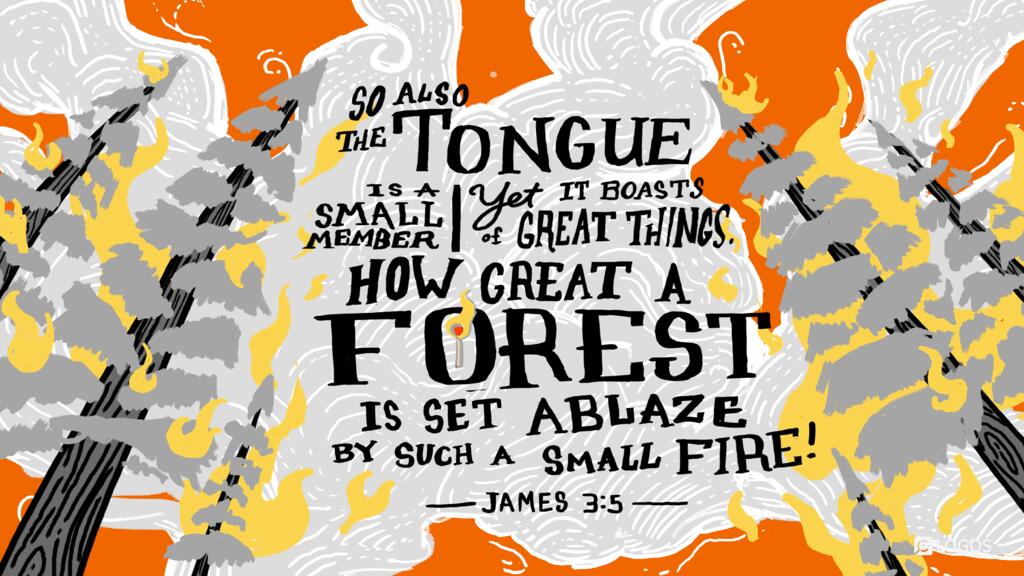
3:1Not many of you should become teachers, my brothers and sisters,1 because you know that we will be judged more strictly.23:2For we all stumble3 in many ways. If someone does not stumble4 in what he says,5 he is a perfect individual,6 able to control the entire body as well. 3:3And if we put bits into the mouths of horses to get them to obey us, then we guide their entire bodies.73:4Look at ships too: Though they are so large and driven by harsh winds, they are steered by a tiny rudder wherever the pilot’s inclination directs. 3:5So too the tongue is a small part of the body,8 yet it has great pretensions.9 Think10 how small a flame sets a huge forest ablaze. 3:6And the tongue is a fire! The tongue represents11 the world of wrongdoing among the parts of our bodies. It12 pollutes the entire body and sets fire to the course of human existence—and is set on fire by hell.13
3:7For every kind of animal, bird, reptile, and sea creature14 is subdued and has been subdued by humankind.153:8But no human being can subdue the tongue; it is a restless16 evil, full of deadly poison. 3:9With it we bless the Lord17 and Father, and with it we curse people18 made in God’s image. 3:10From the same mouth come blessing and cursing. These things should not be so, my brothers and sisters.193:11A spring does not pour out fresh water and bitter water from the same opening, does it? 3:12Can a fig tree produce olives, my brothers and sisters,20 or a vine produce figs? Neither can a salt water spring produce fresh water.
Footnotes
- 1 Grk “brothers.” See note on the phrase “brothers and sisters” in .
- 2 Grk “will receive a greater judgment.”
- 3 Or “fail.”
- 4 Or “fail.”
- 5 Grk “in speech.”
- 6 The word for “man” or “individual” is ἀνήρ (anēr), which often means “male” or “man (as opposed to woman).” But it sometimes is used generically to mean “anyone,” “a person,” as here (cf. 2).
- 7 Grk “their entire body.”
- 8 Grk “a small member.”
- 9 Grk “boasts of great things.”
- 10 Grk “Behold.”
- 11 Grk “makes itself,” “is made.”
- 12 Because of the length and complexity of the Greek sentence, a new sentence was started here in the translation.
- 13 The word translated hell is “Gehenna” (γέεννα, geenna), a Greek transliteration of the Hebrew words ge hinnom (“Valley of Hinnom”). This was the valley along the south side of Jerusalem. In OT times it was used for human sacrifices to the pagan god Molech (cf. Jer 7:31; 19:5–6; 32:35), and it came to be used as a place where human excrement and rubbish were disposed of and burned. In the intertestamental period, it came to be used symbolically as the place of divine punishment (cf. 27:2, 90:26; 4 Ezra 7:36).
- 14 Grk (plurals), “every kind of animals and birds, of reptiles and sea creatures.”
- 15 Grk “the human species.”
- 16 Most (C Ψ 1739c 𝔐 as well as a few versions and fathers) read “uncontrollable” (ἀκατασχετόν, akatascheton), while the most important witnesses (א A B K P 1739* latt) have “restless” (ἀκατάστατον, akatastaton). Externally, the latter reading should be preferred. Internally, however, things get a bit more complex. The notion of being uncontrollable is well suited to the context, especially as a counterbalance to v. 8a, though for this very reason scribes may have been tempted to replace ἀκατάστατον with ἀκατασχετόν. However, in a semantically parallel early Christian text, ἀκατάστατος (akatastatos) was considered strong enough of a term to denounce slander as “a restless demon” ( 27:3). On the other hand, ἀκατάστατον may have been substituted for ἀκατασχετόν by way of assimilation to 1:8 (especially since both words were relatively rare, scribes may have replaced the less familiar with one that was already used in this letter). On internal evidence, it is difficult to decide, though ἀκατασχετόν is slightly preferred. However, in light of the strong support for ἀκατάστατον, and the less-than-decisive internal evidence, ἀκατάστατον is preferred instead.
- 17 Most later (𝔐), along with several versional witnesses, have θεόν (theon, “God”) here instead of κύριον (kurion, “Lord”). Such is a predictable variant since nowhere else in the NT is God described as “Lord and Father,” but he is called “God and Father” on several occasions. Further, the reading κύριον is well supported by early and diversified witnesses (𝔓20 א A B C P Ψ 33 81 945 1241 1739), rendering it as the overwhelmingly preferred reading.
- 18 Grk “men”; but here ἀνθρώπους (anthrōpous) has generic force, referring to both men and women.
- 19 Grk “brothers.” See note on the phrase “brothers and sisters” in .
- 20 Grk “brothers.” See note on the phrase “brothers and sisters” in .
The NET Bible First Edition, Copyright 1996-2005 by Biblical Studies Press