Isaiah 6:1–5
The NET BibleOther versions
English
- NET The NET Bible
- DARBY 1890 Darby Bible
- ASV American Standard Version
- AV 1873 The Cambridge Paragraph Bible of the Authorized English Version
- CSB Christian Standard Bible
- D-R Douay-Rheims Bible
- ESV English Standard Version
- GW GOD’S WORD Translation
- GNB Good News Translation
- HCSB The Holman Christian Standard Bible
- KJV 1900 King James Version
- LSB Legacy Standard Bible
- LEB The Lexham English Bible
- MSG The Message: The Bible in Contemporary Language
- NASB95 New American Standard Bible (1995)
- NCV New Century Version
- NIrV New International Reader’s Version (1998)
- NIV New International Version (2011)
- NKJV The New King James Version
- NLT New Living Translation
- NRSVue New Revised Standard Version: Updated Edition
- RSV The Revised Standard Version
- RSVCE The Revised Standard Version, Catholic Edition
- TNIV Today’s New International Version
- YLT Young’s Literal Translation
Arabic
Czech
French
German
Hebrew
Hungarian
Italian
Korean
Latin
Portuguese
Russian
Simplified Chinese
Spanish
Traditional Chinese
Isaiah’s Commission
6:1In the year of King Uzziah’s death,1 I saw the sovereign master2 seated on a high, elevated throne. The hem of his robe filled the temple. 6:2Seraphs3 stood over him; each one had six wings. With two wings they covered their faces, with two they covered their feet,4 and they used the remaining two to fly. 6:3They called out to one another, “Holy, holy, holy5 is the Lord who commands armies!6 His majestic splendor fills the entire earth!” 6:4The sound of their voices shook the door frames,7 and the temple was filled with smoke.
6:5I said, “Too bad for me! I am destroyed,8 for my lips are contaminated by sin,9 and I live among people whose lips are contaminated by sin.10 My eyes have seen the king, the Lord who commands armies.”11
Footnotes
- 1 That is, approximately 740 b.c.
- 2 The Hebrew term translated “sovereign master” here and in vv. 8, 11 is אֲדֹנָי (’adonay).
- 3 Hebrew שָׂרָף (saraf, “seraph”) literally means “burning one,” perhaps suggesting that these creatures had a fiery appearance (cf. , “flaming creatures”; “heavenly creatures of fire”). Elsewhere in the OT the word “seraph” refers to poisonous snakes (Num 21:6; Deut 8:15; Isa 14:29; 30:6). Perhaps they were called “burning ones” because of their appearance or the effect of their venomous bites, which would cause a victim to burn up with fever. It is possible that the seraphs seen by Isaiah were at least partially serpentine in appearance. Though it might seem strange for a snake-like creature to have wings, two of the texts where “seraphs” are snakes describe them as “flying” (Isa 14:29; 30:6), perhaps referring to their darting movements. See the note at .
- 4 Some understand “feet” here as a euphemistic reference to the genitals.
- 5 Some have seen a reference to the Trinity in the seraphs’ threefold declaration, “holy, holy, holy.” This proposal has no linguistic or contextual basis and should be dismissed as allegorical. Hebrew sometimes uses repetition for emphasis. (See §12.5a; and §133.k.) By repeating the word “holy,” the seraphs emphasize the degree of the Lord’s holiness. For another example of threefold repetition for emphasis, see Ezek 21:27 (Heb. v. 32). (Perhaps Jer 22:29 provides another example.) Or “The Lord who commands armies has absolute sovereign authority!” The basic sense of the word “holy” is “set apart from that which is commonplace, special, unique.” In this context the Lord’s holiness is first and foremost his transcendent sovereignty as the ruler of the world. He is “set apart” from the world over which he rules. Note the emphasis on the elevated position of his throne in v. 1 and his designation as “the king” in v. 5. At the same time his holiness encompasses his moral authority, which derives from his royal position. As king he has the right to dictate to his subjects how they are to live; indeed his very own character sets the standard for proper behavior. He is “set apart” from his subjects in a moral sense as well. He sets the standard; they fall short of it. Note that in v. 5 Isaiah laments that he is morally unworthy to be in the king’s presence.
- 6 Perhaps in this context, the title has a less militaristic connotation and pictures the Lord as the ruler of the heavenly assembly. See the note at .
- 7 On the phrase אַמּוֹת הַסִּפִּים (’ammot hassippim, “pivots of the frames”) see סַף.
- 8 Isaiah uses the suffixed (perfect) form of the verb for rhetorical purposes. In this way his destruction is described as occurring or as already completed. Rather than understanding the verb as derived from דָּמַה (damah, “be destroyed”), some take it from a proposed homonymic root דמה, which would mean “be silent.” In this case, one might translate, “I must be silent.”
- 9 Heb “a man unclean of lips am I.” Isaiah is not qualified to praise the king. His lips (the instruments of praise) are “unclean” because he has been contaminated by sin.
- 10 Heb “and among a nation unclean of lips I live.”
- 11 Perhaps in this context, the title has a less militaristic connotation and pictures the Lord as the ruler of the heavenly assembly. See the note at .
The NET Bible First Edition, Copyright 1996-2005 by Biblical Studies Press
In other versions
ESVEnglish Standard Version
In the year that King Uzziah died I saw the Lord sitting upon a throne, high and lifted up; and the train of his robe filled the temple. Above him stood the seraphim. Each had six wings: with two he covered his face, and with two he covered his feet, and with two he flew. And one called to another and said:
“Holy, holy, holy is the Lord of hosts;
the whole earth is full of his glory!”
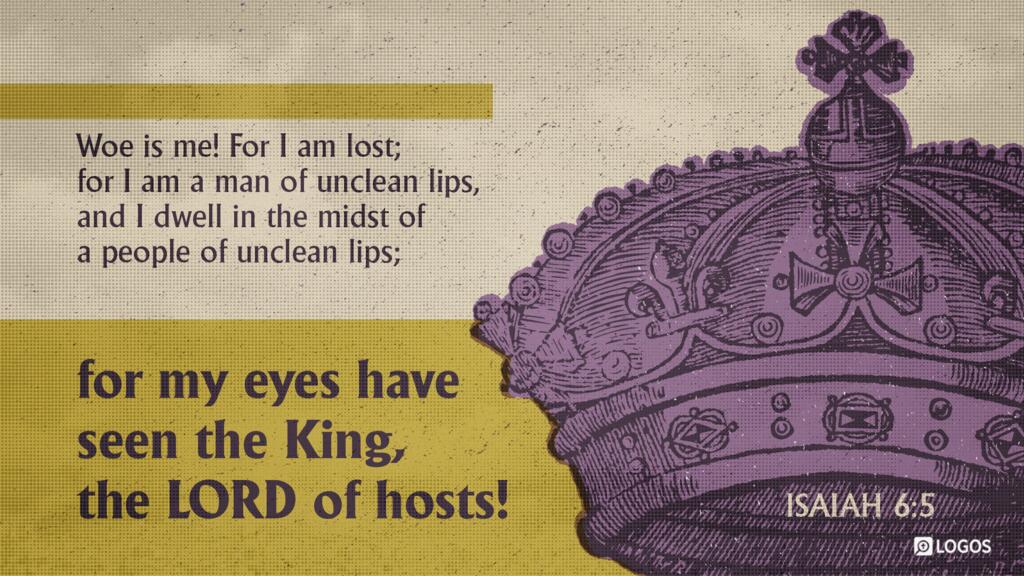
And the foundations of the thresholds shook at the voice of him who called, and the house was filled with smoke. And I said: “Woe is me! For I am lost; for I am a man of unclean lips, and I dwell in the midst of a people of unclean lips; for my eyes have seen the King, the Lord of hosts!”
Copyright 2001 Crossway Bibles
NIVNew International Version (2011)
In the year that King Uzziah died, I saw the Lord, high and exalted, seated on a throne; and the train of his robe filled the temple. Above him were seraphim, each with six wings: With two wings they covered their faces, with two they covered their feet, and with two they were flying. And they were calling to one another:
“Holy, holy, holy is the Lord Almighty;
the whole earth is full of his glory.”
At the sound of their voices the doorposts and thresholds shook and the temple was filled with smoke.
“Woe to me!” I cried. “I am ruined! For I am a man of unclean lips, and I live among a people of unclean lips, and my eyes have seen the King, the Lord Almighty.”
Copyright 1973, 1978, 1984, 2011 Biblica, Inc.
CSBChristian Standard Bible
In the year that King Uzziah died, I saw the Lord seated on a high and lofty throne, and the hem of his robe filled the temple. Seraphim were standing above him; they each had six wings: with two they covered their faces, with two they covered their feet, and with two they flew. And one called to another:
Holy, holy, holy is the Lord of Armies;
his glory fills the whole earth.
The foundations of the doorways shook at the sound of their voices, and the temple was filled with smoke.
Then I said:
Woe is me for I am ruined
because I am a man of unclean lips
and live among a people of unclean lips,
and because my eyes have seen the King,
the Lord of Armies.
Copyright 2017 Holman Bible Publishers
NLTNew Living Translation
It was in the year King Uzziah died that I saw the Lord. He was sitting on a lofty throne, and the train of his robe filled the Temple. Attending him were mighty seraphim, each having six wings. With two wings they covered their faces, with two they covered their feet, and with two they flew. They were calling out to each other,
“Holy, holy, holy is the Lord of Heaven’s Armies!
The whole earth is filled with his glory!”
Their voices shook the Temple to its foundations, and the entire building was filled with smoke.
Then I said, “It’s all over! I am doomed, for I am a sinful man. I have filthy lips, and I live among a people with filthy lips. Yet I have seen the King, the Lord of Heaven’s Armies.”
Holy Bible, New Living Translation, copyright © 1996, 2004, 2015 by Tyndale House Foundation. Used by permission of Tyndale House Publishers. All rights reserved.
LEBThe Lexham English Bible
In the year of the death of Uzziah the king, I saw the Lord sitting on a high and raised throne, and the hem of his robe was filling the temple. Seraphs were standing above him. Each had six wings: with two he covered his face, and with two he covered his feet, and with two he flew.
And the one called to the other and said,
“Holy, holy, holy is Yahweh of hosts!
The whole earth is full of his glory.”
And the pivots of the thresholds shook from the sound of those who called, and the house was filled with smoke.
And I said, “Woe to me! For I am destroyed! For I am a man of unclean lips, and I am living among a people of unclean lips, for my eyes have seen the king, Yahweh of hosts!”
Copyright 2012 Lexham Press
KJV 1900King James Version
In the year that king Uzziah died I saw also the Lord sitting upon a throne, high and lifted up, and his train filled the temple. Above it stood the seraphims: each one had six wings; with twain he covered his face, and with twain he covered his feet, and with twain he did fly. And one cried unto another, and said,
Holy, holy, holy, is the Lord of hosts:
The whole earth is full of his glory.
And the posts of the door moved at the voice of him that cried, and the house was filled with smoke. Then said I, Woe is me! for I am undone; because I am a man of unclean lips, and I dwell in the midst of a people of unclean lips: for mine eyes have seen the King, the Lord of hosts.
Public Domain