Hosea 12:6
The NET BibleOther versions
English
- NET The NET Bible
- DARBY 1890 Darby Bible
- ASV American Standard Version
- AV 1873 The Cambridge Paragraph Bible of the Authorized English Version
- CSB Christian Standard Bible
- D-R Douay-Rheims Bible
- ESV English Standard Version
- GW GOD’S WORD Translation
- GNB Good News Translation
- HCSB The Holman Christian Standard Bible
- KJV 1900 King James Version
- LSB Legacy Standard Bible
- LEB The Lexham English Bible
- MSG The Message: The Bible in Contemporary Language
- NASB95 New American Standard Bible (1995)
- NCV New Century Version
- NIrV New International Reader’s Version (1998)
- NIV New International Version (2011)
- NKJV The New King James Version
- NLT New Living Translation
- NRSVue New Revised Standard Version: Updated Edition
- RSV The Revised Standard Version
- RSVCE The Revised Standard Version, Catholic Edition
- TNIV Today’s New International Version
- YLT Young’s Literal Translation
Arabic
Czech
French
German
Hebrew
Hungarian
Italian
Korean
Latin
Portuguese
Russian
Simplified Chinese
Spanish
Traditional Chinese
12:6But you must return10 to your God,
by maintaining love and justice,
Footnotes
- 10 The verb תָשׁוּב (tashuv, Qal imperfect 2nd person masculine singular from שׁוּב, shuv, “to return”) functions as an imperfect of moral obligation, introducing the following imperatives (e.g., Gen 20:9; Exod 4:15). For this function of the imperfect, see §31.4g.
- 11 The verb וְקַוֵּה (véqavveh, vav + Piel imperative 2nd person masculine singular from קָוָה, qavah, “to wait for”) means “to hope for, wait for, look eagerly for” ( 875 קָוָה 1; קָוָה 2.b). The Qal meaning refers to a general hope; the Piel meaning refers to hope directed toward an object, or hope inserted within a sequence of expectation and fulfillment. When the Piel is used in reference to a thing, it refers to waiting expectantly for something to occur (e.g., Gen 49:18; Isa 5:2, 4, 7; 59:9, 11; Jer 8:15; 13:16; 14:19; Ps 69:21; Job 3:9; 6:19; 11:20). When it is used in reference to God, it refers to the people of God waiting expectantly for God to do something or to fulfill his promise (e.g., Pss 25:5, 21; 27:14; 37:34; 40:2; 52:11; 130:5; Isa 8:17; 25:9; 26:8; 33:2; 51:5; 60:9; Hos 12:7). The personal object can be introduced by the preposition לְ (lamed, “for”; קָוָה 2.a) or אֶל (’el, “for”; קָוָה 2.b; e.g., Pss 27:14; 37:34; Isa 51:5; Hos 12:7). The point seems to be that if Israel will repent and practice moral righteousness, she can look to God in confident expectation that he will intervene on her behalf by relenting from judgment and restoring the covenant blessings.
- 12 The phrase “to return to you” does not appear in the Hebrew text but is implied; it is provided in the translation for clarity. This ellipsis fills out the implicit connotations of the verb קָוָה (qavah, “to wait for”).
The NET Bible First Edition, Copyright 1996-2005 by Biblical Studies Press
In other versions
ESVEnglish Standard Version
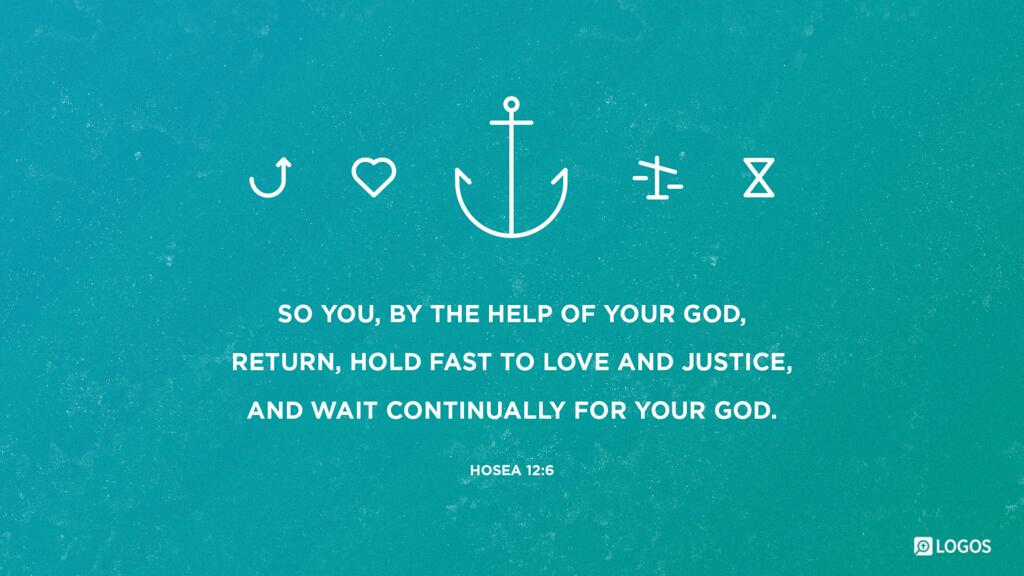
“So you, by the help of your God, return,
hold fast to love and justice,
and wait continually for your God.”
Copyright 2001 Crossway Bibles
NIVNew International Version (2011)
But you must return to your God;
maintain love and justice,
and wait for your God always.
Copyright 1973, 1978, 1984, 2011 Biblica, Inc.
CSBChristian Standard Bible
But you must return to your God.
Maintain love and justice,
and always put your hope in God.
Copyright 2017 Holman Bible Publishers
NLTNew Living Translation
So now, come back to your God.
Act with love and justice,
and always depend on him.
Holy Bible, New Living Translation, copyright © 1996, 2004, 2015 by Tyndale House Foundation. Used by permission of Tyndale House Publishers. All rights reserved.
LEBThe Lexham English Bible
But you, you must return to your God;
keep love and justice,
and wait continually for your God.
Copyright 2012 Lexham Press
KJV 1900King James Version
Therefore turn thou to thy God:
Keep mercy and judgment,
And wait on thy God continually.
Public Domain