Habakkuk 2:3
The NET BibleOther versions
English
- NET The NET Bible
- DARBY 1890 Darby Bible
- ASV American Standard Version
- AV 1873 The Cambridge Paragraph Bible of the Authorized English Version
- CSB Christian Standard Bible
- D-R Douay-Rheims Bible
- ESV English Standard Version
- GW GOD’S WORD Translation
- GNB Good News Translation
- HCSB The Holman Christian Standard Bible
- KJV 1900 King James Version
- LSB Legacy Standard Bible
- LEB The Lexham English Bible
- MSG The Message: The Bible in Contemporary Language
- NASB95 New American Standard Bible (1995)
- NCV New Century Version
- NIrV New International Reader’s Version (1998)
- NIV New International Version (2011)
- NKJV The New King James Version
- NLT New Living Translation
- NRSVue New Revised Standard Version: Updated Edition
- RSV The Revised Standard Version
- RSVCE The Revised Standard Version, Catholic Edition
- TNIV Today’s New International Version
- YLT Young’s Literal Translation
Arabic
Czech
French
German
Hebrew
Hungarian
Italian
Korean
Latin
Portuguese
Russian
Simplified Chinese
Spanish
Traditional Chinese
2:3For the message is a witness to what is decreed;8
it gives reliable testimony about how matters will turn out.9
Even if the message10 is not fulfilled right away, wait patiently;11
for it will certainly come to pass—it will not arrive late.
Footnotes
- 8 Heb “For the vision is still for the appointed time.” The Hebrew word עוֹד (’od, “still”) is better emended to עֵד (’ed, “witness”) in light of the parallelism (see the note on the word “turn out” in the following line). The “appointed time” refers to the time when the divine judgment anticipated in vv. 6–20 will be realized.
- 9 Heb “and a witness to the end and it does not lie.” The Hebrew term יָפֵחַ (yafeakh) has been traditionally understood as a verb form from the root פּוּחַ (puakh, “puff, blow”; cf. “it will come in breathless haste”; “it hastens toward the goal”) but recent scholarship has demonstrated that it is actually a noun meaning “witness” (cf. “it speaks of the end / and will not prove false”; “it speaks of the end, and does not lie”). See J. J. M. Roberts, Nahum, Habakkuk, and Zephaniah (), 106. “The end” corresponds to “the appointed time” of the preceding line and refers to the time when the prophecy to follow will be fulfilled.
- 10 Heb “it”; the referent (the message) has been specified in the translation for clarity.
- 11 Heb “If it should delay, wait for it.” The Hebrew word חָזוֹן (khazon, “vision, message”) is the subject of the third person verbs in v. 3 and the antecedent of the pronominal suffix in the phrase “for it.”
The NET Bible First Edition, Copyright 1996-2005 by Biblical Studies Press
In other versions
ESVEnglish Standard Version
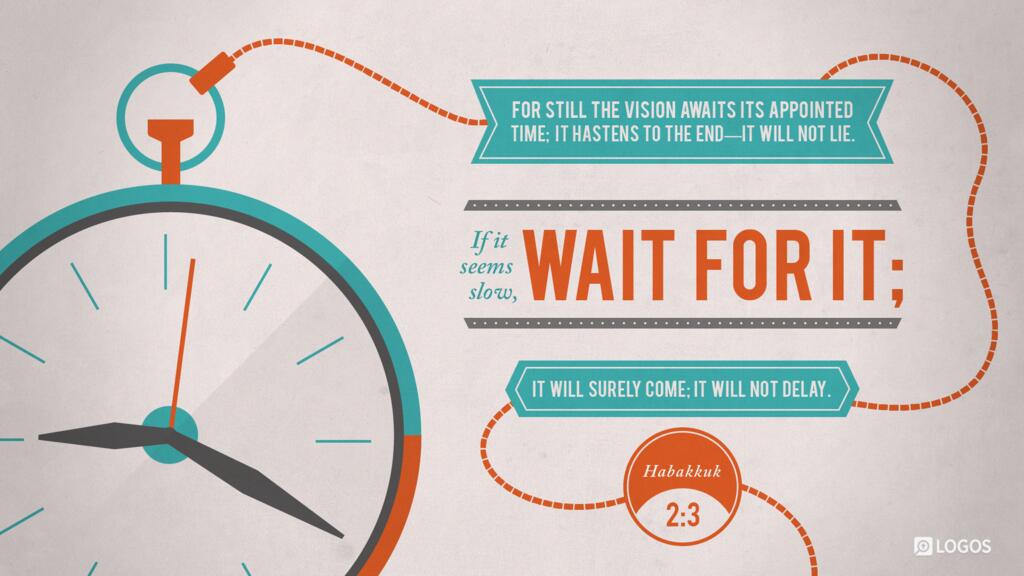
For still the vision awaits its appointed time;
it hastens to the end—it will not lie.
If it seems slow, wait for it;
it will surely come; it will not delay.
Copyright 2001 Crossway Bibles
NIVNew International Version (2011)
For the revelation awaits an appointed time;
it speaks of the end
and will not prove false.
Though it linger, wait for it;
it will certainly come
and will not delay.
Copyright 1973, 1978, 1984, 2011 Biblica, Inc.
CSBChristian Standard Bible
For the vision is yet for the appointed time;
it testifies about the end and will not lie.
Though it delays, wait for it,
since it will certainly come and not be late.
Copyright 2017 Holman Bible Publishers
NLTNew Living Translation
This vision is for a future time.
It describes the end, and it will be fulfilled.
If it seems slow in coming, wait patiently,
for it will surely take place.
It will not be delayed.
Holy Bible, New Living Translation, copyright © 1996, 2004, 2015 by Tyndale House Foundation. Used by permission of Tyndale House Publishers. All rights reserved.
LEBThe Lexham English Bible
For there is yet a vision for the appointed time;
it will give witness to the end, and it will not lie.
If it tarries, wait for it,
for it will surely come and not delay.
Copyright 2012 Lexham Press
KJV 1900King James Version
For the vision is yet for an appointed time,
But at the end it shall speak, and not lie:
Though it tarry, wait for it;
Because it will surely come, it will not tarry.
Public Domain