Genesis 22:1–14
The NET BibleOther versions
English
- NET The NET Bible
- DARBY 1890 Darby Bible
- ASV American Standard Version
- AV 1873 The Cambridge Paragraph Bible of the Authorized English Version
- CSB Christian Standard Bible
- D-R Douay-Rheims Bible
- ESV English Standard Version
- GW GOD’S WORD Translation
- GNB Good News Translation
- HCSB The Holman Christian Standard Bible
- KJV 1900 King James Version
- LSB Legacy Standard Bible
- LEB The Lexham English Bible
- MSG The Message: The Bible in Contemporary Language
- NASB95 New American Standard Bible (1995)
- NCV New Century Version
- NIrV New International Reader’s Version (1998)
- NIV New International Version (2011)
- NKJV The New King James Version
- NLT New Living Translation
- NRSVue New Revised Standard Version: Updated Edition
- RSV The Revised Standard Version
- RSVCE The Revised Standard Version, Catholic Edition
- TNIV Today’s New International Version
- YLT Young’s Literal Translation
Arabic
Czech
French
German
Hebrew
Hungarian
Italian
Korean
Latin
Portuguese
Russian
Simplified Chinese
Spanish
Traditional Chinese
The Sacrifice of Isaac
22:1Some time after these things God tested1 Abraham. He said to him, “Abraham!” “Here I am!” Abraham2 replied. 22:2God3 said, “Take your son—your only son, whom you love, Isaac4—and go to the land of Moriah!5 Offer him up there as a burnt offering6 on one of the mountains which I will indicate to7 you.”
22:3Early in the morning Abraham got up and saddled his donkey.8 He took two of his young servants with him, along with his son Isaac. When he had cut the wood for the burnt offering, he started out9 for the place God had spoken to him about.
22:4On the third day Abraham caught sight of10 the place in the distance. 22:5So he11 said to his servants, “You two stay12 here with the donkey while13 the boy and I go up there. We will worship14 and then return to you.”15
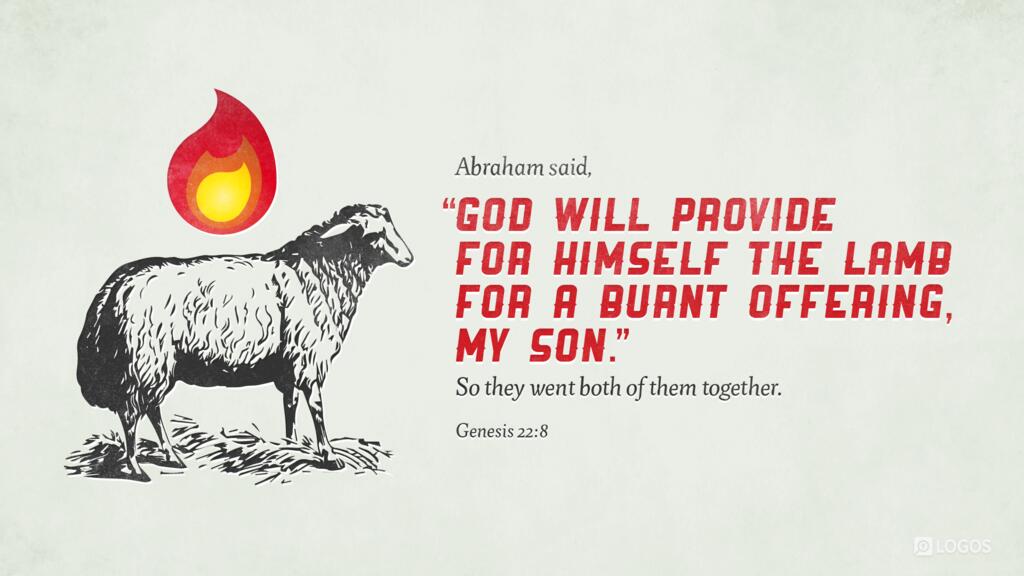
22:6Abraham took the wood for the burnt offering and put it on his son Isaac. Then he took the fire and the knife in his hand,16 and the two of them walked on together. 22:7Isaac said to his father Abraham,17 “My father?” “What is it,18 my son?” he replied. “Here is the fire and the wood,” Isaac said,19 “but where is the lamb for the burnt offering?” 22:8“God will provide20 for himself the lamb for the burnt offering, my son,” Abraham replied. The two of them continued on together.
22:9When they came to the place God had told him about, Abraham built the altar there21 and arranged the wood on it. Next he tied up22 his son Isaac and placed him on the altar on top of the wood. 22:10Then Abraham reached out his hand, took the knife, and prepared to slaughter23 his son. 22:11But the Lord’s angel24 called to him from heaven, “Abraham! Abraham!” “Here I am!” he answered. 22:12“Do not harm the boy!”25 the angel said.26 “Do not do anything to him, for now I know27 that you fear28 God because you did not withhold your son, your only son, from me.”
22:13Abraham looked up29 and saw30 behind him31 a ram caught in the bushes by its horns. So he32 went over and got the ram and offered it up as a burnt offering instead of his son. 22:14And Abraham called the name of that place “The Lord provides.”33 It is said to this day,34 “In the mountain of the Lord provision will be made.”35
Footnotes
- 1 The Hebrew verb used here means “to test; to try; to prove.” In this passage God tests Abraham to see if he would be obedient. See T. W. Mann, The Book of the Torah, 44–48. See also J. L. Crenshaw, A Whirlpool of Torment (), 9–30; and J. I. Lawlor, “The Test of Abraham,” 1 (1980): .
- 2 Heb “he”; the referent (Abraham) has been specified in the translation for clarity.
- 3 Heb “he”; the referent (God) has been specified in the translation for clarity.
- 4 Take your son … Isaac. The instructions are very clear, but the details are deliberate. With every additional description the commandment becomes more challenging.
- 5 There has been much debate over the location of Moriah; 2 Chr 3:1 suggests it may be the site where the temple was later built in Jerusalem.
- 6 A whole burnt offering signified the complete surrender of the worshiper and complete acceptance by God. The demand for a human sacrifice was certainly radical and may have seemed to Abraham out of character for God. Abraham would have to obey without fully understanding what God was about.
- 7 Heb “which I will say to.”
- 8 Heb “Abraham rose up early in the morning and saddled his donkey.”
- 9 Heb “he arose and he went.”
- 10 Heb “lifted up his eyes and saw.”
- 11 Heb “And Abraham.” The proper name has been replaced in the translation by the pronoun (“he”) for stylistic reasons.
- 12 The Hebrew verb is masculine plural, referring to the two young servants who accompanied Abraham and Isaac on the journey.
- 13 The disjunctive clause (with the compound subject preceding the verb) may be circumstantial and temporal.
- 14 This Hebrew word literally means “to bow oneself close to the ground.” It often means “to worship.”
- 15 It is impossible to know what Abraham was thinking when he said, “we will … return to you.” When he went he knew (1) that he was to sacrifice Isaac, and (2) that God intended to fulfill his earlier promises through Isaac. How he reconciled those facts is not clear in the text. Heb 11:17–19 suggests that Abraham believed God could restore Isaac to him through resurrection.
- 16 He took the fire and the knife in his hand. These details anticipate the sacrifice that lies ahead.
- 17 The Hebrew text adds “and said.” This is redundant and has not been translated for stylistic reasons.
- 18 Heb “Here I am” (cf. Gen 22:1).
- 19 Heb “and he said, ‘Here is the fire and the wood.’ ” The referent (Isaac) has been specified in the translation for clarity. Here and in the following verse the order of the introductory clauses and the direct discourse has been rearranged in the translation for stylistic reasons.
- 20 Heb “will see for himself.” The construction means “to look out for; to see to it; to provide.” God will provide is the central theme of the passage and the turning point in the story. Note Paul’s allusion to the story in Rom 8:32 (“how shall he not freely give us all things?”) as well as H. J. Schoeps, “The Sacrifice of Isaac in Paul’s Theology,” 65 (1946): 385–92.
- 21 Abraham built an altar there. The theme of Abraham’s altar building culminates here. He has been a faithful worshiper. Will he continue to worship when called upon to make such a radical sacrifice?
- 22 Then he tied up. This text has given rise to an important theme in Judaism known as the Aqedah, from the Hebrew word for “binding.” When sacrifices were made in the sanctuary, God remembered the binding of Isaac, for which a substitute was offered. See D. Polish, “The Binding of Isaac,” 6 (1957): 17–21.
- 23 Heb “in order to slaughter.”
- 24 Heb “the messenger of the Lord” (also in v. 15). Some identify the angel of the Lord as the preincarnate Christ because in some texts the angel is identified with the Lord himself. However, see the note on the phrase “the Lord’s angel” in .
- 25 Heb “Do not extend your hand toward the boy.”
- 26 Heb “and he said, ‘Do not extend …’ ”; the referent (the angel) has been specified in the context for clarity. The order of the introductory clause and the direct discourse has been rearranged in the translation for stylistic reasons.
- 27 For now I know. The test was designed to see if Abraham would be obedient (see v. 1).
- 28 In this context fear refers by metonymy to obedience that grows from faith.
- 29 Heb “lifted his eyes.”
- 30 Heb “and saw, and look.” The particle הִנֵּה (hinneh, “look”) draws attention to what Abraham saw and invites the audience to view the scene through his eyes.
- 31 The translation follows the reading of the ; a number of Hebrew , the , , and Samaritan Pentateuch read “one” (אֶחָד, ’ekhad) instead of “behind him” (אַחַר, ’akhar).
- 32 Heb “Abraham”; the proper name has been replaced by the pronoun (“he”) in the translation for stylistic reasons.
- 33 Heb “the Lord sees” (יְהוָה יִרְאֶה, yéhvah yir’eh, traditionally transliterated “Jehovah Jireh”; see the note on the word “provide” in v. ). By so naming the place Abraham preserved in the memory of God’s people the amazing event that took place there.
- 34 On the expression to this day see B. Childs, “A Study of the Formula ‘Until this Day’,” 82 (1963): 279–92.
- 35 The saying connected with these events has some ambiguity, which was probably intended. The Niphal verb could be translated (1) “in the mountain of the Lord it will be seen/provided” or (2) “in the mountain the Lord will appear.” If the temple later stood here (see the note on “Moriah” in ), the latter interpretation might find support, for the people went to the temple to appear before the Lord, who “appeared” to them by providing for them his power and blessings. See S. R. Driver, Genesis, 219.
The NET Bible First Edition, Copyright 1996-2005 by Biblical Studies Press