Genesis 2:18–19
The NET BibleOther versions
English
- NET The NET Bible
- DARBY 1890 Darby Bible
- ASV American Standard Version
- AV 1873 The Cambridge Paragraph Bible of the Authorized English Version
- CSB Christian Standard Bible
- D-R Douay-Rheims Bible
- ESV English Standard Version
- GW GOD’S WORD Translation
- GNB Good News Translation
- HCSB The Holman Christian Standard Bible
- KJV 1900 King James Version
- LSB Legacy Standard Bible
- LEB The Lexham English Bible
- MSG The Message: The Bible in Contemporary Language
- NASB95 New American Standard Bible (1995)
- NCV New Century Version
- NIrV New International Reader’s Version (1998)
- NIV New International Version (2011)
- NKJV The New King James Version
- NLT New Living Translation
- NRSVue New Revised Standard Version: Updated Edition
- RSV The Revised Standard Version
- RSVCE The Revised Standard Version, Catholic Edition
- TNIV Today’s New International Version
- YLT Young’s Literal Translation
Arabic
Czech
French
German
Hebrew
Hungarian
Italian
Korean
Latin
Portuguese
Russian
Simplified Chinese
Spanish
Traditional Chinese
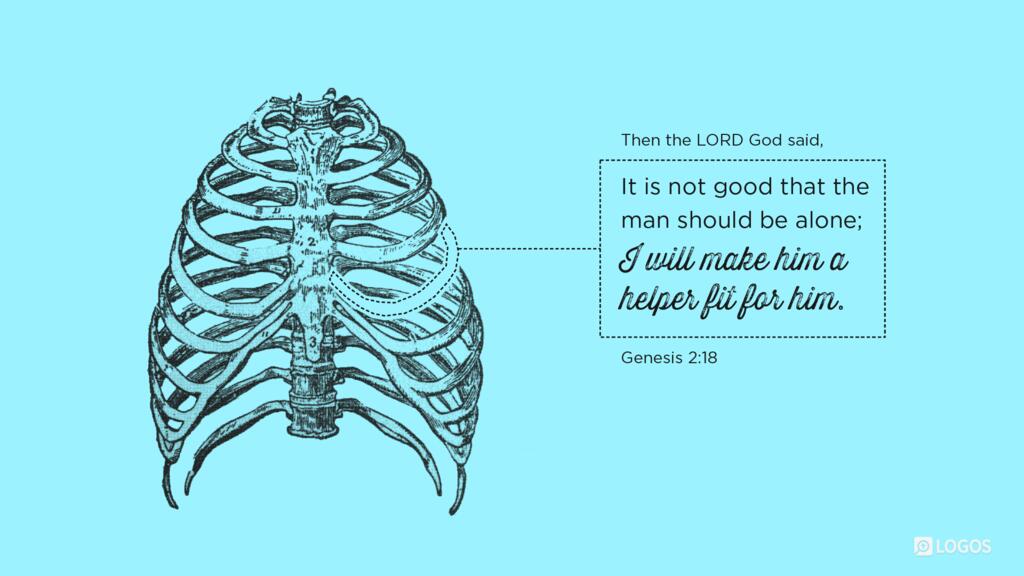
2:18The Lord God said, “It is not good for the man to be alone.55 I will make a companion56 for him who corresponds to him.”57 2:19The Lord God formed58 out of the ground every living animal of the field and every bird of the air. He brought them to the man to see what he would59 name them, and whatever the man called each living creature, that was its name.
Footnotes
- 55 Heb “The being of man by himself is not good.” The meaning of “good” must be defined contextually. Within the context of creation, in which God instructs humankind to be fruitful and multiply, the man alone cannot comply. Being alone prevents the man from fulfilling the design of creation and therefore is not good.
- 56 Traditionally “helper.” The English word “helper,” because it can connote so many different ideas, does not accurately convey the connotation of the Hebrew word עֵזֶר (’ezer). Usage of the Hebrew term does not suggest a subordinate role, a connotation which English “helper” can have. In the Bible God is frequently described as the “helper,” the one who does for us what we cannot do for ourselves, the one who meets our needs. In this context the word seems to express the idea of an “indispensable companion.” The woman would supply what the man was lacking in the design of creation and logically it would follow that the man would supply what she was lacking, although that is not stated here. See further M. L. Rosenzweig, “A Helper Equal to Him,” 139 (1986): 277–80.
- 57 The Hebrew expression כְּנֶגְדּוֹ (kénegdo) literally means “according to the opposite of him.” Translations such as “suitable [for]” (, ), “matching,” “corresponding to” all capture the idea. (Translations that render the phrase simply “partner” [cf. , ], while not totally inaccurate, do not reflect the nuance of correspondence and/or suitability.) The man’s form and nature are matched by the woman’s as she reflects him and complements him. Together they correspond. In short, this prepositional phrase indicates that she has everything that God had invested in him.
- 58 Or “fashioned.” To harmonize the order of events with the chronology of chapter one, some translate the prefixed verb form with vav (ו) consecutive as a past perfect (“had formed,” cf. ) here. (In chapter one the creation of the animals preceded the creation of man; here the animals are created after the man.) However, it is unlikely that the Hebrew construction can be translated in this way in the middle of this pericope, for the criteria for unmarked temporal overlay are not present here. See S. R. Driver, A Treatise on the Use of the Tenses in Hebrew, , and especially R. Buth, “Methodological Collision between Source Criticism and Discourse Analysis,” Biblical Hebrew and Discourse Linguistics, 138–54. For a contrary viewpoint see §33.2.3 and C. J. Collins, “The Wayyiqtol as ‘Pluperfect’: When and Why,” 46 (1995): .
- 59 The imperfect verb form is future from the perspective of the past time narrative.
The NET Bible First Edition, Copyright 1996-2005 by Biblical Studies Press
In other versions
ESVEnglish Standard Version
Then the Lord God said, “It is not good that the man should be alone; I will make him a helper fit for him.” Now out of the ground the Lord God had formed every beast of the field and every bird of the heavens and brought them to the man to see what he would call them. And whatever the man called every living creature, that was its name.
Copyright 2001 Crossway Bibles
NIVNew International Version (2011)
The Lord God said, “It is not good for the man to be alone. I will make a helper suitable for him.”
Now the Lord God had formed out of the ground all the wild animals and all the birds in the sky. He brought them to the man to see what he would name them; and whatever the man called each living creature, that was its name.
Copyright 1973, 1978, 1984, 2011 Biblica, Inc.
CSBChristian Standard Bible
Then the Lord God said, “It is not good for the man to be alone. I will make a helper corresponding to him.” The Lord God formed out of the ground every wild animal and every bird of the sky, and brought each to the man to see what he would call it. And whatever the man called a living creature, that was its name.
Copyright 2017 Holman Bible Publishers
NLTNew Living Translation
Then the Lord God said, “It is not good for the man to be alone. I will make a helper who is just right for him.” So the Lord God formed from the ground all the wild animals and all the birds of the sky. He brought them to the man to see what he would call them, and the man chose a name for each one.
Holy Bible, New Living Translation, copyright © 1996, 2004, 2015 by Tyndale House Foundation. Used by permission of Tyndale House Publishers. All rights reserved.
LEBThe Lexham English Bible
Then Yahweh God said, “it is not good that the man is alone. I will make for him a helper as his counterpart.” And out of the ground Yahweh God formed every beast of the field and every bird of the sky, and he brought each to the man to see what he would call it. And whatever the man called that living creature was its name.
Copyright 2012 Lexham Press
KJV 1900King James Version
And the Lord God said, It is not good that the man should be alone; I will make him an help meet for him. And out of the ground the Lord God formed every beast of the field, and every fowl of the air; and brought them unto Adam to see what he would call them: and whatsoever Adam called every living creature, that was the name thereof.
Public Domain