Genesis 1:3–4
The NET BibleOther versions
English
- NET The NET Bible
- DARBY 1890 Darby Bible
- ASV American Standard Version
- AV 1873 The Cambridge Paragraph Bible of the Authorized English Version
- CSB Christian Standard Bible
- D-R Douay-Rheims Bible
- ESV English Standard Version
- GW GOD’S WORD Translation
- GNB Good News Translation
- HCSB The Holman Christian Standard Bible
- KJV 1900 King James Version
- LSB Legacy Standard Bible
- LEB The Lexham English Bible
- MSG The Message: The Bible in Contemporary Language
- NASB95 New American Standard Bible (1995)
- NCV New Century Version
- NIrV New International Reader’s Version (1998)
- NIV New International Version (2011)
- NKJV The New King James Version
- NLT New Living Translation
- NRSVue New Revised Standard Version: Updated Edition
- RSV The Revised Standard Version
- RSVCE The Revised Standard Version, Catholic Edition
- YLT Young’s Literal Translation
Arabic
Czech
French
German
Hebrew
Hungarian
Italian
Korean
Latin
Portuguese
Russian
Simplified Chinese
Spanish
Traditional Chinese
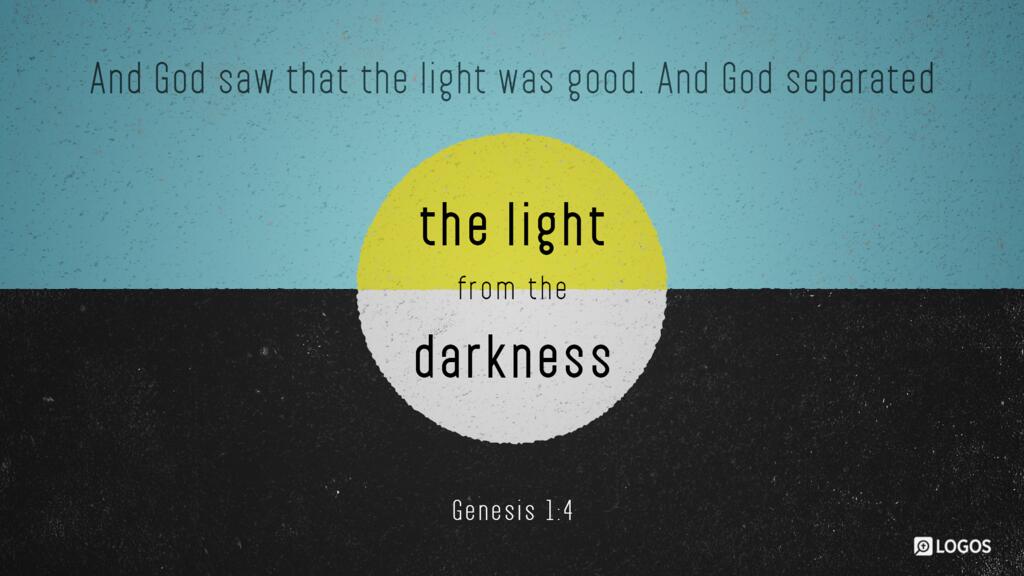
1:3God said,14 “Let there be15 light.”16 And there was light! 1:4God saw17 that the light was good,18 so God separated19 the light from the darkness.
Footnotes
- 14 The prefixed verb form with the vav (ו) consecutive introduces the narrative sequence. Ten times in the chapter the decree of God in creation will be so expressed. For the power of the divine word in creation, see Ps 33:9, John 1:1–3, 1 Cor 8:6, and Col 1:16. God said. By speaking, God brings the world into existence. The efficacious nature of the word of the Lord is a prominent theme in this chapter. It introduces the Law, the words and commandments from the Lord that must be obeyed. The ten decrees of God in this chapter anticipate the ten words in the Decalogue (Exod 20:2–17).
- 15 “Let there be” is the short jussive form of the verb “to be”; the following expression “and there was” is the short preterite form of the same verb. As such, יְהִי (yéhi) and וַיְהִי (vayéhi) form a profound wordplay to express both the calling into existence and the complete fulfillment of the divine word.
- 16 Light. The Hebrew word simply means “light,” but it is used often in scripture to convey the ideas of salvation, joy, knowledge, righteousness, and life. In this context one cannot ignore those connotations, for it is the antithesis of the darkness. The first thing God does is correct the darkness; without the light there is only chaos.
- 17 Heb “And God saw the light, that it was good.” The verb “saw” in this passage carries the meaning “reflected on,” “surveyed,” “concluded,” “noted.” It is a description of reflection of the mind—it is God’s opinion.
- 18 The Hebrew word טוֹב (tov) in this context signifies whatever enhances, promotes, produces, or is conducive for life. It is the light that God considers “good,” not the darkness. Whatever is conducive to life in God’s creation is good, for God himself is good, and that goodness is reflected in all of his works.
- 19 The verb “separate, divide” here explains how God used the light to dispel the darkness. It did not do away with the darkness completely, but made a separation. The light came alongside the darkness, but they are mutually exclusive—a theme that will be developed in the Gospel of John (cf. John 1:5). The idea of separation is critical to this chapter. God separated light from darkness, upper water from lower water, day from night, etc. The verb is important to the Law in general. In Leviticus God separates between clean and unclean, holy and profane (Lev 10:10, 11:47 and 20:24); in Exodus God separates the Holy Place from the Most Holy Place (Exod 26:33). There is a preference for the light over the darkness, just as there will be a preference for the upper waters, the rain water which is conducive to life, over the sea water.
The NET Bible First Edition, Copyright 1996-2005 by Biblical Studies Press
In other versions
ESVEnglish Standard Version
And God said, “Let there be light,” and there was light. And God saw that the light was good. And God separated the light from the darkness.
Copyright 2001 Crossway Bibles
NIVNew International Version (2011)
And God said, “Let there be light,” and there was light. God saw that the light was good, and he separated the light from the darkness.
Copyright 1973, 1978, 1984, 2011 Biblica, Inc.
CSBChristian Standard Bible
Then God said, “Let there be light,” and there was light. God saw that the light was good, and God separated the light from the darkness.
Copyright 2017 Holman Bible Publishers
NLTNew Living Translation
Then God said, “Let there be light,” and there was light. And God saw that the light was good. Then he separated the light from the darkness.
Holy Bible, New Living Translation, copyright © 1996, 2004, 2015 by Tyndale House Foundation. Used by permission of Tyndale House Publishers. All rights reserved.
LEBThe Lexham English Bible
And God said, “Let there be light!” And there was light. And God saw the light, that it was good, and God caused there to be a separation between the light and between the darkness.
Copyright 2012 Lexham Press
KJV 1900King James Version
And God said, Let there be light: and there was light. And God saw the light, that it was good: and God divided the light from the darkness.
Public Domain