Ezra 3:8–13
The NET BibleOther versions
English
- NET The NET Bible
- DARBY 1890 Darby Bible
- ASV American Standard Version
- AV 1873 The Cambridge Paragraph Bible of the Authorized English Version
- CSB Christian Standard Bible
- D-R Douay-Rheims Bible
- ESV English Standard Version
- GW GOD’S WORD Translation
- GNB Good News Translation
- HCSB The Holman Christian Standard Bible
- KJV 1900 King James Version
- LSB Legacy Standard Bible
- LEB The Lexham English Bible
- MSG The Message: The Bible in Contemporary Language
- NASB95 New American Standard Bible (1995)
- NCV New Century Version
- NIrV New International Reader’s Version (1998)
- NIV New International Version (2011)
- NKJV The New King James Version
- NLT New Living Translation
- NRSVue New Revised Standard Version: Updated Edition
- RSV The Revised Standard Version
- RSVCE The Revised Standard Version, Catholic Edition
- TNIV Today’s New International Version
- YLT Young’s Literal Translation
Arabic
Czech
French
German
Hebrew
Hungarian
Italian
Korean
Latin
Portuguese
Russian
Simplified Chinese
Spanish
Traditional Chinese
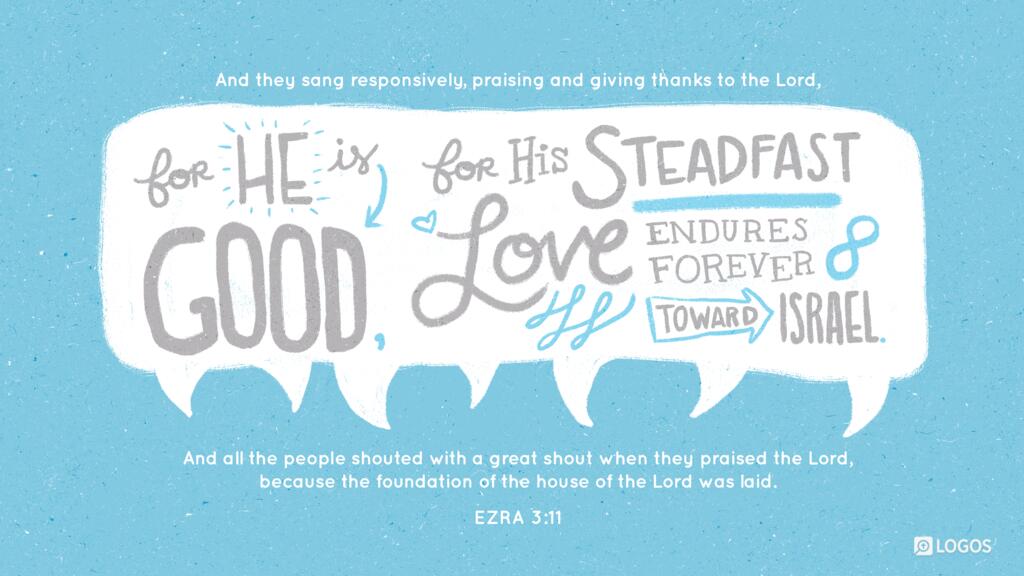
3:8In the second year after they had come to the temple of God in Jerusalem,21 in the second month, Zerubbabel the son of Shealtiel and Jeshua the son of Jozadak initiated the work,22 along with the rest of their associates,23 the priests and the Levites, and all those who were coming to Jerusalem from the exile. They appointed24 the Levites who were at least twenty years old25 to take charge of the work on the Lord’s temple. 3:9So Jeshua appointed both his sons and his relatives,26 Kadmiel and his sons (the sons of Yehudah27), to take charge of the workers in the temple of God, along with the sons of Henadad, their sons, and their relatives28 the Levites. 3:10When the builders established the Lord’s temple, the priests, ceremonially attired and with their clarions,29 and the Levites (the sons of Asaph) with their cymbals, stood to praise the Lord according to the instructions left by30 King David of Israel.313:11With antiphonal response they sang,32 praising and glorifying the Lord:
“For he is good;
his loyal love toward Israel is forever.”
All the people gave a loud33 shout as they praised the Lord when the temple of the Lord was established. 3:12Many of the priests, the Levites, and the leaders34—older people who had seen with their own eyes the former temple while it was still established35—were weeping loudly,36 and many others raised their voice in a joyous shout. 3:13People were unable to tell the difference between the sound of joyous shouting and the sound of the people’s weeping, for the people were shouting so loudly37 that the sound was heard a long way off.
Footnotes
- 21 For location see ; ; ; ; ; ; ; ; .
- 22 Heb “began”; the phrase “the work” is supplied in the translation for the sake of clarity.
- 23 Heb “their brothers.”
- 24 Heb “stood.”
- 25 Heb “from twenty years and upward.”
- 26 Heb “brothers.”
- 27 The name יְהוּדָה (Yehudah; cf. , , “Judah”) is probably a variant of Hodaviah (see Ezra 2:40; cf. , , , , ).
- 28 Heb “brothers.”
- 29 This was a long, straight, metallic instrument used for signal calls, rather than the traditional ram’s horn (both instruments are typically translated “trumpet” by English versions).
- 30 Heb “according to the hands of.”
- 31 See Ps 107:1; 118:1, 29; 136:1. Cf. 2 Chr 5:13; 7:3; 20:21.
- 32 Heb “they answered.”
- 33 Heb “great.”
- 34 Heb “the heads of the fathers.”
- 35 The temple had been destroyed some fifty years earlier by the Babylonians in 586 b.c.
- 36 Heb “with a great voice.”
- 37 Heb “a great shout.”
The NET Bible First Edition, Copyright 1996-2005 by Biblical Studies Press