Exodus 3:5–10
The NET BibleOther versions
English
- NET The NET Bible
- DARBY 1890 Darby Bible
- ASV American Standard Version
- AV 1873 The Cambridge Paragraph Bible of the Authorized English Version
- CSB Christian Standard Bible
- D-R Douay-Rheims Bible
- ESV English Standard Version
- GW GOD’S WORD Translation
- GNB Good News Translation
- HCSB The Holman Christian Standard Bible
- KJV 1900 King James Version
- LSB Legacy Standard Bible
- LEB The Lexham English Bible
- MSG The Message: The Bible in Contemporary Language
- NASB95 New American Standard Bible (1995)
- NCV New Century Version
- NIrV New International Reader’s Version (1998)
- NIV New International Version (2011)
- NKJV The New King James Version
- NLT New Living Translation
- NRSVue New Revised Standard Version: Updated Edition
- RSV The Revised Standard Version
- RSVCE The Revised Standard Version, Catholic Edition
- TNIV Today’s New International Version
- YLT Young’s Literal Translation
Arabic
Czech
French
German
Hebrew
Hungarian
Italian
Korean
Latin
Portuguese
Russian
Simplified Chinese
Spanish
Traditional Chinese
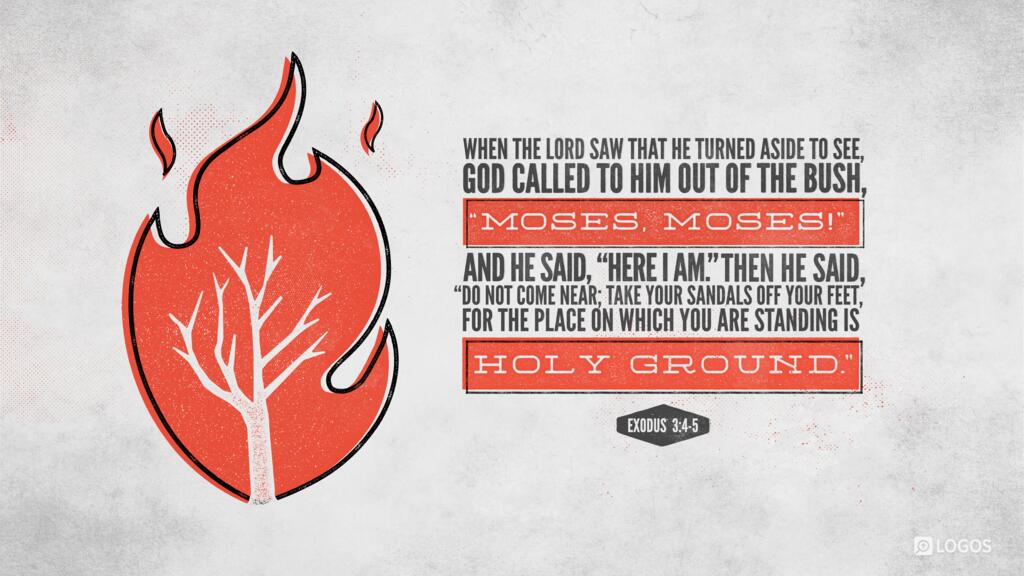
3:5God19 said, “Do not approach any closer!20 Take your sandals off your feet, for the place where you are standing is holy21 ground.”223:6He added, “I am the God of your father,23 the God of Abraham, the God of Isaac, and the God of Jacob.” Then Moses hid his face, because he was afraid to look24 at God.
3:7The Lord said, “I have surely seen25 the affliction of my people who are in Egypt. I have heard their cry because of their taskmasters, for I know their sorrows.263:8I have come down27 to deliver them28 from the hand of the Egyptians and to bring them up from that land to a land that is both good and spacious,29 to a land flowing with milk and honey,30 to the region of the Canaanites, Hittites, Amorites, Perizzites, Hivites, and Jebusites.313:9And now indeed32 the cry33 of the Israelites has come to me, and I have also seen how severely the Egyptians oppress them.343:10So now go, and I will send you35 to Pharaoh to bring my people, the Israelites, out of Egypt.”
Footnotes
- 19 Heb “And he”; the referent (God) has been specified in the translation for clarity.
- 20 Even though the Lord was drawing near to Moses, Moses could not casually approach him. There still was a barrier between God and human, and God had to remind Moses of this with instructions. The removal of sandals was, and still is in the East, a sign of humility and reverence in the presence of the Holy One. It was a way of excluding the dust and dirt of the world. But it also took away personal comfort and convenience and brought the person more closely in contact with the earth.
- 21 The word קֹדֶשׁ (qodesh, “holy”) indicates “set apart, distinct, unique.” What made a mountain or other place holy was the fact that God chose that place to reveal himself or to reside among his people. Because God was in this place, the ground was different—it was holy.
- 22 The causal clause includes within it a typical relative clause, which is made up of the relative pronoun, then the independent personal pronoun with the participle, and then the preposition with the resumptive pronoun. It would literally be “which you are standing on it,” but the relative pronoun and the resumptive pronoun are combined and rendered, “on which you are standing.”
- 23 This self-revelation by Yahweh prepares for the revelation of the holy name. While no verb is used here, the pronoun and the predicate nominative are a construction used throughout scripture to convey the “I am” disclosures—“I [am] the God of.…” But the significant point here is the naming of the patriarchs, for this God is the covenant God, who will fulfill his promises.
- 24 The clause uses the Hiphil infinitive construct with a preposition after the perfect tense: יָרֵא מֵהַבִּיט (yare’ mehabbit, “he was afraid from gazing”) meaning “he was afraid to gaze.” The preposition min (מִן) is used before infinitives after verbs like the one to complete the verb (see 583 7b).
- 25 The use of the infinitive absolute with the perfect tense intensifies the statement: I have surely seen—there is no doubt that I have seen and will do something about it.
- 26 Two new words are introduced now to the report of suffering: “affliction” and “pain/suffering.” These add to the dimension of the oppression of God’s people.
- 27 God’s coming down is a frequent anthropomorphism in Genesis and Exodus. It expresses his direct involvement, often in the exercise of judgment.
- 28 The Hiphil infinitive with the suffix is לְהַצִּילוֹ (léhatsilo, “to deliver them”). It expresses the purpose of God’s coming down. The verb itself is used for delivering or rescuing in the general sense, and snatching out of danger for the specific.
- 29 Heb “to a land good and large”; “to a good and broad land.” In the translation the words “that is both” are supplied because in contemporary English “good and” combined with any additional descriptive term can be understood as elative (“good and large” = “very large”; “good and spacious” = “very spacious”; “good and ready” = “very ready”). The point made in the Hebrew text is that the land to which they are going is both good (in terms of quality) and large (in terms of size).
- 30 This vibrant description of the promised land is a familiar one. Gesenius classifies “milk and honey” as epexegetical genitives because they provide more precise description following a verbal adjective in the construct state ( §128.x). The land is modified by “flowing,” and “flowing” is explained by the genitives “milk and honey.” These two products will be in abundance in the land, and they therefore exemplify what a desirable land it is. The language is hyperbolic, as if the land were streaming with these products.
- 31 Each people group is joined to the preceding by the vav conjunction, “and.” Each also has the definite article, as in other similar lists (3:17; 13:5; 34:11). To repeat the conjunction and article in the translation seems to put more weight on the list in English than is necessary to its function in identifying what land God was giving the Israelites.
- 32 The particle הִנֵּה (hinneh) focuses attention on what is being said as grounds for what follows.
- 33 The word is a technical term for the outcry one might make to a judge. God had seen the oppression and so knew that the complaints were accurate, and so he initiated the proceedings against the oppressors (B. Jacob, Exodus, 59).
- 34 Heb “seen the oppression with which the Egyptians oppress them.” The word for the oppression is now לַחַץ (lakhats), which has the idea of pressure with the oppression—squeezing, pressuring—which led to its later use in the Semitic languages for torture. The repetition in the Hebrew text of the root in the participle form after this noun serves to stress the idea. This emphasis has been represented in the translation by the expression “seen how severely the Egyptians oppress them.”
- 35 The verse has a sequence of volitives. The first form is the imperative לְכָה (lékha, “go”). Then comes the cohortative/imperfect form with the vav (ו), “and I will send you” or more likely “that I may send you” (וְאֶשְׁלָחֲךָ, vé’eshlakhakha), which is followed by the imperative with the vav, “and bring out” or “that you may bring out” (וְהוֹצֵא, véhotse’). The series of actions begins with Moses going. When he goes, it will be the Lord who sends him, and if the Lord sends him, it will be with the purpose of leading Israel out of Egypt. These instructions for Moses are based on the preceding revelation made to him. The deliverance of Israel was to be God’s work—hence, “I will send you.” When God commissioned people, often using the verb “to send,” it indicated that they went with his backing, his power, and his authority. Moses could not have brought Israel out without this. To name this incident a commissioning, then, means that the authority came from God to do the work (compare John 3:2).
The NET Bible First Edition, Copyright 1996-2005 by Biblical Studies Press
In other versions
ESVEnglish Standard Version
Then he said, “Do not come near; take your sandals off your feet, for the place on which you are standing is holy ground.” And he said, “I am the God of your father, the God of Abraham, the God of Isaac, and the God of Jacob.” And Moses hid his face, for he was afraid to look at God.
Then the Lord said, “I have surely seen the affliction of my people who are in Egypt and have heard their cry because of their taskmasters. I know their sufferings, and I have come down to deliver them out of the hand of the Egyptians and to bring them up out of that land to a good and broad land, a land flowing with milk and honey, to the place of the Canaanites, the Hittites, the Amorites, the Perizzites, the Hivites, and the Jebusites. And now, behold, the cry of the people of Israel has come to me, and I have also seen the oppression with which the Egyptians oppress them. Come, I will send you to Pharaoh that you may bring my people, the children of Israel, out of Egypt.”
Copyright 2001 Crossway Bibles
NIVNew International Version (2011)
“Do not come any closer,” God said. “Take off your sandals, for the place where you are standing is holy ground.” Then he said, “I am the God of your father, the God of Abraham, the God of Isaac and the God of Jacob.” At this, Moses hid his face, because he was afraid to look at God.
The Lord said, “I have indeed seen the misery of my people in Egypt. I have heard them crying out because of their slave drivers, and I am concerned about their suffering. So I have come down to rescue them from the hand of the Egyptians and to bring them up out of that land into a good and spacious land, a land flowing with milk and honey—the home of the Canaanites, Hittites, Amorites, Perizzites, Hivites and Jebusites. And now the cry of the Israelites has reached me, and I have seen the way the Egyptians are oppressing them. So now, go. I am sending you to Pharaoh to bring my people the Israelites out of Egypt.”
Copyright 1973, 1978, 1984, 2011 Biblica, Inc.
CSBChristian Standard Bible
“Do not come closer,” he said. “Remove the sandals from your feet, for the place where you are standing is holy ground.” Then he continued, “I am the God of your father, the God of Abraham, the God of Isaac, and the God of Jacob.” Moses hid his face because he was afraid to look at God.
Then the Lord said, “I have observed the misery of my people in Egypt, and have heard them crying out because of their oppressors. I know about their sufferings, and I have come down to rescue them from the power of the Egyptians and to bring them from that land to a good and spacious land, a land flowing with milk and honey—the territory of the Canaanites, Hethites, Amorites, Perizzites, Hivites, and Jebusites. So because the Israelites’ cry for help has come to me, and I have also seen the way the Egyptians are oppressing them, therefore, go. I am sending you to Pharaoh so that you may lead my people, the Israelites, out of Egypt.”
Copyright 2017 Holman Bible Publishers
NLTNew Living Translation
“Do not come any closer,” the Lord warned. “Take off your sandals, for you are standing on holy ground. I am the God of your father—the God of Abraham, the God of Isaac, and the God of Jacob.” When Moses heard this, he covered his face because he was afraid to look at God.
Then the Lord told him, “I have certainly seen the oppression of my people in Egypt. I have heard their cries of distress because of their harsh slave drivers. Yes, I am aware of their suffering. So I have come down to rescue them from the power of the Egyptians and lead them out of Egypt into their own fertile and spacious land. It is a land flowing with milk and honey—the land where the Canaanites, Hittites, Amorites, Perizzites, Hivites, and Jebusites now live. Look! The cry of the people of Israel has reached me, and I have seen how harshly the Egyptians abuse them. Now go, for I am sending you to Pharaoh. You must lead my people Israel out of Egypt.”
Holy Bible, New Living Translation, copyright © 1996, 2004, 2015 by Tyndale House Foundation. Used by permission of Tyndale House Publishers. All rights reserved.
LEBThe Lexham English Bible
And he said, “You must not come near to here. Take off your sandals from on your feet, because the place on which you are standing, it is holy ground.” And he said, “I am the God of your father, the God of Abraham, the God of Isaac, and the God of Jacob.” And Moses hid his face because he was afraid of looking at God.
And Yahweh said, “Surely I have seen the misery of my people who are in Egypt, and I have heard their cry of distress because of their oppressors, for I know their sufferings. And I have come down to deliver them from the hand of the Egyptians and to bring them up from this land to a good and wide land, to a land flowing with milk and honey, to the place of the Canaanites and the Hittites and the Amorites and the Perizzites and the Hivites and the Jebusites. And now, look, the cry of distress of the Israelites has come to me, and also I see the oppression with which the Egyptians are oppressing them. And now come, and I will send you to Pharaoh, and you must bring my people, the Israelites, out from Egypt.”
Copyright 2012 Lexham Press
KJV 1900King James Version
And he said, Draw not nigh hither: put off thy shoes from off thy feet, for the place whereon thou standest is holy ground. Moreover he said, I am the God of thy father, the God of Abraham, the God of Isaac, and the God of Jacob. And Moses hid his face; for he was afraid to look upon God. And the Lord said, I have surely seen the affliction of my people which are in Egypt, and have heard their cry by reason of their taskmasters; for I know their sorrows; And I am come down to deliver them out of the hand of the Egyptians, and to bring them up out of that land unto a good land and a large, unto a land flowing with milk and honey; unto the place of the Canaanites, and the Hittites, and the Amorites, and the Perizzites, and the Hivites, and the Jebusites. Now therefore, behold, the cry of the children of Israel is come unto me: and I have also seen the oppression wherewith the Egyptians oppress them. Come now therefore, and I will send thee unto Pharaoh, that thou mayest bring forth my people the children of Israel out of Egypt.
Public Domain