Exodus 3:4–6
The NET BibleOther versions
English
- NET The NET Bible
- DARBY 1890 Darby Bible
- ASV American Standard Version
- AV 1873 The Cambridge Paragraph Bible of the Authorized English Version
- CSB Christian Standard Bible
- D-R Douay-Rheims Bible
- ESV English Standard Version
- GW GOD’S WORD Translation
- GNB Good News Translation
- HCSB The Holman Christian Standard Bible
- KJV 1900 King James Version
- LSB Legacy Standard Bible
- LEB The Lexham English Bible
- MSG The Message: The Bible in Contemporary Language
- NASB95 New American Standard Bible (1995)
- NCV New Century Version
- NIrV New International Reader’s Version (1998)
- NIV New International Version (2011)
- NKJV The New King James Version
- NLT New Living Translation
- NRSVue New Revised Standard Version: Updated Edition
- RSV The Revised Standard Version
- RSVCE The Revised Standard Version, Catholic Edition
- TNIV Today’s New International Version
- YLT Young’s Literal Translation
Arabic
Czech
French
German
Hebrew
Hungarian
Italian
Korean
Latin
Portuguese
Russian
Simplified Chinese
Spanish
Traditional Chinese
3:4When the Lord15 saw that16 he had turned aside to look, God called to him from within the bush and said, “Moses, Moses!”17 And Moses18 said, “Here I am.” 3:5God19 said, “Do not approach any closer!20 Take your sandals off your feet, for the place where you are standing is holy21 ground.”223:6He added, “I am the God of your father,23 the God of Abraham, the God of Isaac, and the God of Jacob.” Then Moses hid his face, because he was afraid to look24 at God.
Footnotes
- 15 The preterite with the vav (ו) is subordinated as a temporal clause to the main point of the verse, that God called to him. The language is anthropomorphic, as if God’s actions were based on his observing what Moses did.
- 16 The particle כִּי (ki, “that”) introduces the noun clause that functions as the direct object of the verb “saw” (R. J. Williams, Hebrew Syntax, 81, §490).
- 17 The repetition of the name in God’s call is emphatic, making the appeal direct and immediate (see also Gen 22:11; 46:2). The use of the personal name shows how specifically God directed the call and that he knew this person. The repetition may have stressed even more that it was indeed he whom the Lord wanted. It would have been an encouragement to Moses that this was in fact the Lord who was meeting him.
- 18 Heb “And he said”; the referent (Moses) has been specified in the translation for clarity.
- 19 Heb “And he”; the referent (God) has been specified in the translation for clarity.
- 20 Even though the Lord was drawing near to Moses, Moses could not casually approach him. There still was a barrier between God and human, and God had to remind Moses of this with instructions. The removal of sandals was, and still is in the East, a sign of humility and reverence in the presence of the Holy One. It was a way of excluding the dust and dirt of the world. But it also took away personal comfort and convenience and brought the person more closely in contact with the earth.
- 21 The word קֹדֶשׁ (qodesh, “holy”) indicates “set apart, distinct, unique.” What made a mountain or other place holy was the fact that God chose that place to reveal himself or to reside among his people. Because God was in this place, the ground was different—it was holy.
- 22 The causal clause includes within it a typical relative clause, which is made up of the relative pronoun, then the independent personal pronoun with the participle, and then the preposition with the resumptive pronoun. It would literally be “which you are standing on it,” but the relative pronoun and the resumptive pronoun are combined and rendered, “on which you are standing.”
- 23 This self-revelation by Yahweh prepares for the revelation of the holy name. While no verb is used here, the pronoun and the predicate nominative are a construction used throughout scripture to convey the “I am” disclosures—“I [am] the God of.…” But the significant point here is the naming of the patriarchs, for this God is the covenant God, who will fulfill his promises.
- 24 The clause uses the Hiphil infinitive construct with a preposition after the perfect tense: יָרֵא מֵהַבִּיט (yare’ mehabbit, “he was afraid from gazing”) meaning “he was afraid to gaze.” The preposition min (מִן) is used before infinitives after verbs like the one to complete the verb (see 583 7b).
The NET Bible First Edition, Copyright 1996-2005 by Biblical Studies Press
In other versions
ESVEnglish Standard Version
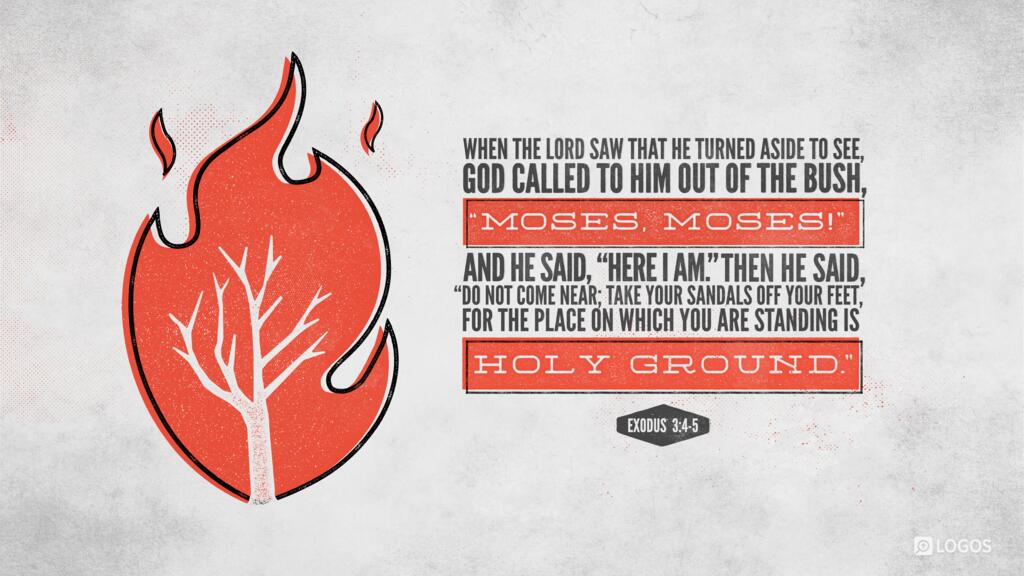
When the Lord saw that he turned aside to see, God called to him out of the bush, “Moses, Moses!” And he said, “Here I am.” Then he said, “Do not come near; take your sandals off your feet, for the place on which you are standing is holy ground.” And he said, “I am the God of your father, the God of Abraham, the God of Isaac, and the God of Jacob.” And Moses hid his face, for he was afraid to look at God.
Copyright 2001 Crossway Bibles
NIVNew International Version (2011)
When the Lord saw that he had gone over to look, God called to him from within the bush, “Moses! Moses!”
And Moses said, “Here I am.”
“Do not come any closer,” God said. “Take off your sandals, for the place where you are standing is holy ground.” Then he said, “I am the God of your father, the God of Abraham, the God of Isaac and the God of Jacob.” At this, Moses hid his face, because he was afraid to look at God.
Copyright 1973, 1978, 1984, 2011 Biblica, Inc.
CSBChristian Standard Bible
When the Lord saw that he had gone over to look, God called out to him from the bush, “Moses, Moses!”
“Here I am,” he answered.
“Do not come closer,” he said. “Remove the sandals from your feet, for the place where you are standing is holy ground.” Then he continued, “I am the God of your father, the God of Abraham, the God of Isaac, and the God of Jacob.” Moses hid his face because he was afraid to look at God.
Copyright 2017 Holman Bible Publishers
NLTNew Living Translation
When the Lord saw Moses coming to take a closer look, God called to him from the middle of the bush, “Moses! Moses!”
“Here I am!” Moses replied.
“Do not come any closer,” the Lord warned. “Take off your sandals, for you are standing on holy ground. I am the God of your father—the God of Abraham, the God of Isaac, and the God of Jacob.” When Moses heard this, he covered his face because he was afraid to look at God.
Holy Bible, New Living Translation, copyright © 1996, 2004, 2015 by Tyndale House Foundation. Used by permission of Tyndale House Publishers. All rights reserved.
LEBThe Lexham English Bible
And Yahweh saw that he turned aside to see, and God called to him from the midst of the bush, and he said, “Moses, Moses.” And he said, “Here I am.” And he said, “You must not come near to here. Take off your sandals from on your feet, because the place on which you are standing, it is holy ground.” And he said, “I am the God of your father, the God of Abraham, the God of Isaac, and the God of Jacob.” And Moses hid his face because he was afraid of looking at God.
Copyright 2012 Lexham Press
KJV 1900King James Version
And when the Lord saw that he turned aside to see, God called unto him out of the midst of the bush, and said, Moses, Moses. And he said, Here am I. And he said, Draw not nigh hither: put off thy shoes from off thy feet, for the place whereon thou standest is holy ground. Moreover he said, I am the God of thy father, the God of Abraham, the God of Isaac, and the God of Jacob. And Moses hid his face; for he was afraid to look upon God.
Public Domain