Exodus 28:1–4
The NET BibleOther versions
English
- NET The NET Bible
- DARBY 1890 Darby Bible
- ASV American Standard Version
- AV 1873 The Cambridge Paragraph Bible of the Authorized English Version
- CSB Christian Standard Bible
- D-R Douay-Rheims Bible
- ESV English Standard Version
- GW GOD’S WORD Translation
- GNB Good News Translation
- HCSB The Holman Christian Standard Bible
- KJV 1900 King James Version
- LSB Legacy Standard Bible
- LEB The Lexham English Bible
- MSG The Message: The Bible in Contemporary Language
- NASB95 New American Standard Bible (1995)
- NCV New Century Version
- NIrV New International Reader’s Version (1998)
- NIV New International Version (2011)
- NKJV The New King James Version
- NLT New Living Translation
- NRSVue New Revised Standard Version: Updated Edition
- RSV The Revised Standard Version
- RSVCE The Revised Standard Version, Catholic Edition
- TNIV Today’s New International Version
- YLT Young’s Literal Translation
Arabic
Czech
French
German
Hebrew
Hungarian
Italian
Korean
Latin
Portuguese
Russian
Simplified Chinese
Spanish
Traditional Chinese
The Clothing of the Priests
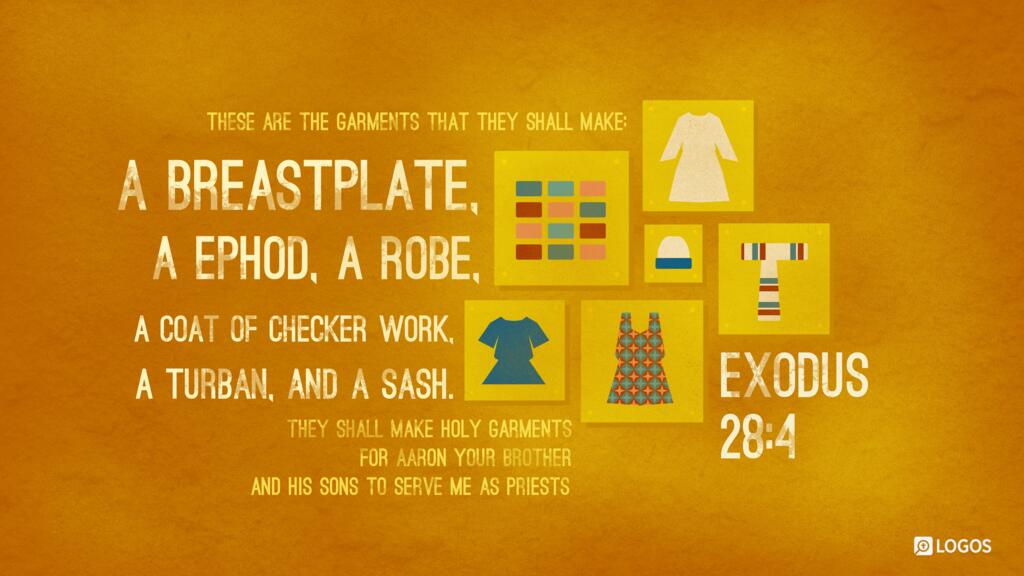
28:11 “And you, bring near2 to you your brother Aaron and his sons with him from among the Israelites, so that they may minister as my priests3—Aaron, Nadab and Abihu, Eleazar and Ithamar, Aaron’s sons. 28:2You must make holy garments4 for your brother Aaron, for glory and for beauty.528:3You6 are to speak to all who are specially skilled,7 whom I have filled with the spirit of wisdom,8 so that they may make9 Aaron’s garments to set him apart10 to minister as my priest. 28:4Now these are the garments that they are to make: a breastpiece,11 an ephod,12 a robe, a fitted13 tunic, a turban, and a sash. They are to make holy garments for your brother Aaron and for his sons, that they may minister as my priests.
Footnotes
- 1 Some modern scholars find this and the next chapter too elaborate for the wilderness experience. To most of them this reflects the later Zadokite priesthood of the writer’s (P’s) day that was referred to Mosaic legislation for authentication. But there is no compelling reason why this should be late; it is put late because it is assumed to be P, and that is assumed to be late. But both assumptions are unwarranted. This lengthy chapter could be divided this way: instructions for preparing the garments (1–5), details of the apparel (6–39), and a warning against deviating from these (40–43). The subject matter of the first part is that God requires that his chosen ministers reflect his holy nature; the point of the second part is that God requires his ministers to be prepared to fulfill the tasks of the ministry, and the subject matter of the third part is that God warns all his ministers to safeguard the holiness of their service.
- 2 The verb is the Hiphil imperative of the root קָרַב (qarav, “to draw near”). In the present stem the word has religious significance, namely, to present something to God, like an offering.
- 3 This entire clause is a translation of the Hebrew לְכַהֲנוֹ־לִי (lékhahano-li, “that he might be a priest to me”), but the form is unusual. The word means “to be a priest” or “to act as a priest.” The etymology of the word for priest, כֹּהֵן (kohen), is uncertain.
- 4 The genitive “holiness” is the attribute for “garments”—“garments of holiness.” The point of the word “holy” is that these garments would be distinctive from ordinary garments, for they set Aaron apart to sanctuary service and ministry.
- 5 The expression is לְכָבוֹד וּלְתִפְארֶת (lékhavod ulétif’aret, “for glory and for beauty”). W. C. Kaiser (“Exodus,” 2:), quoting the ’s “to give him dignity and honor,” says that these clothes were to exalt the office of the high priest as well as beautify the worship of God (which explains more of what the text has than the rendering). The meaning of the word “glory” has much to do with the importance of the office, to be sure, but in Exodus the word has been used also for the brilliance of the presence of Yahweh, and so the magnificence of these garments might indeed strike the worshiper with the sense of the exaltation of the service.
- 6 Heb “And you, you will speak to.”
- 7 Heb “wise of heart.” The word for “wise” (חַכְמֵי, khakhme, the plural construct form) is from the word group that is usually translated “wisdom, wise, be wise,” but it has as its basic meaning “skill” or “skillful.” This is the way it is used in 31:3, 6 and 35:10 etc. God gave these people “wisdom” so that they would know how to make these things. The “heart” for the Hebrews is the locus of understanding, the mind and the will. To be “wise of heart” or “wise in heart” means that they had the understanding to do skillful work, they were talented artisans and artists.
- 8 There is no necessity to take this as a reference to the Holy Spirit who produces wisdom in these people, although that is not totally impossible. A number of English versions (e.g., , , , , , , ) do not even translate the word “spirit.” It probably refers to their attitude and ability. U. Cassuto has “to all the artisans skilled in the making of stately robes, in the heart [i.e., mind] of each of whom I have implanted sagacity in his craft so that he may do his craft successfully” (Exodus, ).
- 9 The form is the perfect tense with the vav (ו) consecutive; after the instruction to speak to the wise, this verb, equal to an imperfect, will have the force of purpose.
- 10 Or “to sanctify him” () or “to consecrate him” (, , ). It is the garments that will set Aaron apart, or sanctify him, not the workers. The expression could be taken to mean “for his consecration” () since the investiture is part of his being set apart for service.
- 11 The breastpiece seems to have been a pouch of sorts or to have had a pocket, since it was folded in some way (28:16; 39:9) and contained the Urim and Thummim (Exod 28:30; Lev 8:8).
- 12 The word “ephod” is taken over directly from Hebrew, because no one knows how to translate it, nor is there agreement about its design. It refers here to a garment worn by the priests, but the word can also refer to some kind of image for a god (Judg 8:27).
- 13 The word תָּשְׁבֵּץ (tashbets), which describes the tunic and which appears only in this verse, is related to a verb (also rare) of the same root in 28:39 that describes making the tunic. Their meaning is uncertain (see the extended discussion in C. Houtman, Exodus, 3:473–75). A related noun describes gold fasteners and the “settings,” or “mountings,” for precious stones (28:11, 13, 14, 20, 25; 36:18; 39:6, 13, 16, 18; cf. Ps 45:14). The word “fitted” in 28:4 reflects the possibility that “the tunic is to be shaped by sewing, … so that it will fit tightly around the body” (C. Houtman, Exodus, 3:475).
The NET Bible First Edition, Copyright 1996-2005 by Biblical Studies Press
In other versions
ESVEnglish Standard Version
“Then bring near to you Aaron your brother, and his sons with him, from among the people of Israel, to serve me as priests—Aaron and Aaron’s sons, Nadab and Abihu, Eleazar and Ithamar. And you shall make holy garments for Aaron your brother, for glory and for beauty. You shall speak to all the skillful, whom I have filled with a spirit of skill, that they make Aaron’s garments to consecrate him for my priesthood. These are the garments that they shall make: a breastpiece, an ephod, a robe, a coat of checker work, a turban, and a sash. They shall make holy garments for Aaron your brother and his sons to serve me as priests.
Copyright 2001 Crossway Bibles
NIVNew International Version (2011)
“Have Aaron your brother brought to you from among the Israelites, along with his sons Nadab and Abihu, Eleazar and Ithamar, so they may serve me as priests. Make sacred garments for your brother Aaron to give him dignity and honor. Tell all the skilled workers to whom I have given wisdom in such matters that they are to make garments for Aaron, for his consecration, so he may serve me as priest. These are the garments they are to make: a breastpiece, an ephod, a robe, a woven tunic, a turban and a sash. They are to make these sacred garments for your brother Aaron and his sons, so they may serve me as priests.
Copyright 1973, 1978, 1984, 2011 Biblica, Inc.
CSBChristian Standard Bible
“Have your brother Aaron, with his sons, come to you from the Israelites to serve me as priest—Aaron, his sons Nadab and Abihu, Eleazar and Ithamar. Make holy garments for your brother Aaron, for glory and beauty. You are to instruct all the skilled artisans, whom I have filled with a spirit of wisdom, to make Aaron’s garments for consecrating him to serve me as priest. These are the garments that they must make: a breastpiece, an ephod, a robe, a specially woven tunic, a turban, and a sash. They are to make holy garments for your brother Aaron and his sons so that they may serve me as priests.
Copyright 2017 Holman Bible Publishers
NLTNew Living Translation
“Call for your brother, Aaron, and his sons, Nadab, Abihu, Eleazar, and Ithamar. Set them apart from the rest of the people of Israel so they may minister to me and be my priests. Make sacred garments for Aaron that are glorious and beautiful. Instruct all the skilled craftsmen whom I have filled with the spirit of wisdom. Have them make garments for Aaron that will distinguish him as a priest set apart for my service. These are the garments they are to make: a chestpiece, an ephod, a robe, a patterned tunic, a turban, and a sash. They are to make these sacred garments for your brother, Aaron, and his sons to wear when they serve me as priests.
Holy Bible, New Living Translation, copyright © 1996, 2004, 2015 by Tyndale House Foundation. Used by permission of Tyndale House Publishers. All rights reserved.
LEBThe Lexham English Bible
“And bring near to you Aaron, your brother, and his sons with him from the midst of the Israelites to serve as priests for me—Aaron, Nadab and Abihu, Eleazar and Ithamar, the sons of Aaron. And you will make holy garments for Aaron, your brother, for glory and for splendor. And you will speak to all the skilled of heart, whom I have given a gift of skill, and they will make the garments of Aaron to consecrate him for his serving as my priest. And these are the garments that they will make: A breast piece and an ephod and a robe and a tunic of specially woven fabric, a turban and a sash. And they will make holy garments for Aaron your brother, and for his sons to serve as priests for me.
Copyright 2012 Lexham Press
KJV 1900King James Version
And take thou unto thee Aaron thy brother, and his sons with him, from among the children of Israel, that he may minister unto me in the priest’s office, even Aaron, Nadab and Abihu, Eleazar and Ithamar, Aaron’s sons. And thou shalt make holy garments for Aaron thy brother for glory and for beauty. And thou shalt speak unto all that are wise hearted, whom I have filled with the spirit of wisdom, that they may make Aaron’s garments to consecrate him, that he may minister unto me in the priest’s office. And these are the garments which they shall make; a breastplate, and an ephod, and a robe, and a broidered coat, a mitre, and a girdle: and they shall make holy garments for Aaron thy brother, and his sons, that he may minister unto me in the priest’s office.
Public Domain