Exodus 19:18–20
The NET BibleOther versions
English
- NET The NET Bible
- DARBY 1890 Darby Bible
- ASV American Standard Version
- AV 1873 The Cambridge Paragraph Bible of the Authorized English Version
- CSB Christian Standard Bible
- D-R Douay-Rheims Bible
- ESV English Standard Version
- GW GOD’S WORD Translation
- GNB Good News Translation
- HCSB The Holman Christian Standard Bible
- KJV 1900 King James Version
- LSB Legacy Standard Bible
- LEB The Lexham English Bible
- MSG The Message: The Bible in Contemporary Language
- NASB95 New American Standard Bible (1995)
- NCV New Century Version
- NIrV New International Reader’s Version (1998)
- NIV New International Version (2011)
- NKJV The New King James Version
- NLT New Living Translation
- NRSVue New Revised Standard Version: Updated Edition
- RSV The Revised Standard Version
- RSVCE The Revised Standard Version, Catholic Edition
- TNIV Today’s New International Version
- YLT Young’s Literal Translation
Arabic
Czech
French
German
Hebrew
Hungarian
Italian
Korean
Latin
Portuguese
Russian
Simplified Chinese
Spanish
Traditional Chinese
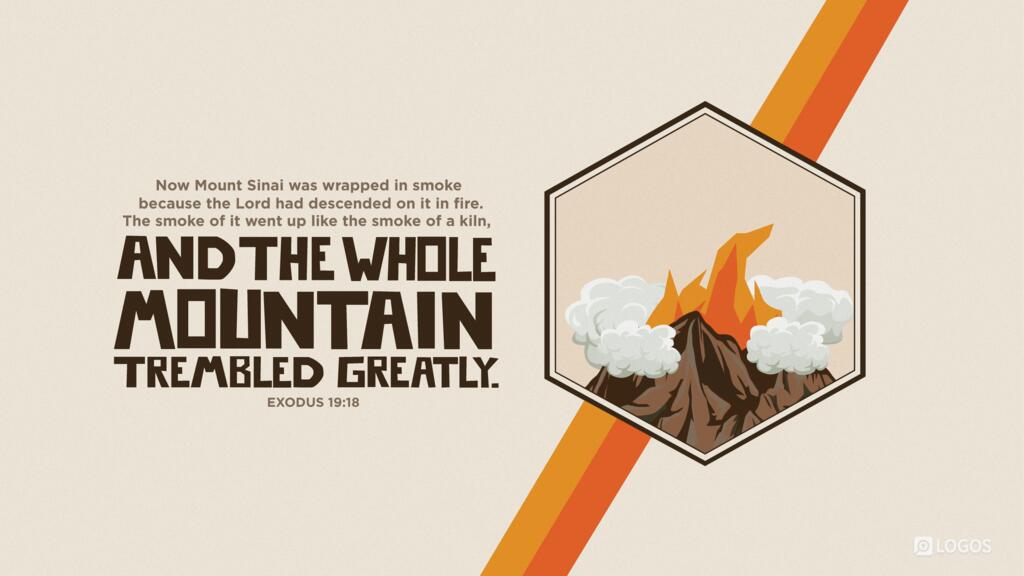
19:18Now Mount Sinai was completely covered with smoke because the Lord had descended on it in fire, and its smoke went up like the smoke of a great furnace,33 and the whole mountain shook34 violently. 19:19When the sound of the horn grew louder and louder,35 Moses was speaking36 and God was answering him with a voice.37
19:20The Lord came down on Mount Sinai, on the top of the mountain, and the Lord summoned Moses to the top of the mountain, and Moses went up.
Footnotes
- 33 The image is that of a large kiln, as in Gen 19:28.
- 34 This is the same word translated “trembled” above (v. 16).
- 35 The active participle הוֹלֵךְ (holekh) is used to add the idea of “continually” to the action of the sentence; here the trumpet became very loud—continually. See §113.u.
- 36 The two verbs here (“spoke” and “answered”) are imperfect tenses; they emphasize repeated action but in past time. The customary imperfect usually is translated “would” or “used to” do the action, but here continuous action in past time is meant. S. R. Driver translates it “kept speaking” and “kept answering” (Exodus, ).
- 37 The text simply has בְּקוֹל (béqol); it could mean “with a voice” or it could mean “in thunder” since “voice” was used in v. 16 for thunder. In this context it would be natural to say that the repeated thunderings were the voice of God—but how is that an answer? Deut 4:12 says that the people heard the sound of words. U. Cassuto (Exodus, ) rightly comments, “He was answering him with a loud voice so that it was possible for Moses to hear His words clearly in the midst of the storm.” He then draws a parallel from Ugaritic where it tells that one of the gods was speaking in a loud voice.
The NET Bible First Edition, Copyright 1996-2005 by Biblical Studies Press
In other versions
ESVEnglish Standard Version
Now Mount Sinai was wrapped in smoke because the Lord had descended on it in fire. The smoke of it went up like the smoke of a kiln, and the whole mountain trembled greatly. And as the sound of the trumpet grew louder and louder, Moses spoke, and God answered him in thunder. The Lord came down on Mount Sinai, to the top of the mountain. And the Lord called Moses to the top of the mountain, and Moses went up.
Copyright 2001 Crossway Bibles
NIVNew International Version (2011)
Mount Sinai was covered with smoke, because the Lord descended on it in fire. The smoke billowed up from it like smoke from a furnace, and the whole mountain trembled violently. As the sound of the trumpet grew louder and louder, Moses spoke and the voice of God answered him.
The Lord descended to the top of Mount Sinai and called Moses to the top of the mountain. So Moses went up
Copyright 1973, 1978, 1984, 2011 Biblica, Inc.
CSBChristian Standard Bible
Mount Sinai was completely enveloped in smoke because the Lord came down on it in fire. Its smoke went up like the smoke of a furnace, and the whole mountain shook violently. As the sound of the trumpet grew louder and louder, Moses spoke and God answered him in the thunder.
The Lord came down on Mount Sinai at the top of the mountain. Then the Lord summoned Moses to the top of the mountain, and he went up.
Copyright 2017 Holman Bible Publishers
NLTNew Living Translation
All of Mount Sinai was covered with smoke because the Lord had descended on it in the form of fire. The smoke billowed into the sky like smoke from a brick kiln, and the whole mountain shook violently. As the blast of the ram’s horn grew louder and louder, Moses spoke, and God thundered his reply. The Lord came down on the top of Mount Sinai and called Moses to the top of the mountain. So Moses climbed the mountain.
Holy Bible, New Living Translation, copyright © 1996, 2004, 2015 by Tyndale House Foundation. Used by permission of Tyndale House Publishers. All rights reserved.
LEBThe Lexham English Bible
And Mount Sinai was all wrapped in smoke because Yahweh went down on it in the fire, and its smoke went up like the smoke of a smelting furnace, and the whole mountain trembled greatly. And the sound of the ram’s horn became louder and louder, and Moses would speak, and God would answer him with a voice.
And Yahweh went down on Mount Sinai, to the top of the mountain, and Yahweh called Moses to the top of the mountain, and Moses went up.
Copyright 2012 Lexham Press
KJV 1900King James Version
And mount Sinai was altogether on a smoke, because the Lord descended upon it in fire: and the smoke thereof ascended as the smoke of a furnace, and the whole mount quaked greatly. And when the voice of the trumpet sounded long, and waxed louder and louder, Moses spake, and God answered him by a voice. And the Lord came down upon mount Sinai, on the top of the mount: and the Lord called Moses up to the top of the mount; and Moses went up.
Public Domain