Exodus 17:14–16
The NET BibleOther versions
English
- NET The NET Bible
- DARBY 1890 Darby Bible
- ASV American Standard Version
- AV 1873 The Cambridge Paragraph Bible of the Authorized English Version
- CSB Christian Standard Bible
- D-R Douay-Rheims Bible
- ESV English Standard Version
- GW GOD’S WORD Translation
- GNB Good News Translation
- HCSB The Holman Christian Standard Bible
- KJV 1900 King James Version
- LSB Legacy Standard Bible
- LEB The Lexham English Bible
- MSG The Message: The Bible in Contemporary Language
- NASB95 New American Standard Bible (1995)
- NCV New Century Version
- NIrV New International Reader’s Version (1998)
- NIV New International Version (2011)
- NKJV The New King James Version
- NLT New Living Translation
- NRSVue New Revised Standard Version: Updated Edition
- RSV The Revised Standard Version
- RSVCE The Revised Standard Version, Catholic Edition
- TNIV Today’s New International Version
- YLT Young’s Literal Translation
Arabic
Czech
French
German
Hebrew
Hungarian
Italian
Korean
Latin
Portuguese
Russian
Simplified Chinese
Spanish
Traditional Chinese
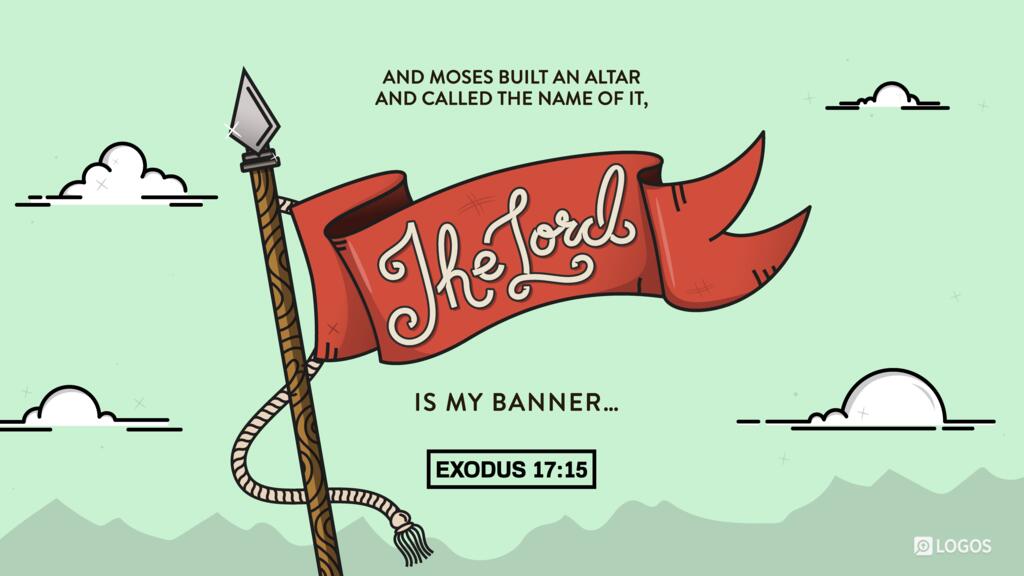
17:14The Lord said to Moses, “Write this as a memorial in the38 book, and rehearse39 it in Joshua’s hearing;40 for I will surely wipe out41 the remembrance42 of Amalek from under heaven. 17:15Moses built an altar, and he called it “The Lord is my Banner,”4317:16for he said, “For a hand was lifted up to the throne of the Lord44—that the Lord will have war with Amalek from generation to generation.”45
Footnotes
- 38 The presence of the article does not mean that he was to write this in a book that was existing now, but in one dedicated to this purpose (book, meaning scroll). See §126.s.
- 39 The Hebrew word is “place,” meaning that the events were to be impressed on Joshua.
- 40 Heb “in the ears of Joshua.” The account should be read to Joshua.
- 41 The construction uses the infinitive absolute and the imperfect tense to stress the resolution of Yahweh to destroy Amalek. The verb מָחָה (makhah) is often translated “blot out”—but that is not a very satisfactory image, since it would not remove completely what is the object. “Efface, erase, scrape off” (as in a palimpsest, a manuscript that is scraped clean so it can be reused) is a more accurate image.
- 42 This would seem to be defeated by the preceding statement that the events would be written in a book for a memorial. If this war is recorded, then the Amalekites would be remembered. But here God was going to wipe out the memory of them. But the idea of removing the memory of a people is an idiom for destroying them—they will have no posterity and no lasting heritage.
- 43 Heb “Yahweh-nissi” (so ), which means “Yahweh is my banner.” Note that when Israel murmured and failed God, the name commemorated the incident or the outcome of their failure. When they were blessed with success, the naming praised God. Here the holding up of the staff of God was preserved in the name for the altar—God gave them the victory.
- 44 The line here is very difficult. The Hebrew text has כִּי־יָד עַל־כֵּס יָהּ (ki yad ’al kes yah, “for a hand on the throne of Yah”). If the word is “throne” (and it is not usually spelled like this), then it would mean Moses’ hand was extended to the throne of God, showing either intercession or source of power. It could not be turned to mean that the hand of Yah was taking an oath to destroy the Amalekites. The took the same letters, but apparently saw the last four (כסיה) as a verbal form; it reads “with a secret hand.” Most scholars have simply assumed that the text is wrong, and כֵּס should be emended to נֵס (nes) to fit the name, for this is the pattern of naming in the OT with popular etymologies—some motif of the name must be found in the sentiment. This would then read, “My hand on the banner of Yah.” It would be an expression signifying that the banner, the staff of God, should ever be ready at hand when the Israelites fight the Amalekites again.
- 45 The message of this short narrative, then, concerns the power of God to protect his people. The account includes the difficulty, the victory, and the commemoration. The victory must be retained in memory by the commemoration. So the expositional idea could focus on that: The people of God must recognize (both for engaging in warfare and for praise afterward) that victory comes only with the power of God. In the NT the issue is even more urgent, because the warfare is spiritual—believers do not wrestle against flesh and blood. So only God’s power will bring victory.
The NET Bible First Edition, Copyright 1996-2005 by Biblical Studies Press
In other versions
ESVEnglish Standard Version
Then the Lord said to Moses, “Write this as a memorial in a book and recite it in the ears of Joshua, that I will utterly blot out the memory of Amalek from under heaven.” And Moses built an altar and called the name of it, The Lord Is My Banner, saying, “A hand upon the throne of the Lord! The Lord will have war with Amalek from generation to generation.”
Copyright 2001 Crossway Bibles
NIVNew International Version (2011)
Then the Lord said to Moses, “Write this on a scroll as something to be remembered and make sure that Joshua hears it, because I will completely blot out the name of Amalek from under heaven.”
Moses built an altar and called it The Lord is my Banner. He said, “Because hands were lifted up against the throne of the Lord, the Lord will be at war against the Amalekites from generation to generation.”
Copyright 1973, 1978, 1984, 2011 Biblica, Inc.
CSBChristian Standard Bible
The Lord then said to Moses, “Write this down on a scroll as a reminder and recite it to Joshua: I will completely blot out the memory of Amalek under heaven.”
And Moses built an altar and named it, “The Lord Is My Banner.” He said, “Indeed, my hand is lifted up toward the Lord’s throne. The Lord will be at war with Amalek from generation to generation.”
Copyright 2017 Holman Bible Publishers
NLTNew Living Translation
After the victory, the Lord instructed Moses, “Write this down on a scroll as a permanent reminder, and read it aloud to Joshua: I will erase the memory of Amalek from under heaven.” Moses built an altar there and named it Yahweh-nissi (which means “the Lord is my banner”). He said, “They have raised their fist against the Lord’s throne, so now the Lord will be at war with Amalek generation after generation.”
Holy Bible, New Living Translation, copyright © 1996, 2004, 2015 by Tyndale House Foundation. Used by permission of Tyndale House Publishers. All rights reserved.
LEBThe Lexham English Bible
And Yahweh said to Moses, “Write this as a memorial in the scroll and recite it in the hearing of Joshua, because I will utterly blot out the remembrance of Amalek from under the heavens.”
And Moses built an altar, and he called its name Yahweh Is My Banner. And he said, “Because a hand was against the throne of Yah, a war will be for Yahweh with Amalek from generation to generation.”
Copyright 2012 Lexham Press
KJV 1900King James Version
And the Lord said unto Moses, Write this for a memorial in a book, and rehearse it in the ears of Joshua: for I will utterly put out the remembrance of Amalek from under heaven. And Moses built an altar, and called the name of it Jehovah-nissi: For he said, Because the Lord hath sworn that the Lord will have war with Amalek from generation to generation.
Public Domain