Exodus 14:10–14
The NET BibleOther versions
English
- NET The NET Bible
- DARBY 1890 Darby Bible
- ASV American Standard Version
- AV 1873 The Cambridge Paragraph Bible of the Authorized English Version
- CSB Christian Standard Bible
- D-R Douay-Rheims Bible
- ESV English Standard Version
- GW GOD’S WORD Translation
- GNB Good News Translation
- HCSB The Holman Christian Standard Bible
- KJV 1900 King James Version
- LSB Legacy Standard Bible
- LEB The Lexham English Bible
- MSG The Message: The Bible in Contemporary Language
- NASB95 New American Standard Bible (1995)
- NCV New Century Version
- NIrV New International Reader’s Version (1998)
- NIV New International Version (2011)
- NKJV The New King James Version
- NLT New Living Translation
- NRSVue New Revised Standard Version: Updated Edition
- RSV The Revised Standard Version
- RSVCE The Revised Standard Version, Catholic Edition
- TNIV Today’s New International Version
- YLT Young’s Literal Translation
Arabic
Czech
French
German
Hebrew
Hungarian
Italian
Korean
Latin
Portuguese
Russian
Simplified Chinese
Spanish
Traditional Chinese
14:10When22 Pharaoh got closer,23 the Israelites looked up,24 and there were the Egyptians marching after them,25 and they were terrified.26 The Israelites cried out to the Lord,2714:11and they said to Moses, “Is it because there are no graves in Egypt that you have taken us away to die in the desert?28 What in the world29 have you done to us by bringing30 us out of Egypt? 14:12Isn’t this what we told you31 in Egypt, ‘Leave us alone so that we can serve the Egyptians,32 because it is better for us to serve33 the Egyptians than to die in the desert!’ ”34
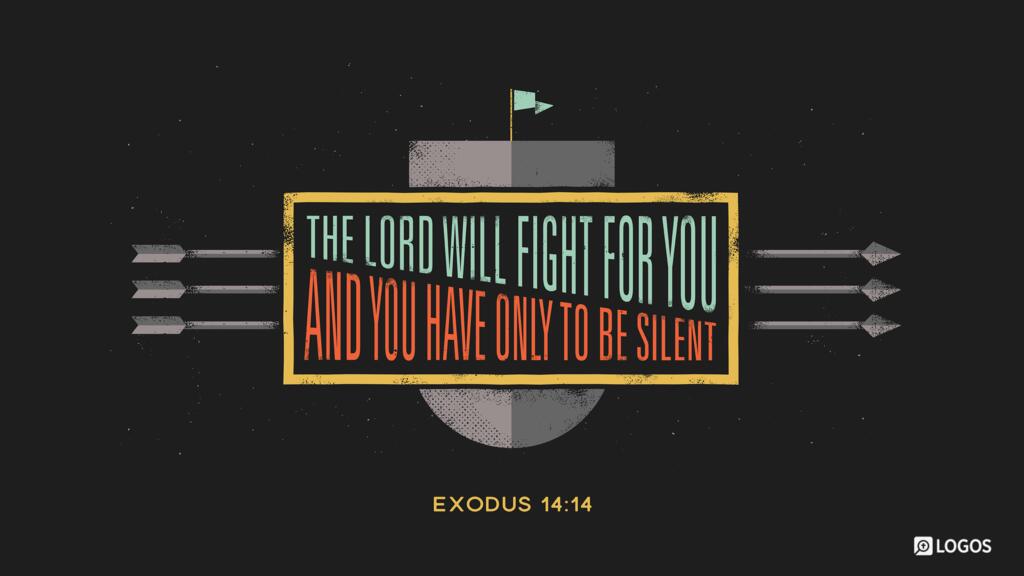
14:13Moses said to the people, “Do not fear!35 Stand firm36 and see37 the salvation38 of the Lord that he will provide39 for you today; for the Egyptians that you see today you will never, ever see again.4014:14The Lord41 will fight for you, and you can be still.”42
Footnotes
- 22 The disjunctive vav introduces a circumstantial clause here.
- 23 Heb “drew near.”
- 24 Heb “lifted up their eyes,” an expression that indicates an intentional and careful looking—they looked up and fixed their sights on the distance.
- 25 The construction uses הִנֵּה (hinneh) with the participle, traditionally rendered “and behold, the Egyptians were marching after them.” The deictic particle calls attention in a dramatic way to what was being seen. It captures the surprise and the sudden realization of the people.
- 26 The verb “feared” is intensified by the adverb מְאֹד (mé’od): “they feared greatly” or “were terrified.” In one look their defiant boldness seems to have evaporated.
- 27 Their cry to the Lord was proper and necessary. But their words to Moses were a rebuke and disloyal, showing a lack of faith and understanding. Their arrogance failed them in the crisis because it was built on the arm of flesh. Moses would have to get used to this murmuring, but here he takes it in stride and gives them the proper instructions. They had cried to the Lord, and now the Lord would deliver.
- 28 B. Jacob (Exodus, 396–97) notes how the speech is overly dramatic and came from a people given to using such exaggerations (Num 16:14), even using a double negative. The challenge to Moses brings a double irony. To die in the desert would be without proper burial, but in Egypt there were graves—it was a land of tombs and graves! Gesenius notes that two negatives in the sentence do not nullify each other but make the sentence all the more emphatic: “Is it because there were no graves …?” ( §152.y).
- 29 The demonstrative pronoun has the enclitic use again, giving a special emphasis to the question (R. J. Williams, Hebrew Syntax, 24, §118).
- 30 The Hebrew term לְהוֹצִּיאָנוּ (léhotsi’anu) is the Hiphil infinitive construct with a suffix, “to bring us out.” It is used epexegetically here, explaining the previous question.
- 31 Heb “Is not this the word that we spoke to you.”
- 32 U. Cassuto (Exodus, ) explains this statement by the people as follows: “The question appears surprising at first, for we have not read previously that such words were spoken to Moses. Nor is the purport of the protest of the Israelite foremen (v 21 [5:21]) identical with that of the words uttered now. However, from a psychological standpoint the matter can be easily explained. In the hour of peril the children of Israel remember that remonstrance, and now it seems to them that it was of a sharper character and flowed from their foresight, and that the present situation justifies it, for death awaits them at this moment in the desert.” This declaration that “we told you so,” born of fright, need not have been strictly accurate or logical.
- 33 Heb “better for us to serve.”
- 34 Since Hebrew does not use quotation marks to indicate the boundaries of quotations, there is uncertainty about whether the Israelites’ statement in Egypt includes the end of v. 12 or consists solely of “leave us alone so that we can serve the Egyptians.” In either case, the command to Moses to leave them alone rested on the assumption, spoken or unspoken, that serving Egypt would be less risky than what Moses was proposing. Now with the Egyptian army on the horizon, the Israelites are sure that their worst predictions are about to take place.
- 35 The use of אַל (’al) with the jussive has the force of “stop fearing.” It is a more immediate negative command than לֹא (lo’) with the imperfect (as in the Decalogue).
- 36 The force of this verb in the Hitpael is “to station oneself” or “stand firm” without fleeing.
- 37 The form is an imperative with a vav (ו). It could also be rendered “stand firm and you will see” meaning the result, or “stand firm that you may see” meaning the purpose.
- 38 Or “victory” () or “deliverance” (, ).
- 39 Heb “do,” i.e., perform or accomplish.
- 40 The construction uses a verbal hendiadys consisting of a Hiphil imperfect (“you will not add”) and a Qal infinitive construct with a suffix (“to see them”)—“you will no longer see them.” Then the clause adds “again, for ever.” U. Cassuto (Exodus, ) notes that the antithetical parallelism between seeing salvation and seeing the Egyptians, as well as the threefold repetition of the word “see” cannot be accidental; so too the alliteration of the last three words beginning with ayin (ע).
- 41 The word order places emphasis on “the Lord” (Heb “Yahweh”).
- 42 The imperfect tense needs to be interpreted in contrast to all that Yahweh will be doing. It may be given a potential imperfect nuance (as here), or it may be obligatory to follow the command to stand firm: “you must be still.”
The NET Bible First Edition, Copyright 1996-2005 by Biblical Studies Press
In other versions
ESVEnglish Standard Version
When Pharaoh drew near, the people of Israel lifted up their eyes, and behold, the Egyptians were marching after them, and they feared greatly. And the people of Israel cried out to the Lord. They said to Moses, “Is it because there are no graves in Egypt that you have taken us away to die in the wilderness? What have you done to us in bringing us out of Egypt? Is not this what we said to you in Egypt: ‘Leave us alone that we may serve the Egyptians’? For it would have been better for us to serve the Egyptians than to die in the wilderness.” And Moses said to the people, “Fear not, stand firm, and see the salvation of the Lord, which he will work for you today. For the Egyptians whom you see today, you shall never see again. The Lord will fight for you, and you have only to be silent.”
Copyright 2001 Crossway Bibles
NIVNew International Version (2011)
As Pharaoh approached, the Israelites looked up, and there were the Egyptians, marching after them. They were terrified and cried out to the Lord. They said to Moses, “Was it because there were no graves in Egypt that you brought us to the desert to die? What have you done to us by bringing us out of Egypt? Didn’t we say to you in Egypt, ‘Leave us alone; let us serve the Egyptians’? It would have been better for us to serve the Egyptians than to die in the desert!”
Moses answered the people, “Do not be afraid. Stand firm and you will see the deliverance the Lord will bring you today. The Egyptians you see today you will never see again. The Lord will fight for you; you need only to be still.”
Copyright 1973, 1978, 1984, 2011 Biblica, Inc.
CSBChristian Standard Bible
As Pharaoh approached, the Israelites looked up and there were the Egyptians coming after them! The Israelites were terrified and cried out to the Lord for help. They said to Moses, “Is it because there are no graves in Egypt that you have taken us away to die in the wilderness? What have you done to us by bringing us out of Egypt? Isn’t this what we told you in Egypt: Leave us alone so that we may serve the Egyptians? It would have been better for us to serve the Egyptians than to die in the wilderness.”
But Moses said to the people, “Don’t be afraid. Stand firm and see the Lord’s salvation that he will accomplish for you today; for the Egyptians you see today, you will never see again. The Lord will fight for you, and you must be quiet.”
Copyright 2017 Holman Bible Publishers
NLTNew Living Translation
As Pharaoh approached, the people of Israel looked up and panicked when they saw the Egyptians overtaking them. They cried out to the Lord, and they said to Moses, “Why did you bring us out here to die in the wilderness? Weren’t there enough graves for us in Egypt? What have you done to us? Why did you make us leave Egypt? Didn’t we tell you this would happen while we were still in Egypt? We said, ‘Leave us alone! Let us be slaves to the Egyptians. It’s better to be a slave in Egypt than a corpse in the wilderness!’ ”
But Moses told the people, “Don’t be afraid. Just stand still and watch the Lord rescue you today. The Egyptians you see today will never be seen again. The Lord himself will fight for you. Just stay calm.”
Holy Bible, New Living Translation, copyright © 1996, 2004, 2015 by Tyndale House Foundation. Used by permission of Tyndale House Publishers. All rights reserved.
LEBThe Lexham English Bible
And Pharaoh approached, and the Israelites lifted their eyes, and there were the Egyptians traveling after them! And they were very afraid, and the Israelites cried out to Yahweh. And they said to Moses, “Because there are no graves in Egypt? Is that why you have taken us to die in the desert? What is this you have done to us by bringing us out from Egypt! Isn’t this the word we spoke to you in Egypt, saying, ‘Leave us alone so that we can serve Egypt!’ because serving Egypt is better for us than our dying in the desert.” And Moses said to the people, “You must not be afraid. Stand still and see the salvation of Yahweh, which he will accomplish for you today, because the Egyptians whom you see today you will see never again. Yahweh will fight for you, and you must be quiet.”
Copyright 2012 Lexham Press
KJV 1900King James Version
And when Pharaoh drew nigh, the children of Israel lifted up their eyes, and, behold, the Egyptians marched after them; and they were sore afraid: and the children of Israel cried out unto the Lord. And they said unto Moses, Because there were no graves in Egypt, hast thou taken us away to die in the wilderness? wherefore hast thou dealt thus with us, to carry us forth out of Egypt? Is not this the word that we did tell thee in Egypt, saying, Let us alone, that we may serve the Egyptians? For it had been better for us to serve the Egyptians, than that we should die in the wilderness. And Moses said unto the people, Fear ye not, stand still, and see the salvation of the Lord, which he will shew to you to day: for the Egyptians whom ye have seen to day, ye shall see them again no more for ever. The Lord shall fight for you, and ye shall hold your peace.
Public Domain