Ephesians 5:8–14
The NET BibleOther versions
English
- NET The NET Bible
- DARBY 1890 Darby Bible
- ASV American Standard Version
- AV 1873 The Cambridge Paragraph Bible of the Authorized English Version
- CSB Christian Standard Bible
- D-R Douay-Rheims Bible
- ESV English Standard Version
- GW GOD’S WORD Translation
- GNB Good News Translation
- HCSB The Holman Christian Standard Bible
- KJV 1900 King James Version
- LSB Legacy Standard Bible
- LEB The Lexham English Bible
- MSG The Message: The Bible in Contemporary Language
- NASB95 New American Standard Bible (1995)
- NCV New Century Version
- NIrV New International Reader’s Version (1998)
- NIV New International Version (2011)
- NKJV The New King James Version
- NLT New Living Translation
- NRSVue New Revised Standard Version: Updated Edition
- RSV The Revised Standard Version
- RSVCE The Revised Standard Version, Catholic Edition
- YLT Young’s Literal Translation
Arabic
Czech
French
German
Greek
Hungarian
Italian
Korean
Latin
Portuguese
Russian
Simplified Chinese
Spanish
Traditional Chinese
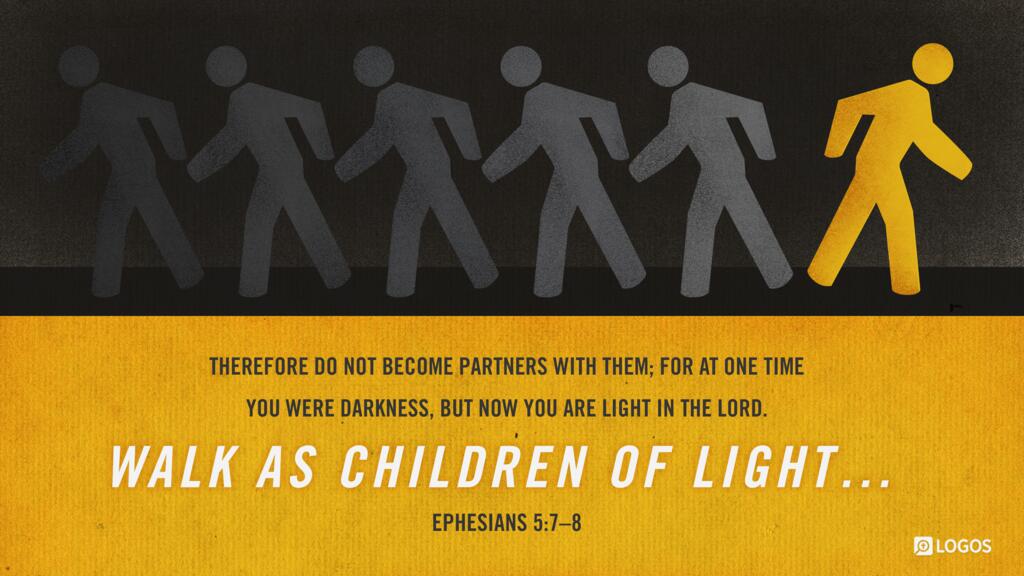
5:8for you were at one time darkness, but now you are11 light in the Lord. Walk as children of the light—5:9for the fruit of the light12 consists in13 all goodness, righteousness, and truth—5:10trying to learn14 what is pleasing to the Lord. 5:11Do not participate in the unfruitful deeds of darkness, but rather15 expose them.165:12For the things they do17 in secret are shameful even to mention. 5:13But all things being exposed by the light are made evident. 5:14For everything made evident is light, and for this reason it says:18
Rise from the dead,
and Christ will shine on you!”21
Footnotes
- 11 The verb “you are” is implied in the Greek text, but is supplied in the English translation to make it clear.
- 12 Several (𝔓46 D2 Ψ 𝔐) have πνεύματος (pneumatos, “Spirit”) instead of φωτός (phōtos, “light”). Although most today regard φωτός as obviously original ( gives it an “A” rating), a case could be made that πνεύματος is what the author wrote. First, although this is largely a Byzantine reading (D2 often, if not normally, assimilates to the Byzantine text), 𝔓46 gives the reading much greater credibility. Internally, the φωτός at the end of v. could have lined up above the πνεύματος in v. 9 in a scribe’s exemplar, thus occasioning dittography. (It is interesting to note that in both 𝔓49 and א the two instances of φωτός line up.) However, written in a contracted form, as a nomen sacrum (Π Ν Σ)—a practice found even in the earliest —πνεύματος would not have been easily confused with ΦΩΤΟΣ (there being only the last letter to occasion homoioteleuton rather than the last three). Further, the external evidence for φωτός is quite compelling (𝔓49 א A B D* F G P 33 81 1739 1881 2464 latt co); it is rather doubtful that the early and widespread witnesses all mistook πνεύματος for φωτός. In addition, πνεύματος can be readily explained as harking back to Gal 5:22 (“the fruit of the Spirit”). Thus, on balance, φωτός appears to be original, giving rise to the reading πνεύματος.
- 13 Grk “in.” The idea is that the fruit of the light is “expressed in” or “consists of.”
- 14 δοκιμάζω 1 translates δοκιμάζοντες (dokimazontes) in Eph 5:10 as “try to learn.”
- 15 The Greek conjunction καὶ (kai) seems to be functioning here ascensively, (i.e., “even”), but is difficult to render in this context using good English. It may read something like: “but rather even expose them!”
- 16 Grk “rather even expose.”
- 17 The participle τὰ … γινόμενα (ta … ginomena) usually refers to “things happening” or “things which are,” but with the following genitive phrase ὑπʼ αὐτῶν (hup’ autōn), which indicates agency, the idea seems to be “things being done.” This passive construction was translated as an active one to simplify the English style.
- 18 The following passage has been typeset as poetry because many scholars regard this passage as poetic or hymnic. These terms are used broadly to refer to the genre of writing, not to the content. There are two broad criteria for determining if a passage is poetic or hymnic: “(a) stylistic: a certain rhythmical lilt when the passages are read aloud, the presence of parallelismus membrorum (i.e., an arrangement into couplets), the semblance of some metre, and the presence of rhetorical devices such as alliteration, chiasmus, and antithesis; and (b) linguistic: an unusual vocabulary, particularly the presence of theological terms, which is different from the surrounding context” (P. T. O’Brien, Philippians [], ). Classifying a passage as hymnic or poetic is important because understanding this genre can provide keys to interpretation. However, not all scholars agree that the above criteria are present in this passage, so the decision to typeset it as poetry should be viewed as a tentative decision about its genre.
- 19 Grk “Rise up.”
- 20 The articular nominative participle ὁ καθεύδων (ho katheudōn) is probably functioning as a nominative for vocative. Thus, it has been translated as “O sleeper.”
- 21 A composite quotation, possibly from Isa 26:19, 51:17, 52:1, and 60:1.
The NET Bible First Edition, Copyright 1996-2005 by Biblical Studies Press
In other versions
ESVEnglish Standard Version
for at one time you were darkness, but now you are light in the Lord. Walk as children of light (for the fruit of light is found in all that is good and right and true), and try to discern what is pleasing to the Lord. Take no part in the unfruitful works of darkness, but instead expose them. For it is shameful even to speak of the things that they do in secret. But when anything is exposed by the light, it becomes visible, for anything that becomes visible is light. Therefore it says,
“Awake, O sleeper,
and arise from the dead,
and Christ will shine on you.”
Copyright 2001 Crossway Bibles
NIVNew International Version (2011)
For you were once darkness, but now you are light in the Lord. Live as children of light (for the fruit of the light consists in all goodness, righteousness and truth) and find out what pleases the Lord. Have nothing to do with the fruitless deeds of darkness, but rather expose them. It is shameful even to mention what the disobedient do in secret. But everything exposed by the light becomes visible—and everything that is illuminated becomes a light. This is why it is said:
“Wake up, sleeper,
rise from the dead,
and Christ will shine on you.”
Copyright 1973, 1978, 1984, 2011 Biblica, Inc.
CSBChristian Standard Bible
For you were once darkness, but now you are light in the Lord. Walk as children of light—for the fruit of the light consists of all goodness, righteousness, and truth—testing what is pleasing to the Lord. Don’t participate in the fruitless works of darkness, but instead expose them. For it is shameful even to mention what is done by them in secret. Everything exposed by the light is made visible, for what makes everything visible is light. Therefore it is said:
Get up, sleeper, and rise up from the dead,
and Christ will shine on you.
Copyright 2017 Holman Bible Publishers
NLTNew Living Translation
For once you were full of darkness, but now you have light from the Lord. So live as people of light! For this light within you produces only what is good and right and true.
Carefully determine what pleases the Lord. Take no part in the worthless deeds of evil and darkness; instead, expose them. It is shameful even to talk about the things that ungodly people do in secret. But their evil intentions will be exposed when the light shines on them, for the light makes everything visible. This is why it is said,
“Awake, O sleeper,
rise up from the dead,
and Christ will give you light.”
Holy Bible, New Living Translation, copyright © 1996, 2004, 2015 by Tyndale House Foundation. Used by permission of Tyndale House Publishers. All rights reserved.
LEBThe Lexham English Bible
for you were formerly darkness, but now you are light in the Lord. Live like children of light (for the fruit of the light is in all goodness and righteousness and truth), trying to learn what is well-pleasing to the Lord. And do not participate in the unfruitful deeds of darkness, but rather even expose them. For it is shameful even to speak about the things being done by them in secret, but all things exposed by the light are made visible, for everything made visible is light. Therefore it says,
Wake up, sleeper,
and rise from the dead,
and Christ will shine on you.
Copyright 2012 Lexham Press
KJV 1900King James Version
For ye were sometimes darkness, but now are ye light in the Lord: walk as children of light: (For the fruit of the Spirit is in all goodness and righteousness and truth;) Proving what is acceptable unto the Lord. And have no fellowship with the unfruitful works of darkness, but rather reprove them. For it is a shame even to speak of those things which are done of them in secret. But all things that are reproved are made manifest by the light: for whatsoever doth make manifest is light. Wherefore he saith, Awake thou that sleepest, and arise from the dead, and Christ shall give thee light.
Public Domain