Ephesians 1:11–12
The NET BibleOther versions
English
- NET The NET Bible
- DARBY 1890 Darby Bible
- ASV American Standard Version
- AV 1873 The Cambridge Paragraph Bible of the Authorized English Version
- CSB Christian Standard Bible
- D-R Douay-Rheims Bible
- ESV English Standard Version
- GW GOD’S WORD Translation
- GNB Good News Translation
- HCSB The Holman Christian Standard Bible
- KJV 1900 King James Version
- LSB Legacy Standard Bible
- LEB The Lexham English Bible
- MSG The Message: The Bible in Contemporary Language
- NASB95 New American Standard Bible (1995)
- NCV New Century Version
- NIrV New International Reader’s Version (1998)
- NIV New International Version (2011)
- NKJV The New King James Version
- NLT New Living Translation
- NRSVue New Revised Standard Version: Updated Edition
- RSV The Revised Standard Version
- RSVCE The Revised Standard Version, Catholic Edition
- YLT Young’s Literal Translation
Arabic
Czech
French
German
Greek
Hungarian
Italian
Korean
Latin
Portuguese
Russian
Simplified Chinese
Spanish
Traditional Chinese
1:11In Christ28 we too have been claimed as God’s own possession,29 since we were predestined according to the one purpose of him who accomplishes all things according to the counsel of his will 1:12so that we, who were the first to set our hope30 on Christ,31 would be to the praise of his glory.
Footnotes
- 28 Grk “in whom,” as a continuation of the previous verse.
- 29 Grk “we were appointed by lot.” The notion of the verb κληρόω (klēroō) in the OT was to “appoint a portion by lot” (the more frequent cognate verb κληρονομέω [klēronomeō] meant “obtain a portion by lot”). In the passive, as here, the idea is that “we were appointed [as a portion] by lot” ( κληρόω 1). The words “God’s own” have been supplied in the translation to clarify this sense of the verb. An alternative interpretation is that believers receive a portion as an inheritance: “In Christ we too have been appointed a portion of the inheritance.” See H. W. Hoehner, Ephesians, 226–27, for discussion on this interpretive issue. God’s own possession. Although God is not mentioned explicitly in the Greek text, it is clear from the context that he has chosen believers for himself. Just as with the nation Israel, the church is God’s chosen portion or possession (cf. Deut 32:8–9).
- 30 Or “who had already hoped.”
- 31 Or “the Messiah.”
The NET Bible First Edition, Copyright 1996-2005 by Biblical Studies Press
In other versions
ESVEnglish Standard Version
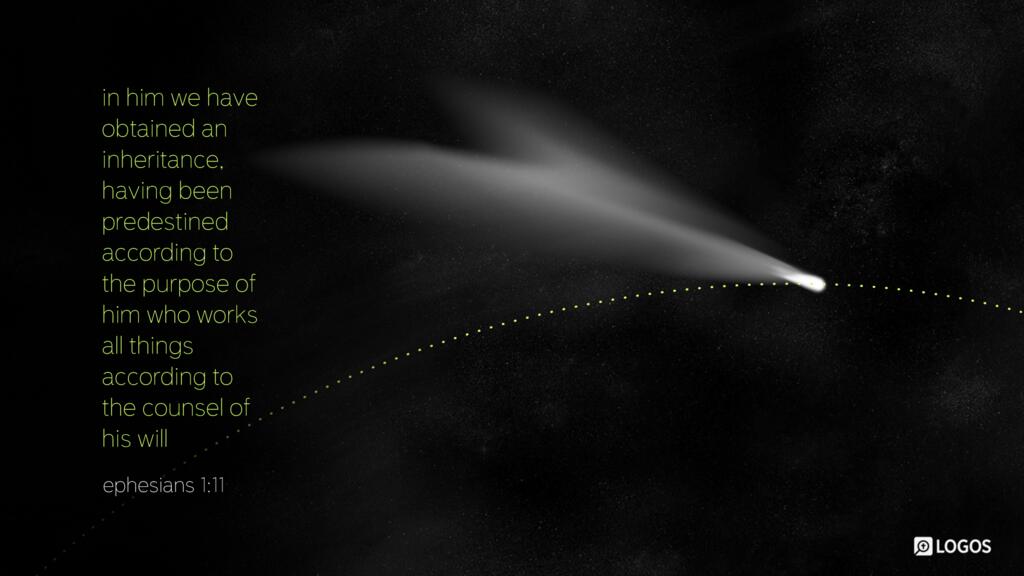
In him we have obtained an inheritance, having been predestined according to the purpose of him who works all things according to the counsel of his will, so that we who were the first to hope in Christ might be to the praise of his glory.
Copyright 2001 Crossway Bibles
NIVNew International Version (2011)
In him we were also chosen, having been predestined according to the plan of him who works out everything in conformity with the purpose of his will, in order that we, who were the first to put our hope in Christ, might be for the praise of his glory.
Copyright 1973, 1978, 1984, 2011 Biblica, Inc.
CSBChristian Standard Bible
In him we have also received an inheritance, because we were predestined according to the plan of the one who works out everything in agreement with the purpose of his will, so that we who had already put our hope in Christ might bring praise to his glory.
Copyright 2017 Holman Bible Publishers
NLTNew Living Translation
Furthermore, because we are united with Christ, we have received an inheritance from God, for he chose us in advance, and he makes everything work out according to his plan.
God’s purpose was that we Jews who were the first to trust in Christ would bring praise and glory to God.
Holy Bible, New Living Translation, copyright © 1996, 2004, 2015 by Tyndale House Foundation. Used by permission of Tyndale House Publishers. All rights reserved.
LEBThe Lexham English Bible
in whom also we were chosen, having been predestined according to the purpose of the One who works all things according to the counsel of his will, that we who hoped beforehand in Christ should be for the praise of his glory,
Copyright 2012 Lexham Press
KJV 1900King James Version
In whom also we have obtained an inheritance, being predestinated according to the purpose of him who worketh all things after the counsel of his own will: That we should be to the praise of his glory, who first trusted in Christ.
Public Domain