2 Samuel 7:8–16
The NET BibleOther versions
English
- NET The NET Bible
- DARBY 1890 Darby Bible
- ASV American Standard Version
- AV 1873 The Cambridge Paragraph Bible of the Authorized English Version
- CSB Christian Standard Bible
- D-R Douay-Rheims Bible
- ESV English Standard Version
- GW GOD’S WORD Translation
- GNB Good News Translation
- HCSB The Holman Christian Standard Bible
- KJV 1900 King James Version
- LSB Legacy Standard Bible
- LEB The Lexham English Bible
- MSG The Message: The Bible in Contemporary Language
- NASB95 New American Standard Bible (1995)
- NCV New Century Version
- NIrV New International Reader’s Version (1998)
- NIV New International Version (2011)
- NKJV The New King James Version
- NLT New Living Translation
- NRSVue New Revised Standard Version: Updated Edition
- RSV The Revised Standard Version
- RSVCE The Revised Standard Version, Catholic Edition
- TNIV Today’s New International Version
- YLT Young’s Literal Translation
Arabic
Czech
French
German
Hebrew
Hungarian
Italian
Korean
Latin
Portuguese
Russian
Simplified Chinese
Spanish
Traditional Chinese
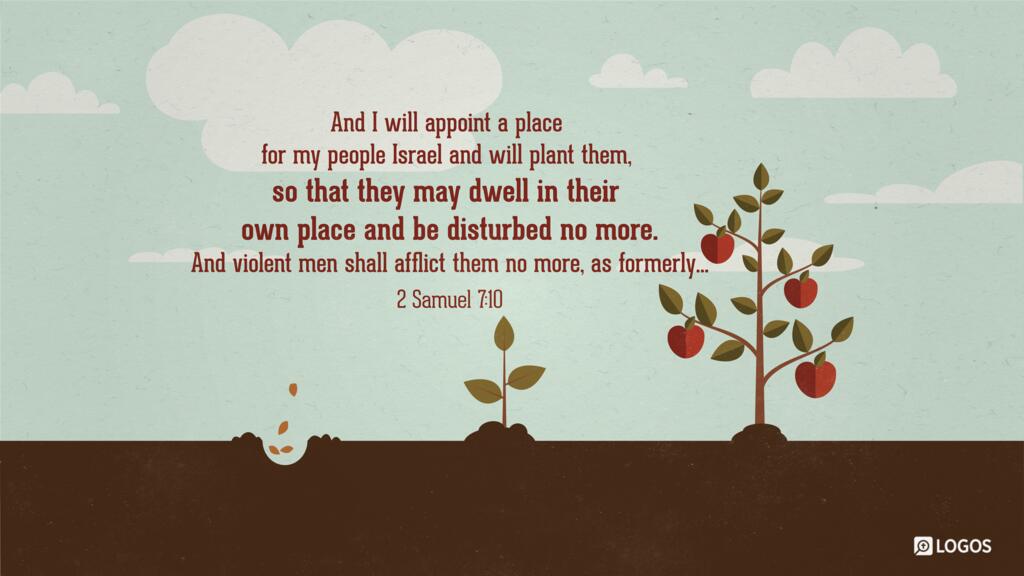
7:8“So now, say this to my servant David: ‘This is what the Lord of hosts says: I took you from the pasture and from your work as a shepherd11 to make you leader of my people Israel. 7:9I was with you wherever you went, and I defeated12 all your enemies before you. Now I will make you as famous as the great men of the earth.137:10I will establish a place for my people Israel and settle14 them there; they will live there and not be disturbed15 any more. Violent men16 will not oppress them again, as they did in the beginning 7:11and during the time when I appointed judges to lead my people Israel. Instead, I will give you relief17 from all your enemies. The Lord declares18 to you that he himself19 will build a dynastic house20 for you. 7:12When the time comes for you to die,21 I will raise up your descendant, one of your own sons, to succeed you,22 and I will establish his kingdom. 7:13He will build a house for my name, and I will make his dynasty permanent.237:14I will become his father and he will become my son. When he sins, I will correct him with the rod of men and with wounds inflicted by human beings. 7:15But my loyal love will not be removed from him as I removed it from Saul, whom I removed from before you. 7:16Your house and your kingdom will stand before me24 permanently; your dynasty25 will be permanent.’ ”
Footnotes
- 11 Heb “and from after the sheep.”
- 12 Heb “cut off.”
- 13 Heb “and I will make for you a great name like the name of the great ones who are in the earth.”
- 14 Heb “plant.”
- 15 Heb “shaken.”
- 16 Heb “the sons of violence.”
- 17 Or “rest.”
- 18 In the Hebrew text the verb is apparently perfect with vav consecutive, which would normally suggest a future sense (“he will declare”; so the , ἀπαγγελεῖ [apangelei]). But the context seems instead to call for a present or past nuance (“he declares” or “he has declared”). The synoptic passage in 1 Chr 17:10 has וָאַגִּד (va’aggid, “and I declared”). The construction used in 2 Sam 7:11 highlights this important statement.
- 19 Heb “the Lord.”
- 20 Heb “house,” but used here in a metaphorical sense, referring to a royal dynasty. Here the Lord’s use of the word plays off the literal sense that David had in mind as he contemplated building a temple for the Lord. To reflect this in the English translation the adjective “dynastic” has been supplied.
- 21 Heb, “when your days are full and you lie down with your ancestors.”
- 22 Heb “your seed after you who comes out from your insides.”
- 23 Heb “and I will establish the throne of his kingdom permanently.”
- 24 Heb “before you.” A few medieval Hebrew read instead “before me,” which makes better sense contextually. (See also the and the .) The reading is probably the result of dittography (note the ך [kaf] at the beginning of the next form), with the extra ך then being interpreted as a pronominal suffix.
- 25 Heb “throne.”
The NET Bible First Edition, Copyright 1996-2005 by Biblical Studies Press