2 Chronicles 24:1–35:27
The NET BibleOther versions
English
- NET The NET Bible
- DARBY 1890 Darby Bible
- ASV American Standard Version
- AV 1873 The Cambridge Paragraph Bible of the Authorized English Version
- CSB Christian Standard Bible
- D-R Douay-Rheims Bible
- ESV English Standard Version
- GW GOD’S WORD Translation
- GNB Good News Translation
- HCSB The Holman Christian Standard Bible
- KJV 1900 King James Version
- LSB Legacy Standard Bible
- LEB The Lexham English Bible
- MSG The Message: The Bible in Contemporary Language
- NASB95 New American Standard Bible (1995)
- NCV New Century Version
- NIrV New International Reader’s Version (1998)
- NIV New International Version (2011)
- NKJV The New King James Version
- NLT New Living Translation
- NRSVue New Revised Standard Version: Updated Edition
- RSV The Revised Standard Version
- RSVCE The Revised Standard Version, Catholic Edition
- YLT Young’s Literal Translation
Arabic
Czech
French
German
Hebrew
Hungarian
Italian
Korean
Latin
Portuguese
Russian
Simplified Chinese
Spanish
Traditional Chinese
Joash’s Reign
24:1Joash was seven years old when he began to reign. He reigned for forty years in Jerusalem.1 His mother was Zibiah, who was from Beer Sheba. 24:2Joash did what the Lord approved2 throughout the lifetime3 of Jehoiada the priest. 24:3Jehoiada chose two wives for him who gave him sons and daughters.
24:4Joash was determined to repair the Lord’s temple.424:5He assembled the priests and Levites and ordered them, “Go out to the cities of Judah and collect the annual quota of silver from all Israel for repairs on the temple of your God. Be quick about it!” But the Levites delayed.
24:6So the king summoned Jehoiada the chief priest,5 and said to him, “Why have you not made6 the Levites collect7 from Judah and Jerusalem the tax authorized by Moses the Lord’s servant and by the assembly of Israel at the tent containing the tablets of the law?”824:7(Wicked Athaliah and her sons had broken into God’s temple and used all the holy items of the Lord’s temple in their worship of the Baals.) 24:8The king ordered a chest to be made and placed outside the gate of the Lord’s temple.924:9An edict was sent throughout Judah and Jerusalem requiring the people to bring to the Lord the tax that Moses, God’s servant, imposed on Israel in the wilderness.1024:10All the officials and all the people gladly brought their silver and threw it into the chest until it was full. 24:11Whenever the Levites brought the chest to the royal accountant and they saw there was a lot of silver, the royal scribe and the accountant of the high priest emptied the chest and then took it back to its place. They went through this routine every day and collected a large amount of silver.
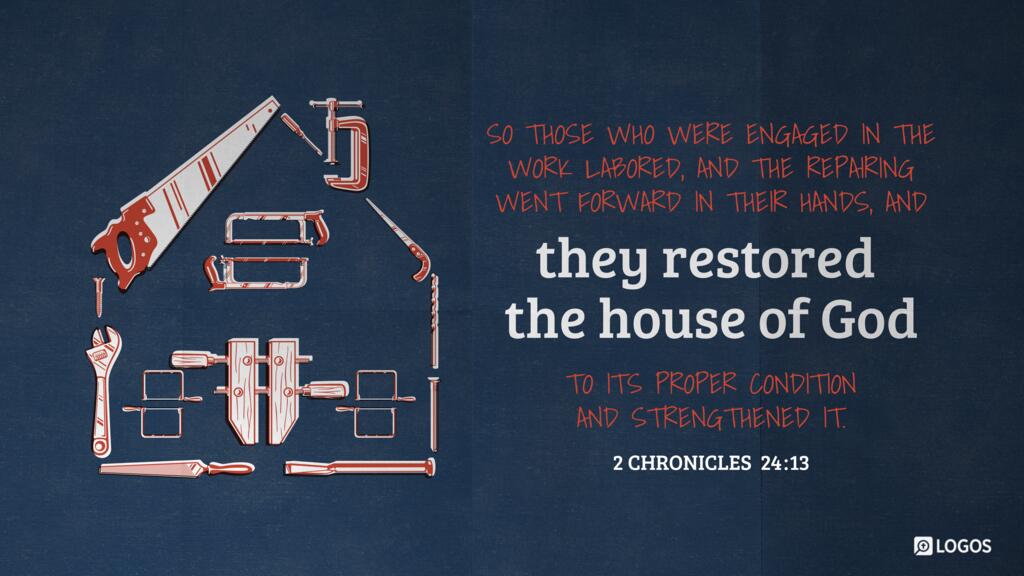
24:12The king and Jehoiada gave it to the construction foremen11 assigned to the Lord’s temple. They hired carpenters and craftsmen to repair the Lord’s temple, as well as those skilled in working with iron and bronze to restore the Lord’s temple. 24:13They worked hard and made the repairs.12 They followed the measurements specified for God’s temple and restored it.1324:14When they were finished, they brought the rest of the silver to the king and Jehoiada. They used it to make items for the Lord’s temple, including items used in the temple service and for burnt sacrifices, pans, and various other gold and silver items. Throughout Jehoiada’s lifetime, burnt sacrifices were offered regularly in the Lord’s temple.
24:15Jehoiada grew old and died at the age of 130.1424:16He was buried in the City of David15 with the kings, because he had accomplished good in Israel and for God and his temple.
24:17After Jehoiada died, the officials of Judah visited the king and declared their loyalty to him.16 The king listened to their advice.1724:18They abandoned the temple of the Lord God of their ancestors,18 and worshiped19 the Asherah poles and idols. Because of this sinful activity, God was angry with Judah and Jerusalem. 24:19The Lord sent prophets among them to lead them back to him.20 They warned21 the people, but they would not pay attention. 24:20God’s Spirit energized22 Zechariah son of Jehoiada the priest. He stood up before the people and said to them, “This is what God says: ‘Why are you violating the commands of the Lord? You will not be prosperous! Because you have rejected the Lord, he has rejected you!’ ” 24:21They plotted against him and by royal decree stoned him to death in the courtyard of the Lord’s temple. 24:22King Joash disregarded23 the loyalty his father Jehoiada had shown him and killed Jehoiada’s24 son. As Zechariah25 was dying, he said, “May the Lord take notice and seek vengeance!”26
24:23At the beginning27 of the year the Syrian army attacked28 Joash29 and invaded Judah and Jerusalem. They wiped out all the leaders of the people and sent all the plunder they gathered to the king of Damascus. 24:24Even though the invading Syrian army was relatively weak, the Lord handed over to them Judah’s very large army,30 for the people of Judah31 had abandoned the Lord God of their ancestors. The Syrians32 gave Joash what he deserved.3324:25When they withdrew, they left Joash34 badly wounded. His servants plotted against him because of what he had done to35 the son36 of Jehoiada the priest. They murdered him on his bed. Thus37 he died and was buried in the City of David,38 but not in the tombs of the kings. 24:26The conspirators were Zabad son of Shimeath (an Ammonite woman) and Jehozabad son of Shimrith (a Moabite woman).
24:27The list of Joash’s39 sons, the many prophetic oracles pertaining to him, and the account of his building project on God’s temple are included in the record of the Scroll of the Kings.40 His son Amaziah replaced him as king.
Amaziah’s Reign
25:1Amaziah was twenty-five years old when he began to reign, and he reigned for twenty-nine years in Jerusalem.1 His mother was Jehoaddan, who was from Jerusalem. 25:2He did what the Lord approved,2 but not with wholehearted devotion.3
25:3When he had secured control of the kingdom,4 he executed the servants who had assassinated his father.525:4However, he did not execute their sons. He obeyed the Lord’s commandment as recorded in the law scroll of Moses,6 “Fathers must not be executed for what their sons do,7 and sons must not be executed for what their fathers do.8 A man must be executed only for his own sin.”9
25:5Amaziah assembled the people of Judah10 and assigned them by families to the commanders of units of a thousand and the commanders of units of a hundred for all Judah and Benjamin. He counted those twenty years old and up and discovered there were 300,000 young men of fighting age11 equipped with spears and shields.1225:6He hired 100,000 Israelite warriors for a hundred talents13 of silver.
25:7But a prophet14 visited him and said: “O king, the Israelite troops must not go with you, for the Lord is not with Israel or any of the Ephraimites.1525:8Even if you go and fight bravely in battle, God will defeat you16 before the enemy. God is capable of helping or defeating.”1725:9Amaziah asked the prophet:18 “But what should I do about the hundred talents of silver I paid the Israelite troops?” The prophet19 replied, “The Lord is capable of giving you more than that.” 25:10So Amaziah dismissed the troops that had come to him from Ephraim and sent them home.20 They were very angry at Judah and returned home incensed. 25:11Amaziah boldly led his army to the Valley of Salt,21 where he defeated22 10,000 Edomites.2325:12The men24 of Judah captured 10,000 men alive. They took them to the top of a cliff and threw them over.25 All the captives26 fell to their death.2725:13Now the troops Amaziah had dismissed and had not allowed to fight in the battle28 raided29 the cities of Judah from Samaria30 to Beth Horon. They killed31 3,000 people and carried off a large amount of plunder.
25:14When Amaziah returned from defeating the Edomites, he brought back the gods of the people32 of Seir and made them his personal gods.33 He bowed down before them and offered them sacrifices. 25:15The Lord was angry at Amaziah and sent a prophet to him, who said, “Why are you following34 these gods35 that could not deliver their own people from your power?”3625:16While he was speaking, Amaziah37 said to him, “Did we appoint you to be a royal counselor? Stop prophesying or else you will be killed!”38 So the prophet stopped, but added, “I know that the Lord has decided39 to destroy you, because you have done this thing and refused to listen to my advice.”
25:17After King Amaziah of Judah consulted with his advisers,40 he sent this message to the king of Israel, Joash son of Jehoahaz, the son of Jehu, “Come, face me on the battlefield.”4125:18King Joash of Israel sent this message back to King Amaziah of Judah, “A thorn bush in Lebanon sent this message to a cedar in Lebanon, ‘Give your daughter to my son as a wife.’ Then a wild animal of Lebanon came by and trampled down the thorn bush.4225:19You defeated Edom43 and it has gone to your head.44 Gloat over your success,45 but stay in your palace. Why bring calamity on yourself? Why bring down yourself and Judah along with you?”46
25:20But Amaziah did not heed the warning,47 for God wanted to hand them over to Joash because they followed the gods of Edom.4825:21So King Joash of Israel attacked. He and King Amaziah of Judah faced each other on the battlefield49 in Beth Shemesh of Judah. 25:22Judah was defeated by Israel, and each man ran back home.5025:23King Joash of Israel captured King Amaziah of Judah, son of Joash son of Jehoahaz, in Beth Shemesh and brought him to Jerusalem. He broke down the wall of Jerusalem from the Gate of Ephraim to the Corner Gate—a distance of about six hundred feet.5125:24He took away all the gold and silver, all the items found in God’s temple that were in the care of Obed-Edom, the riches in the royal palace, and some hostages. Then he went back to Samaria.
25:25King Amaziah son of Joash of Judah lived for fifteen years after the death of King Joash son of Jehoahaz of Israel. 25:26The rest of the events of Amaziah’s reign, from start to finish, are recorded in the Scroll of the Kings of Judah and Israel.5225:27From the time Amaziah turned from following the Lord, conspirators plotted against him in Jerusalem,53 so he fled to Lachish. But they sent assassins after him54 and they killed him there. 25:28His body was carried back by horses,55 and he was buried in Jerusalem with his ancestors56 in the City of David.57
Uzziah’s Reign
26:1All the people of Judah took Uzziah,1 who was sixteen years old, and made him king in his father Amaziah’s place. 26:2Uzziah2 built up Elat and restored it to Judah after King Amaziah3 had passed away.4
26:3Uzziah was sixteen years old when he began to reign, and he reigned for fifty-two years in Jerusalem.5 His mother’s name was Jecholiah, who was from Jerusalem. 26:4He did what the Lord approved, just as his father Amaziah had done.626:5He followed7 God during…
This passage has been shortened. Keep reading 2 Chronicles 24:1–35:27 in Logos
Footnotes
- 1 For location see ; ; ; ; ; ; ; ; .
- 2 Heb “and Joash did what was proper in the eyes of the Lord.”
- 3 Heb “all the days of.”
- 4 Heb “and it was, later, there was with the heart of Joash to repair the house of the Lord.”
- 5 Heb “Jehoiada the head”; the word “priest” not in the Hebrew text but is implied.
- 6 Heb “sought.”
- 7 Heb “bring.”
- 8 Heb “the tent of testimony.”
- 9 Heb “and the king said [it] and they made a chest and placed it in the gate of the house of the Lord outside.”
- 10 Heb “and they gave voice in Judah and Jerusalem to bring to the Lord the tax of Moses the servant of God upon Israel in the wilderness.”
- 11 Heb “doers of the work.”
- 12 Heb “and the doers of the work worked, and the repairs went up for the work by their hand.”
- 13 Heb “and they caused the house of God to stand according to its measurements and they strengthened it.”
- 14 Heb “and Jehoiada grew old and was full of days and died; [he was] one hundred thirty years old when he died.”
- 15 The phrase the City of David refers here to the fortress of Zion in Jerusalem, not to Bethlehem. See 2 Sam 5:7.
- 16 Heb “came and bowed down to the king.”
- 17 Heb “to them.”
- 18 Heb “fathers” (also in v. 24).
- 19 Heb “served.”
- 20 Heb “and he sent among them prophets to bring them back to the Lord.”
- 21 Heb “testified among.”
- 22 Heb “clothed.”
- 23 Heb “did not remember.”
- 24 Heb “his”; the referent (Jehoiada) has been specified in the translation for clarity.
- 25 Heb “he”; the referent (Zechariah) has been specified in the translation for clarity.
- 26 Heb “and seek [–].” The direct object of “seek” is omitted in the Hebrew text but implied; “vengeance” is supplied for clarification.
- 27 Heb “turning.”
- 28 Heb “went up against.”
- 29 Heb “him”; the referent (Joash) has been specified in the translation for clarity.
- 30 Heb “though with a small amount of men the army of Aram came, the Lord gave into their hand an army [that was] very large.”
- 31 Heb “they”; the referent (the people of Judah) has been specified in the translation for clarity.
- 32 Heb “they”; the referent (the Syrians) has been specified in the translation for clarity.
- 33 Heb “executed judgments [on] Joash.”
- 34 Heb “him”; the referent (Joash) has been specified in the translation for clarity.
- 35 Heb “because of the shed blood of.”
- 36 The has the plural בְּנֵי (béney, “sons”), but the final yod is dittographic. Note the yod that immediately follows.
- 37 Heb “and he died.”
- 38 The phrase the City of David refers here to the fortress of Zion in Jerusalem, not to Bethlehem. See 2 Sam 5:7.
- 39 Heb “his”; the referent (Joash) has been specified in the translation for clarity.
- 40 Heb “And his sons and the abundance of the oracle[s] against him, and the founding of the house of God, look are they not written on the writing of the scroll of the kings?”
- 1 For location see ; ; ; ; ; ; ; ; .
- 2 Heb “he did what was proper in the eyes of the Lord.”
- 3 Heb “a complete heart.”
- 4 Heb “when the kingdom was secure upon him.”
- 5 Heb “he killed his servants, the ones who had struck down the king, his father.”
- 6 Heb “as it is written in the scroll of the law of Moses which the Lord commanded, saying.”
- 7 Heb “on account of sons.”
- 8 Heb “on account of fathers.”
- 9 This law is recorded in Deut 24:16.
- 10 Heb “Judah.” The words “the people of” are supplied in the translation for clarity. The Hebrew text uses the name “Judah” by metonymy here for the people of Judah.
- 11 Heb “young men going out to war.”
- 12 Heb “holding a spear and a shield.”
- 13 The Hebrew word כִּכַּר (kikar, “circle”) refers generally to something that is round. When used of metals it can refer to a disk-shaped weight made of the metal or, by extension, to a standard unit of weight. According to the older (Babylonian) standard the “talent” weighed 130 lbs. (58.9 kg), but later this was lowered to 108.3 lbs. (49.1 kg). More recent research suggests the “light” standard talent was 67.3 lbs. (30.6 kg). Using this as the standard for calculation, the weight of the silver was 6,730 lbs. (3,060 kg).
- 14 Heb “man of God.”
- 15 Heb “Israel, all the sons of Ephraim.”
- 16 Heb “cause you to stumble.”
- 17 Heb “to cause to stumble.”
- 18 Heb “said to the man of God.”
- 19 Heb “man of God.”
- 20 Heb “and Amaziah separated them, the troops who came to him from Ephraim, to go to their place.”
- 21 Heb “and Amaziah strengthened himself and led his people and went to the Valley of Salt.”
- 22 Or “struck down.”
- 23 Heb “sons of Seir.”
- 24 Heb “sons.”
- 25 Heb “and threw them from the top of the cliff.”
- 26 Heb “all of them.”
- 27 Heb “smashed in pieces.”
- 28 Heb “had sent back from going with him to the battle.”
- 29 Heb “stripped.”
- 30 For location see ; ; ; ; .
- 31 Heb “struck down.”
- 32 Heb “sons.”
- 33 Heb “caused them to stand for him as gods.”
- 34 Heb “seeking,” perhaps in the sense of “consulting [an oracle from].”
- 35 Heb “the gods of the people.”
- 36 Heb “hand.”
- 37 Heb “he”; the referent (Amaziah) has been specified in the translation for clarity.
- 38 Heb “Stop yourself! Why should they strike you down?”
- 39 The verb יָעַץ (ya’ats, “has decided”) is from the same root as יוֹעֵץ (yo’ets, “counselor”) in v. 16 and עֵצָה (’etsah, “advice”) later in v. 16. The wordplay highlights the appropriate nature of the divine punishment. Amaziah rejected the counsel of God’s prophet; now he would be the victim of God’s “counsel.”
- 40 The words “with his advisers” are supplied in the translation for clarification.
- 41 Heb “let us look at each other [in the] face.” The expression refers here not to a visit but to meeting in battle. See v. 21.
- 42 The thorn bush in the allegory is Judah. Amaziah’s success had deceived him into thinking he was on the same level as the major powers in the area (symbolized by the cedar). In reality he was not capable of withstanding an attack by a real military power such as Israel (symbolized by the wild animal).
- 43 Heb “you say [to yourself], ‘look, you have defeated Edom.’ ”
- 44 Heb “and your heart is lifted up.”
- 45 Heb “to glorify.”
- 46 Heb “Why get involved in calamity and fall, you and Judah with you?”
- 47 Heb “did not listen.”
- 48 Heb “because it was from God in order to give them into the hand because they sought the gods of Edom.”
- 49 Heb “looked at each other [in the] face.” See the note on the expression “Come on, face me on the battlefield” in v. .
- 50 Heb “and Judah was struck down before Israel and they fled, each to his tent.”
- 51 Heb “400 cubits.” Assuming a cubit of 18 inches (45 cm), the distance would have been about 600 feet (180 m).
- 52 Heb “As for the rest of the events of Amaziah, the former and the latter, are they not—behold, they are written on the scroll of the kings of Judah and Israel.”
- 53 Heb “and they conspired against him [with] a conspiracy in Jerusalem.”
- 54 Heb “and they sent after him to Lachish.”
- 55 Heb “and they carried him on horses.”
- 56 Heb “fathers.”
- 57 The Hebrew text has “Judah,” but some medieval read “David,” as does the parallel passage in 2 Kgs 14:20. The phrase the City of David refers here to the fortress of Zion in Jerusalem, not to Bethlehem. See 2 Sam 5:7.
- 1 The parallel account in 2 Kgs 15:1–8 has the variant spelling “Azariah.”
- 2 Heb “he”; the referent (Uzziah) has been specified in the translation for clarity.
- 3 Heb “after the king”; the referent (Amaziah) has been specified in the translation for clarity.
- 4 “slept with his fathers.”
- 5 For location see ; ; ; ; ; ; ; ; .
- 6 Heb “he did what was proper in the eyes of the Lord, according to all which Amaziah his father had done.”
- 7 Heb “sought.”
The NET Bible First Edition, Copyright 1996-2005 by Biblical Studies Press