1 John 4:13b
The NET BibleOther versions
English
- NET The NET Bible
- DARBY 1890 Darby Bible
- ASV American Standard Version
- AV 1873 The Cambridge Paragraph Bible of the Authorized English Version
- CSB Christian Standard Bible
- D-R Douay-Rheims Bible
- ESV English Standard Version
- GW GOD’S WORD Translation
- GNB Good News Translation
- HCSB The Holman Christian Standard Bible
- KJV 1900 King James Version
- LSB Legacy Standard Bible
- LEB The Lexham English Bible
- MSG The Message: The Bible in Contemporary Language
- NASB95 New American Standard Bible (1995)
- NCV New Century Version
- NIrV New International Reader’s Version (1998)
- NIV New International Version (2011)
- NKJV The New King James Version
- NLT New Living Translation
- NRSVue New Revised Standard Version: Updated Edition
- RSV The Revised Standard Version
- RSVCE The Revised Standard Version, Catholic Edition
- TNIV Today’s New International Version
- YLT Young’s Literal Translation
Arabic
Czech
French
German
Greek
Hungarian
Italian
Korean
Latin
Portuguese
Russian
Simplified Chinese
Spanish
Traditional Chinese
4:13By this33 we know that we reside in God34 and he in us: in that he has given us of his Spirit.35
Footnotes
- 33 Again whether the referent of the phrase ἐν τούτῳ (en toutō) (1) precedes or (2) follows is a problem. This time there are two ὅτι (hoti) clauses which follow. The first is an indirect discourse clause related to γινώσκομεν (ginōskomen) and giving the content of what believers know: “that we reside in him and he in us.” The second ὅτι clause is epexegetical (or explanatory) to the ἐν τούτῳ phrase, explaining how believers know that they reside in God and God remains in them: “in that he has given us of his Spirit.” By this we know. According to the author of 1 John, the Father’s giving of the indwelling Holy Spirit to the believer is one means of providing assurance to the believer of his relationship to God. This is what was also stated in 1 John 3:24b in essentially identical terms.
- 34 Grk “in him.” Context indicates that the pronoun refers to God (see 4:12).
- 35 The genitive of his Spirit here, like the phrase in 3:24, probably reflects a partitive nuance, so that the author portrays God as ‘apportioning’ his Spirit to individual believers. This leads to the important observation that the author is not particularly interested in emphasizing (1) the ongoing interior witness of the Holy Spirit (which is what the passage is often understood to mean) but is emphasizing (2) the fact that God has given the Spirit to believers, and it is this fact that gives believers assurance of their relationship to God. In other words, it is the fact that the Holy Spirit has been given to believers, rather than the ongoing interior testimony of the Holy Spirit within the believer, which is the primary source of the believer’s assurance.
The NET Bible First Edition, Copyright 1996-2005 by Biblical Studies Press
In other versions
ESVEnglish Standard Version
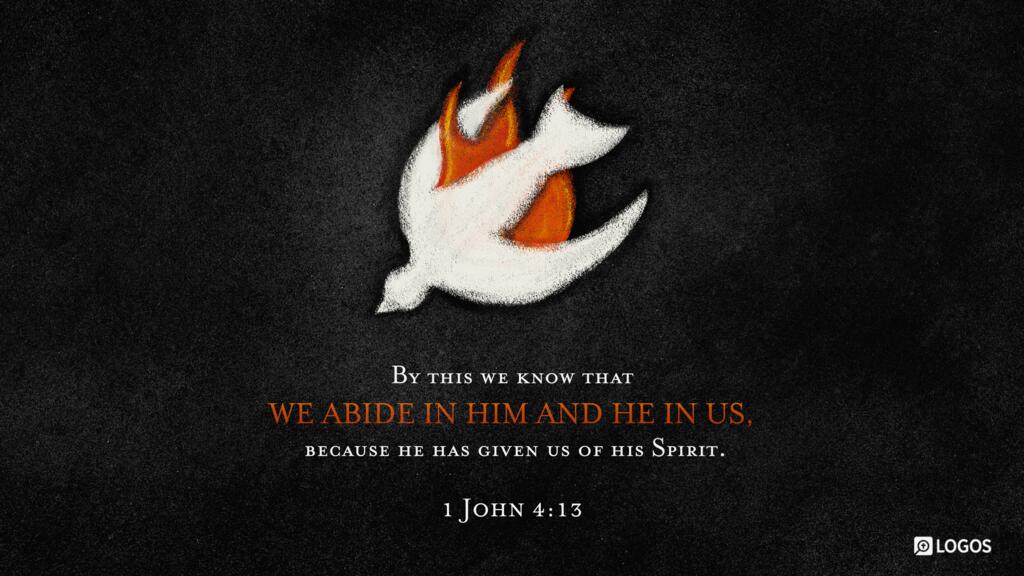
By this we know that we abide in him and he in us, because he has given us of his Spirit.
Copyright 2001 Crossway Bibles
NIVNew International Version (2011)
This is how we know that we live in him and he in us: He has given us of his Spirit.
Copyright 1973, 1978, 1984, 2011 Biblica, Inc.
CSBChristian Standard Bible
This is how we know that we remain in him and he in us: He has given us of his Spirit.
Copyright 2017 Holman Bible Publishers
NLTNew Living Translation
And God has given us his Spirit as proof that we live in him and he in us.
Holy Bible, New Living Translation, copyright © 1996, 2004, 2015 by Tyndale House Foundation. Used by permission of Tyndale House Publishers. All rights reserved.
LEBThe Lexham English Bible
By this we know that we reside in him and he in us: that he has given us of his Spirit.
Copyright 2012 Lexham Press
KJV 1900King James Version
Hereby know we that we dwell in him, and he in us, because he hath given us of his Spirit.
Public Domain